
UNITED STATES
SECURITIES AND EXCHANGE COMMISSION
Washington, D.C. 20549
FORM 10-K
(Mark One)
For the fiscal year ended December 31 , 2025
OR
For the transition period from________to________
Commission File Number 001-38434
| (Exact name of registrant as specified in its charter) | ||
| (State or other jurisdiction of incorporation or organization) | (I.R.S. Employer Identification Number) | |||||||||||||
Dropbox, Inc.
(Address of principal executive offices, including zip code)
(415 ) 930-7766
(Registrant's telephone number, including area code)
| Title of each class | Trading Symbol(s) | Name of exchange on which registered | ||||||||||||
Securities registered pursuant to Section 12(g) of the Act None | ||||||||||||||
Indicate by check mark if the registrant is a well-known seasoned issuer, as defined in Rule 405 of the Securities Act. Yes ☒ No ☐
Indicate by check mark if the registrant is not required to file reports pursuant to Section 13 or Section 15(d) of the Securities Exchange Act of 1934 (the "Exchange Act"). Yes ☐ No ☒
Indicate by check mark whether the registrant (1) has filed all reports required to be filed by Section 13 or 15(d) of the Securities Exchange Act of 1934 during the preceding 12 months (or for such shorter period that the registrant was required to file such reports) and (2) has been subject to such filing requirements for the past 90 days. Yes ☒ No ☐
Indicate by check mark whether the registrant has submitted electronically every Interactive Data File required to be submitted pursuant to Rule 405 of Regulation S-T (§232.405 of this chapter) during the preceding 12 months (or for such shorter period that the registrant was required to submit such files). Yes ☒ No ☐
Indicate by check mark whether the registrant is a large accelerated filer, an accelerated filer, a non-accelerated filer, a smaller reporting company, or an emerging growth company. See the definitions of “large accelerated filer,” “accelerated filer,” “smaller reporting company,” and “emerging growth company” in Rule 12b-2 of the Exchange Act. (Check one):
| ☒ | Accelerated filer | ☐ | ||||||||||||||||||
| Non-accelerated filer | ☐ | Smaller reporting company | ||||||||||||||||||
| Emerging growth company | ||||||||||||||||||||
If an emerging growth company, indicate by check mark if the registrant has elected not to use the extended transition period for complying with any new or revised financial accounting standards provided pursuant to Section 13(a) of the Exchange Act. ☐
Indicate by check mark whether the registrant has filed a report on and attestation to its management’s assessment of the effectiveness of its internal control over financial reporting under Section 404(b) of the Sarbanes-Oxley Act (15 U.S.C. 7262(b)) by the registered public accounting firm that prepared or issued its audit report. ☒
If securities are registered pursuant to Section 12(b) of the Act, indicate by check mark whether the financial statements of the registrant included in the filing reflect the correction of an error to previously issued financial statements. ☐
Indicate by check mark whether any of those error corrections are restatements that required a recovery analysis of incentive-based compensation received by any of the registrant’s executive officers during the relevant recovery period pursuant to §240.10D-1(b). ☐
Indicate by check mark whether the registrant is a shell company (as defined in Rule 12b-2 of the Exchange Act). Yes ☐ No ☒
The aggregate market value of the registrant's Class A common stock held by non-affiliates of the registrant, based on the closing price of a share of the registrant's Class A common stock on June 30, 2025 as reported by the NASDAQ Global Select Market on such date was approximately $3,097.8 million. Shares of the registrant’s Class A common stock held by each executive officer, director and holder of 5% or more of the outstanding Class A common stock have been excluded as such persons may be deemed to be affiliates. This calculation does not reflect a determination that certain persons are affiliates of the registrant for any other purpose.
As of February 13, 2026, there were 165,704,072 shares of the registrants’ Class A common stock outstanding (which includes 8,266,666 shares of Class A common stock subject to restricted stock awards that were granted pursuant to the Co-Founder Grant, and vest upon the satisfaction of a service condition and achievement of certain stock price goals and 22,427 shares of Class A common stock subject to restricted stock awards that were granted to other Dropbox executives and vest upon the satisfaction of a service condition), 75,484,246 shares of the registrant’s Class B common stock outstanding, and no shares of the registrant’s Class C common stock outstanding.
DOCUMENTS INCORPORATED BY REFERENCE
Portions of the registrant's definitive Proxy Statement relating to the 2025 Annual Meeting of Stockholders are incorporated herein by references in Part II and Part III of this Annual Report on Form 10-K to the extent stated herein. Such Proxy Statement will be filed with the Securities and Exchange Commission within 120 days of the registrant's fiscal year ended December 31, 2025.
1
| TABLE OF CONTENTS | ||||||||
| Page | ||||||||
| Part I | ||||||||
| Item 1. | ||||||||
| Item 1A. | ||||||||
| Item 1B. | ||||||||
| Item 1C | ||||||||
| Item 2. | ||||||||
| Item 3. | ||||||||
| Item 4. | ||||||||
| Part II | ||||||||
| Item 5. | ||||||||
| Item 6. | ||||||||
| Item 7. | ||||||||
| Item 7A. | ||||||||
| Item 8. | ||||||||
| Item 9. | ||||||||
| Item 9A. | ||||||||
| Item 9B. | ||||||||
| Item 9C. | ||||||||
| Part III | ||||||||
| Item 10. | ||||||||
| Item 11. | ||||||||
| Item 12. | ||||||||
| Item 13. | ||||||||
| Item 14. | ||||||||
| Part IV | ||||||||
| Item 15. | ||||||||
| Item 16. | ||||||||
2
SPECIAL NOTE REGARDING FORWARD-LOOKING STATEMENTS
This Annual Report on Form 10-K contains forward-looking statements within the meaning of Section 27A of the Securities Act of 1933, as amended (the “Securities Act”), and Section 21E of the Securities Exchange Act of 1934, as amended (the “Exchange Act”), which statements involve substantial risk and uncertainties. Forward-looking statements generally relate to future events or our future financial or operating performance. In some cases, you can identify forward-looking statements because they contain words such as “may,” “will,” “should,” “expects,” “plans,” “anticipates,” “could,” “intends,” “target,” “projects,” “contemplates,” “believes,” “estimates,” “predicts,” “potential,” or “continue” or the negative of these words or other similar terms or expressions that concern our expectations, strategy, plans, or intentions. Forward-looking statements contained in this Annual Report on Form 10-K include, but are not limited to, statements about:
•Our future financial performance, including trends in revenue, costs of revenue, gross profit or gross margin, operating expenses, paying users, annual recurring revenue, average revenue per user, free cash flow, and the assumptions underlying such trends;
•Our ability to attract and retain users and convert users to paying users;
•Our ability to prevent security breaches and our liability or other potential legal, regulatory, or reputational consequences of any unauthorized access to our data or our customer data;
•Our ability to prevent any significant disruption of service on our platform or loss of content;
•Our ability to compete successfully in competitive markets;
•Our expectations regarding the potential impacts of permanent global remote or distributed work, on our business, the business of our customers, suppliers and partners, and the economy;
•The demand for our platform or for content collaboration solutions in general;
•Our ability to effectively integrate our platform with others;
•Our ability to respond to rapid technological changes, including our ability to take advantage of potential market opportunities arising from what we believe to be a more permanent shift towards remote or distributed work;
•Our ability to achieve or maintain profitability;
•Our expectations around future growth;
•Our ability to successfully introduce new products and features;
•Our ability to effectively invest in the development of new products and technologies;
•Our ability to attract, retain, integrate, and manage key and other highly qualified personnel, including as a result of our Virtual First work model with an increasingly distributed workforce;
•Our capital allocation plans, including expected allocations of cash and timing for our share repurchases and other investments;
•Our expectations regarding the challenges and anticipated benefits to our business from our Virtual First work model as well as the impact to our financial results and business operations as a result of this model;
•Our expectations regarding general economic, political, and market trends and their respective impacts on our business;
•The effects of new or modified laws, policies, taxes, and regulations on our business;
•Our ability to maintain, protect, and enhance our intellectual property;
•The sufficiency of our cash and cash equivalents to meet our liquidity needs; and
3
•Acquisitions of companies and assets, including our ability to successfully integrate and realize the anticipated benefits of such acquisitions.
We caution you that the foregoing list may not contain all of the forward-looking statements made in this Annual Report on Form 10-K.
You should not rely upon forward-looking statements as predictions of future events. We have based the forward-looking statements contained in this Annual Report on Form 10-K primarily on our current expectations and projections about future events and trends that we believe may affect our business, financial condition, results of operations, and prospects. The outcome of the events described in these forward-looking statements is subject to risks, uncertainties, and other factors described in the section titled “Risk Factors” and elsewhere in this Annual Report on Form 10-K. Moreover, we operate in a very competitive and rapidly changing environment. New risks and uncertainties emerge from time to time, and it is not possible for us to predict all risks and uncertainties that could have an impact on the forward-looking statements contained in this Annual Report on Form 10-K. We cannot assure you that the results, events, and circumstances reflected in the forward-looking statements will be achieved or occur, and actual results, events, or circumstances could differ materially from those described in the forward-looking statements.
The forward-looking statements made in this Annual Report on Form 10-K relate only to events as of the date on which the statements are made. We undertake no obligation to update any forward-looking statements made in this Annual Report on Form 10-K to reflect events or circumstances after the date of this Annual Report on Form 10-K or to reflect new information or the occurrence of unanticipated events, except as required by law. We may not actually achieve the plans, intentions, or expectations disclosed in our forward-looking statements, and you should not place undue reliance on our forward-looking statements. Our forward-looking statements do not reflect the potential impact of any future acquisitions, mergers, dispositions, joint ventures, or investments we may make.
4
SUMMARY OF RISK FACTORS
Below is a summary of the principal factors that could materially harm our business, operating results and/or financial condition, impair our future prospects or cause the price of our Class A common stock to decline. This summary does not address all of the risks that we face. Additional discussion of the risks summarized in this risk factor summary, and other risks that we face, can be found below under the heading “Risk Factors” and should be carefully considered, together with other information in this Form 10-K and our other filings with the Securities and Exchange Commission ("SEC") before making an investment decision regarding our Class A common stock.
•Our rate of growth has declined and we have experienced negative growth in past periods. If we do not successfully execute our plan for future growth, our growth rate may continue to decline and we may continue to experience negative growth in future periods.
•Our business depends on our ability to attract and retain users, convert users to paying users and upgrade paying users, and any decline in acquisitions, renewals or upgrades could adversely affect our future results of operations.
•We have in the past and may continue to experience privacy and data security breaches or incidents.
•Our business could be harmed by any significant disruption of service on our platform or loss of content.
•We operate in competitive markets, and we must continue to compete effectively.
•Failure to respond to rapid technological changes, extend our platform, or develop new features or products may harm our ability to compete effectively, which would adversely affect our business.
•Our business depends upon the interoperability of our platform across devices, operating systems, and third-party applications that we do not control.
•We generate revenue from sales of subscriptions to our platform, and declines in demand for our platform, or for content collaboration solutions in general, could negatively impact our business.
•We depend on our key personnel and other highly qualified personnel, and if we fail to attract, integrate, and retain our personnel, and maintain our unique corporate culture, our business could be harmed.
•We operate with a Virtual First workforce and the long-term impact of this model on our financial results and business operations remains uncertain.
•Our business may be significantly impacted by a change in general economic, political, and market conditions, including any resulting effect on consumer or business spending.
•Our lack of a significant outbound sales force may limit the potential growth of our business.
•Our revenue growth rate has declined in recent periods and may continue to slow in the future.
•We may increase expenses in the future, and we may not be able to achieve or maintain profitability in future periods.
•Servicing our indebtedness under our term loan facility, 2026 Notes and 2028 Notes (as defined below) may require a significant amount of cash, and we may not have sufficient cash flow or the ability to raise the funds necessary to satisfy our obligations under the term loan facility, 2026 Notes, or 2028 Notes.
5
PART I.
ITEM 1. BUSINESS
Overview
Dropbox, Inc. (the “Company”, “we”, or “us”) is the one place to keep life organized and keep work moving.
We were founded in 2007 with a simple idea: Life would be a lot better if everyone could access their most important information anytime from any device. We’ve largely accomplished that mission by building tools to help people work from anywhere—and along the way we recognized that for most of our users, sharing and collaborating on the Dropbox, Inc. platform (“Dropbox”) was even more valuable than storing files.
Our market opportunity grew as we’ve expanded from keeping files in sync to keeping teams in sync. Today, we are focused on reimagining the way work gets done by reducing the inordinate amount of time and energy the world spends on “work about work”—tedious tasks like searching for content, switching between applications, and managing workflows. We believe the need for our platform will continue to grow as teams become more fluid and global, and content is increasingly fragmented across incompatible tools and devices. Dropbox breaks down silos by centralizing the flow of information between the products and services our users prefer, even if they’re not our own. In a world where using technology at work can be fragmented and distracting, Dropbox makes it easy to focus on the work that matters.
By solving these universal problems, we’ve become invaluable to our users. The popularity of our platform allows us to scale efficiently. We’ve built a thriving global business with 18.08 million paying users as of December 31, 2025.
What Sets Us Apart
From our founding, we’ve focused on simplifying the lives of our users. In a world where business software can be frustrating to use, challenging to integrate, and expensive to sell, we take a different approach. As businesses around the world adapt to a distributed environment, we are at the forefront of developing the technology to support them. We provide tools to help distributed teams prioritize, get organized, and keep work moving securely—from anywhere.
Simple and intuitive design
While traditional tools developed in the desktop age have struggled to keep up with evolving user demands, Dropbox was designed for the cloud era. We build simple, beautiful products that bring joy to our users and make it easier for them to do their best work.
Open ecosystem
Because people use a wide variety of devices, tools and platforms, Dropbox works across the devices, operating systems, and apps users want—from Android to iOS, Windows, Mac, desktop, and mobile. We also integrate seamlessly with other products, integrating with partners including Microsoft, Zoom, Slack (now part of Salesforce), BetterCloud, Atlassian, Google and a variety of productivity, collaboration, data management, and security vendors.
Viral, bottom-up adoption
Every year, millions of users sign up for Dropbox. Bottom-up adoption within organizations has been critical to our strategy and success as users increasingly choose their own tools at work. We generate over 90% of our revenue from self-serve channels—users who purchase a subscription through our app or website.
Performance and security
Our custom-built infrastructure allows us to maintain high standards of performance, availability, and security. Dropbox is built on proprietary, block-level sync technology to achieve industry-leading performance. We designed our platform with multiple layers of redundancy to guard against data loss and deliver high availability. We also offer numerous layers of protection, from secure file data transfer and encryption to network configuration and application-level controls.
Our Solution
Dropbox allows individuals, teams, and organizations to collaborate more effectively and focus on the work that matters. Anyone can sign up for free through our website or app, and upgrade to a paid subscription plan for premium features. Our
6
customers include individuals, families, teams, and organizations of all sizes, from freelancers and small businesses to Fortune 100 companies. They work across a wide range of industries, including professional services, technology, media, education, industrial, consumer and retail, and financial services. Within companies, our platform is used by all types of teams and functions, including sales, marketing, product, design, engineering, finance, legal, and human resources.
Key elements of our platform
•Unified home for content. We provide a unified home for the world’s content and the relevant context around it. To date, our users have added hundreds of billions of pieces of content to Dropbox, totaling over multiple exabytes of data. When users adopt the Dropbox platform, they gain access to a digital workspace that supports the full content lifecycle—they can create and organize their content, access it from anywhere, share it with internal and external collaborators, and review feedback and history.
•Global sharing network. We’ve built one of the largest collaboration platforms in the world. We cater to the needs of dynamic, dispersed teams. The overwhelming majority of our customers use Dropbox to share and collaborate. More users benefit from frictionless sharing, and powerful network effects increase the utility and stickiness of our platform.
•Product experiences and integrations. The insights we glean from our community of users and our deep integrations with best-of-breed companies lead us to develop or acquire new product experiences and extend the capabilities of our platform. Products like Dropbox Backup, Dropbox Sign, DocSend, Dropbox Dash ("Dash"), Dropbox Replay, Dropbox Transfer, and Reclaim.ai, Inc. ("Reclaim") and deep integrations with companies like Microsoft, Zoom, Atlassian, Slack (now part of Salesforce), BetterCloud and Google help us provide our users with the functionality they need to do their best work. Machine learning further improves the user experience by enabling more intelligent search, better organization, and utility of information. We have also made investments in developing products that incorporate artificial intelligence ("AI") technologies, further expanding the value of our platform and deepening user engagement. Additionally, our strategic partnerships with AI-focused companies strengthen our ability to drive AI-powered innovation and reimagine digital collaboration.
These elements reinforce one another to produce a powerful flywheel effect. As users create and share more content with more people, they expand our global sharing network. This network allows us to gather insights and feedback that help us create new product experiences. And with our scale, we can instantly put these innovations in the hands of millions. This, in turn, helps attract more users and content, which further propels the flywheel.
Our Capabilities
Dropbox is a single organized place where individuals and teams can create content, access it from anywhere, and share it with collaborators. The power of our platform lies in the breadth of our capabilities and the diverse ways our users make Dropbox work for them. We monetize through a range of subscription plans. Our platform capabilities are described below:
Create
Paper. With Dropbox Paper, users can co-author content, tag others, create timelines, assign tasks with due dates, embed and comment on files, tables, checklists, code snippets, and rich media—all in real-time. We designed Paper to be simple and beautiful so users can focus on the most important ideas and tasks at hand.
Doc scanner. The doc scanner in our mobile app lets users create content in Dropbox from hard copies. This includes transforming everything from printed materials to whiteboard brainstorming sessions into digital documents that users can edit and share. We apply proprietary machine learning techniques to automatically detect the document being scanned, extract it from the background, fit it to a rectangular shape, remove shadows, adjust the contrast, and save it as a PDF or image file. For Dropbox Business teams, scanned content is analyzed using Optical Character Recognition so text within these scans is searchable in Dropbox.
Access and organize
Search. Dropbox has powerful search capabilities that allow users to quickly find the files and folders they need. Our autocomplete technology surfaces and prioritizes content based on users’ previous activity. For Dropbox Plus, Professional, and Business users, full text search allows users to scan the entire content of their files.
Rich previews. Rich previews allow users to easily interact with files across any device without having to open different applications. Users can comment on, annotate, review, and present files, and see who viewed and edited them. We support previews of over 300 file types, and Dropbox users currently preview files tens of millions of times every day.
7
Version history. As paying users work on files, our servers keep snapshots of all their changes. Users can see a file’s complete version history to reference and retrieve older versions, with version histories retained for up to 365 days for paying users, depending on the users’ subscription.
Third-party ecosystem. Our open and thriving ecosystem fosters deeper relationships with our users and developers. Developers can build applications that connect to Dropbox through our DBX Developer Platform. For example, email apps can plug into Dropbox to send attachments or shared links, video-conferencing apps allow users to start meetings and share content natively from Dropbox, and eSignature apps give users the ability to manage and maintain contract workflows all from within Dropbox. As of December 31, 2025, Dropbox received over 75 billion API calls per month and just over 1,000,000 developers had registered and built applications on our platform. In addition, more than 80% of Dropbox Business teams have linked to one or more third-party applications.
Rewind. Dropbox Rewind is a tool that lets a user take a folder, or their entire account, back to a specific point in time. The tool uses version history to undo changes made to files and folders, and can recover any file edits or deletions up to the last 365 days, depending on the users’ subscription.
Dropbox Backup. Dropbox Backup automatically syncs folders on a user's computer to the cloud. When turned on, files on the user's PC or Mac are continuously backed up on the cloud. Any changes made in synced folders are automatically updated in the Dropbox account and on the hard drive. Dropbox Backup allows users to get up-to-date versions of files stored on the user's PC or Mac from anywhere and from any device instantly. Content is secure in the cloud, no matter what happens to the user's computer.
Dash. Dropbox Dash is an AI-powered, universal search tool that enables teams to find, organize, share, and manage content across Dropbox and other connected third-party applications from a single interface. Dash uses AI to surface relevant results and insights across connected content while respecting existing permissions and security controls.
Reclaim. Reclaim is an AI-powered scheduling tool that helps companies prioritize tasks and coordinate schedules with a calendar app.
Share
Folders. There are three types of folders in Dropbox: private, shared, and team folders. A private folder allows an individual to sync files between devices. A shared folder allows users to quickly and easily start a project space for group collaboration. A team folder, which is only available for Dropbox Business teams, is a central, administrator-managed hub where they can store and collaborate on content.
Shared links. Users can share files and folders with anyone, including non-Dropbox users, by creating a Dropbox link. Once created, the link can be sent through email, text, Meta, X, instant message, or other channels. The recipient can view the file with a rich preview or see all the files in a shared folder. Dropbox Professional subscribers and Dropbox Business teams can set passwords and expiration dates and specify whether recipients can comment on or download the files.
Transfer. Dropbox Transfer gives users a quick and secure way to send large files or collections of files to anyone. With Transfer, users can send up to 100 GB of files in just a few clicks, depending on the users’ subscription. Users also have the option to drag and drop files to upload from their computer, or add items stored in Dropbox. After creating a transfer, users receive a link that can be pasted anywhere and sent to anyone. Recipients receive copies of the files, so the sender’s originals remain untouched.
File requests. With file requests, users can invite anyone to submit files into a specified Dropbox folder through a simple link—regardless of whether the recipient has a Dropbox account. File requests are ideal for tasks such as collecting bids from contractors or requesting submissions from coworkers and clients. All submitted files are organized into a Dropbox folder that’s private to the requesting user.
Watermarking. Our Dropbox watermarking feature allows users to protect and share digital files quickly and easily. The watermark feature can be used to protect graphic designs, confidential contracts, and personal photographs. Users can create their own custom watermark and watermark any file without leaving Dropbox.
DocSend. DocSend is a secure document sharing and analytics platform that gives customers visibility into what happens to their documents after they send them. DocSend technology enables customers to track who opens their documents and how
8
much time they spend on each page, protect documents with security features like email verification and viewer whitelisting, and share multiple documents with a single link.
Collaborate
Comments and annotations. Dropbox comments and annotations marry content with the conversations and relevant context around it. Instead of being scattered across separate silos, such as email and chat, the editing and development of content are tied to a file. Users can give feedback on specific parts of files through a rich, innovative overlay on our web and mobile platforms.
File activity stream. An activity feed lives next to every file preview on our web interface and in the desktop app, telling users what’s happening with a file. The feed shows when someone opens a file, edits a file, or shares a file.
Notifications. We use real-time notifications across all our channels—web, desktop, email, and mobile—to keep users up-to-date on what’s happening with their work. Users can choose to be notified when someone opens, edits, shares, or comments on a file, or adds a file to their shared folders.
Viewer information and presence. On both file previews and Paper docs, Dropbox shows users in real-time who’s viewing a doc and when a doc was last viewed by other users. On desktop, the Dropbox badge is a subtle overlay to Microsoft Word, Excel, and PowerPoint that lets users know if someone opens or edits the file they’re working in. The Dropbox badge gives users real-time insight into how others are interacting with their content, bringing modern collaboration features often found only in web-based documents to desktop files.
Dropbox Sign. Dropbox Sign is an eSignature and document workflow platform that enables customers to easily sign, send, and receive documents through its intuitive web and mobile based interfaces. Once documents are signed, copies automatically sync to the user's Dropbox account.
FormSwift. FormSwift is a cloud-based service that gives individuals and businesses a simple solution to create, complete, edit, and save critical business forms and agreements.
Secure
Security protections. We employ strong protections for all of the data on our platform.
•Encryption. Dropbox file data at rest is encrypted using 256-bit Advanced Encryption Standard, or AES. To protect data in transit between Dropbox apps such as desktop, mobile, API, or web and our servers, Dropbox uses Secure Sockets Layer, or SSL, and Transport Layer Security, or TLS, for data transfer, creating a secure tunnel protected by 128-bit or higher AES encryption.
•File recovery. Every deletion event in Dropbox is recorded, including when groups of files are deleted. Users can easily recover files through our web interface. Dropbox Plus subscribers may recover prior versions for up to 30 days after deletion, and Dropbox Professional and Dropbox Business subscribers may recover prior versions for up to 180 days after deletion.
Administrator controls. Dropbox Business team administrators have many ways to customize security settings in both global and granular ways, including real-time detections of suspicious behavior, risky activity, and potential data leaks.
•Sharing permissions: Team administrators can set up and monitor how their members share team folders, and can set sharing permissions on all folders, sub-folders, and links through the sharing tab.
•Remote device wipe: Team administrators can delete their organization’s Dropbox content from a member’s linked devices, which is especially useful should someone lose a device or leave the team.
•Audit log: Team administrators can monitor which members are sharing files and logging into Dropbox, among other events. They can review activity logs, create full reports for specific time ranges, and pull activity reports on specific members. Advanced and Enterprise team administrators have access to audit logs with file-event tracking.
•Device approvals: Advanced and Enterprise team administrators can manage how members access Dropbox on their devices.
•Tiered administrator roles: Advanced and Enterprise teams have the ability to set multiple administrator roles, each with a different set of permissions.
•Network control: Enterprise team administrators can restrict personal Dropbox usage on their organization’s network.
9
Third-party security integrations. We’ve partnered with industry-leading third parties to enable us to provide a wide range of IT processes and satisfy industry compliance standards, including:
•Security information and event management: Allows Dropbox Business administrators to oversee and manage employee activity, and access sensitive data through the administrator page.
•Data loss prevention: Protects sensitive data like personally identifiable information and payment card industry data stored in Dropbox Business accounts.
•eDiscovery and legal hold: Enables secure search and the ability to collect and preserve electronically stored information in Dropbox Business accounts.
•Digital rights management: Provides third-party encryption for company data stored in Dropbox Business accounts.
•Data migration and on-premises backup: Assists in transferring large amounts of data between locations and securing sensitive information with on-site data backup.
•Identity management: Allows companies to keep their Dropbox Business team authenticated with an external identity provider like Active Directory.
Our Subscription Plans
We offer a range of subscription plans for our users, including a free, Basic plan, paid Personal plans, and Business plans.
Our Customers
We’ve built a thriving global business with 18.08 million paying users. As of December 31, 2025, we had approximately 575,000 paying Dropbox Business teams. Our customer base is highly diversified, and in 2025, 2024, and 2023, no customer accounted for more than 1% of our revenue. Our customers include individuals, families, teams, and organizations of all sizes, from freelancers and small businesses to Fortune 100 companies. They work across a wide range of industries, including professional services, technology, media, education, industrials, consumer and retail, and financial services. Within companies, our platform is used by all types of teams and functions, including sales, marketing, product, design, engineering, finance, legal, and human resources.
How we support our customers
All of our users can access support through the following resources:
•Help center: Provides an online repository of helpful information about our platform, responses to frequently asked questions, and best practices for use.
•Community support: Facilitates collaboration between users on answers, solutions, and ideas about our platform in an online community.
•Social media support: Provides users real-time product and service updates, and offers tips and troubleshooting information.
•Guided troubleshooting: Offers step-by-step instructions to resolve common questions and provides a portal to submit help requests for questions that aren’t otherwise addressed.
We also offer additional levels of support for our paying users depending on the subscription plan they choose.
Our Sales and Marketing Approach
As users share content and collaborate on our platform, they introduce and invite new users, driving growth. We generate over 90% of our revenue from self-serve channels, which limits customer acquisition costs.
We’ve developed an efficient marketing function that’s focused on building brand awareness and reinforcing our self-serve model.
Our goal is to rapidly demonstrate the value of our platform to our users in order to convert them to paying users and upgrade them to our premium offerings. This includes introducing capabilities such as Dropbox Dash, our AI-powered universal search tool, which enables users to find, organize, share, and manage content across Dropbox and other connected third-party applications from a single interface. We reach them through in-product prompts and notifications, time-limited trials of paid subscription plans, email, and lifecycle marketing. Each year, hundreds of millions of devices—including computers,
10
phones, and tablets—are actively connected to the Dropbox platform, representing a large number of touchpoints to communicate with our users. We complement our self-serve strategy with targeted outbound sales to pursue organizations best suited to our product.
Once prospects are identified, our sales team works to broaden adoption of our platform into wider-scale deployments. We also acquire some users through paid marketing and distribution partnerships in which hardware manufacturers pre-install our software on their devices.
Our Technology Infrastructure and Operations
Our users trust us with their most important content, and we focus on providing them with a secure and easy-to-use platform. More than 90% of our users’ data is stored on our own custom-built infrastructure, which has been designed from the ground up to be reliable and secure, and to provide annual data durability of at least 99.999999999%. We have datacenter co-location facilities in Oregon, Texas, Virginia, Paris and Hamburg.
We also utilize Amazon Web Services ("AWS") for the remainder of our users’ storage needs and to help deliver our services. These AWS datacenters are located in the United States, Australia, Europe, and Japan, which allows us to localize where content is stored. Our technology infrastructure, combined with select use of AWS resources, provides us with a distributed and scalable architecture on a global scale.
We designed our platform with multiple layers of redundancy to guard against data loss and deliver high availability. Incremental backups are performed hourly and full backups are performed daily. In addition, as a default, redundant copies of content are stored independently in at least two separate geographic regions and replicated reliably within each region.
We make investments in technology both to improve our existing products and services and to develop new ones. We have made, and continue to make, investments in developing products that will incorporate AI, such as Dash.
Our Commitment to Security, Privacy and Legal Compliance
Trust is the foundation of our relationship with our users, and we take significant measures every day to protect their privacy and security.
Security
Our sophisticated infrastructure is designed to protect our users’ content while it is transferred, stored, and processed. We offer multiple layers of protection, including secure file data transfer, encryption, network configuration, and application-level controls. For Dropbox Business teams, our tools also empower administrators with control and visibility features that allow them to customize our platform to their organizations’ needs. Our information security policies and management framework are designed to build a culture of security, and we continually assess risks and improve the security, confidentiality, integrity, and availability of our systems. We voluntarily engage third-party security auditors to test our systems and controls at least annually against the most widely recognized security standards and regulations. We also encourage and support independent research through our bug bounty program, where we work with leading security researchers from around the world to maintain the high standards of security our users have come to expect.
Dropbox supports HIPAA and HITECH compliance. We sign business associate agreements with our customers who require them in order to comply with the Health Insurance Portability and Accountability Act, or HIPAA, and the Health Information Technology for Economic and Clinical Health Act, or HITECH. We also offer a HIPAA assessment report performed by an independent third party.
Privacy
We are committed to keeping user data private, and are subject to a number of privacy laws and regulations such as the European Union's General Data Protection Regulation ("GDPR") and the California Consumer Privacy Act ("CCPA") in the U.S. These laws and regulations impose increasingly numerous, complex obligations on us. To address our obligations under such privacy laws and regulations, we operate a robust privacy program and have appointed a Data Protection Officer. Our privacy policy details how we process our users’ personal data as well as the steps we take to protect it. For third-party developers that create applications that connect to Dropbox, we also set forth terms and guidelines that explain their obligation to protect the privacy of our users' personal data.
11
Other Government Regulations
We are subject to compliance with various laws and regulations. These include those covering copyright, indecent content, child protection, and similar matters regarding the content stored and created on our platform as well as consumer protection laws that may impact our sales and marketing efforts, including laws related to subscriptions, billing, and auto renewal. In addition to laws and regulations governing content stored and created on our platform and consumer protection, we are also subject to anti-corruption laws and export and import regulations. The laws in these areas are often in a state of flux and can vary widely between jurisdictions. To comply with and manage our obligations under such laws and regulations, we track relevant legislative, regulatory, and contractual requirements. In addition, we have instituted processes and policies to ensure we review our business practices for appropriate compliance with such requirements.
Our Competition
The market for content collaboration platforms is competitive and rapidly changing. Certain features of our platform compete in the cloud storage market with products offered by Microsoft, Amazon, Apple, Google, and Adobe and in the content collaboration market with products offered by Microsoft, Atlassian, Slack (now part of Salesforce) and Google. On a more limited basis, we compete with Box in the cloud storage market for deployments by large enterprises as well as in the e-signature market along with Adobe and DocuSign and in the AI content search market along with Glean, Guru and Notion. We also compete with smaller private companies that offer point solutions in the cloud storage market or the content collaboration market.
We believe that the principal competitive factors in our markets include the following:
•user-centric design;
•ease of adoption and use;
•scale of user network;
•features and platform experience;
•performance;
•brand;
•security and privacy;
•accessibility across several devices, operating systems, and applications;
•third-party integration;
•customer support;
•continued innovation;
•pricing
•investments in AI; and
•macroeconomic trends.
We believe we compete favorably across these factors, however, some of our competitors may have greater name recognition, longer operating histories, more varied services, the ability to bundle a broader range of products and services, larger marketing budgets, established marketing relationships, access to larger user bases, major distribution agreements with hardware manufacturers and resellers, and greater financial, technical, and other resources.
Intellectual Property
We believe that our intellectual property rights are valuable and important to our business. We rely on patents, patent applications, trademarks, copyrights, trade secrets, know-how license agreements, confidentiality procedures, non-disclosure agreements, employee disclosure and invention assignment agreements, and other contractual rights to establish and protect our proprietary rights. In addition, from time to time we’ve purchased patents, inbound licenses, trademarks, domain names, and patent applications from third parties.
We have over 1,900 issued patents and more than 280 pending patent applications in the United States and abroad. These patents and patent applications seek to protect our proprietary inventions relevant to our business. In addition, we license a number of key third-party patents in the file collaboration, storage, syncing, and sharing markets.
12
We have trademark rights in our name, our logo, and other brand indicia, and have trademark registrations for select marks in the United States and many other jurisdictions around the world. We also have registered domain names for websites that we use in our business, such as www.dropbox.com, and similar variations.
We intend to pursue additional intellectual property protection to the extent we believe it would be beneficial and cost-effective. Despite our efforts to protect our intellectual property rights, they may not be respected in the future or may be invalidated, circumvented, or challenged. In addition, the laws of various foreign countries where our products are distributed may not protect our intellectual property rights to the same extent as laws in the United States.
Human Capital
At Dropbox, we believe that the world can work better. But that starts with us: building a team that emphasizes the kindness and collaboration needed to grow. We believe the strength of our workforce is one of the most significant contributors to our success. As of December 31, 2025, we had 2,113 full-time employees. Of our full-time employees, 1,612 were located in the United States and 501 were employees located outside of the United States. None of our employees are represented by a labor union, except to the extent certain employees outside the United States are represented by national trade unions or local works councils. We have not experienced any work stoppages, and we believe that our employee relations are strong.
Virtual First
We operate in a Virtual First work model pursuant to which remote work is the primary experience for all of our employees. As a result, we have seen our workforce become more distributed over time. Teams also meet in person several times a year, using repurposed real estate called "Dropbox Studios" or flexible workspaces known as "On-Demand Spaces.” Part of Virtual First includes empowering our employees to adopt flexible working arrangements and providing tools for efficient remote collaboration and continuing to provide opportunities for in-person collaboration at “Dropbox Studios” or “On-Demand Spaces.” Additionally, we provide our employees with a quarterly allowance that can be used to cover expenses related to health and fitness, family and caregiver support, productivity and ergonomics, financial wellness, and learning and development programs, as well as resources to support their effectiveness in their work environments.
Compensation and Benefits Program
Our compensation program is designed to attract and reward talented individuals who possess the skills necessary to support our business, contribute to our strategic goals and create long-term value for our stockholders. We provide employees with competitive compensation packages that include base salary, annual incentive bonuses, 401(k) with a company match up to a specific threshold, and equity awards which align the interests of our employees with our stockholders. Our competitive benefits package includes medical, dental, vision, life and disability plans. In addition to these core benefits, we also provide enhanced mental health benefits, family formation benefits and our adoption and surrogacy assistance program. Our comprehensive programs also provide various leave benefits - including paid parental leave for all eligible employees.
Employee Wellness and Safety
We recognize the importance of the well-being of our employees. With our Virtual First work model, we remain committed to supporting their wellness and development. A component of our comprehensive health and wellness benefits package to all employees includes time-off opportunities as well as mental and physical wellness benefits. We conduct a bi-annual employee satisfaction survey to gather candid feedback from employees with focus on areas such as experience with our managers, wellness initiatives, career and company initiatives. Survey results are reviewed extensively and become part of our action plans at all levels of the organization.
In addition, the safety of our employees is paramount to our success. We have a physical security policy applicable to all our employees with a global physical security team that is empowered to protect the safety of our employees in the event of emergencies or disasters.
Learning and Development
We want all of our employees to have thriving careers where they grow and develop in meaningful ways. We develop and provide access to internal learning and development resources to assist in professional development in various ways such as skills-building programs, on-demand learning options, mentoring programs, and leadership development courses. We launched an AI Academy with multiple tracks in 2025 to help all Dropboxers learn to use AI responsibly and more proficiently to be more productive in their roles. We also offer extensive onboarding and training programs to prepare our employees at all levels for career progression and individual development.
13
Community
We empower our employees to give back to their communities by providing paid volunteer time off, matching a portion of employee donations to nonprofits, and making product donations to nonprofit organizations nominated by our employees.
Corporate Information
We were incorporated in May 2007 as Evenflow, Inc., a Delaware corporation, and changed our name to Dropbox, Inc. in October 2009. In March 2025, we reincorporated in the state of Nevada. Our principal offices are located at 1800 Owens Street, San Francisco, California, 94158, and our telephone number is (415) 930-7766. Our Class A common stock is listed on the Nasdaq Global Select Market under the symbol “DBX.”
Available Information
Our website is located at http://www.dropbox.com/, our investor relations website is located at http://investors.dropbox.com/, and our blog is located at https://blog.dropbox.com/topics/news. We have used, and intend to continue to use, our investor relations website, our blog, press releases, public conference calls and webcasts to disclose material non-public information and to comply with our disclosure obligations under Regulation FD. The following filings are available through our investor relations website after we file them with the SEC: Annual Report on Form 10-K, Quarterly Reports on Form 10-Q, current reports on Form 8-K, and our Proxy Statement for our annual meeting of stockholders. These filings are also available for download free of charge on our investor relations website. The SEC also maintains an Internet website that contains reports, proxy statements and other information about issuers, like us, that file electronically with the SEC. The address of that website is www.sec.gov. The contents of these websites are not incorporated into this filing. Further, the Company’s references to the URLs for these websites are intended to be inactive textual references only.
14
ITEM 1A. RISK FACTORS
Investing in our Class A common stock involves a high degree of risk. In addition to the other information set forth in this Annual Report, you should carefully consider the risks and uncertainties described below, together with all of the other information in this Annual Report on Form 10-K, including the section titled “Management’s Discussion and Analysis of Financial Condition and Results of Operations” and our consolidated financial statements and related notes, before making a decision to invest in our Class A common stock. Our business, results of operations, financial condition, or prospects could also be harmed by risks and uncertainties that are not presently known to us or that we currently believe are not material. If any of the risks actually occur, our business, results of operations, financial condition, and prospects could be materially and adversely affected. In that event, the market price of our Class A common stock could decline, and you could lose all or part of your investment. In addition, any worsening of the economic environment may exacerbate the risks described below, any of which could have a material impact on us. This situation continues to evolve, and additional impacts may arise that we are not currently aware of.
Risks Related to Our Business and Operations
Our rate of growth has declined and we have experienced negative growth in past periods. If we do not successfully execute our plan for future growth, our growth rate may continue to decline and we may continue to experience negative growth in future periods.
The rate of growth of our business and revenue has declined in recent periods and we have experienced negative growth. If we are unable to execute on our new product initiatives and plans for growth in the future, we may be unable to reverse this trend. Our new product initiatives, including any AI-based initiatives, are intended to result in growth, but such initiatives require a period of investment and ultimately may not succeed on the timelines we expect or at all. If our new products or product enhancements do not achieve adequate adoption by our customers or do not result in increased paid users or subsequent renewals, our competitive position will be impaired or our anticipated revenue growth may not be achieved. Any additional revenue our new initiatives generate may be insufficient to offset the amounts we have invested or the declining rates of growth in other areas of our business and may harm our profitability.
Efforts to grow and expand our business, including the introduction of new features and products, places a continuous significant strain on our management, operational, and financial resources. As we introduce new products and features, including AI features, our information technology systems, organizational structures, and internal controls and procedures may not be adequate to support our operations, particularly to the extent our user base and third-party relationships expand or change as a result of these new products and features. In addition, our challenges may be heightened in connection with our Virtual First work model, as we engage an increasingly distributed employee base in countries around the world, as well as our focus on aligning our resources to create a nimble and streamlined organization. Issues related to Virtual First have from time-to-time in the past, and may in the future, slow or limit our ability to execute against our product initiatives, impact user experience, and impair growth. Moreover, any increasing complexity of our product offerings could harm our customer experience and negatively impact user retention or the conversion of registered users to paying users.
In order to return to growth or reaccelerate our growth, we must effectively allocate our resources and if we invest in future growth, or reduce resources allocated to certain products, functions, or strategies, and fail to achieve our goals our business will be harmed. Our ability to forecast our future results of operations and future growth is subject to a number of risks and uncertainties, including our ability to effectively plan for and model future growth, and we have not always received, and we may not in the future receive, the return we expect on investments that we make in our business in the time we expect or at all. We have encountered in the past, and may encounter in the future, risks and uncertainties frequently experienced by companies in rapidly changing industries. If we fail to achieve the necessary level of efficiency in our organization, or our investments do not result in the growth we expect, our business, results of operations, and financial condition could be harmed.
Our business depends on our ability to attract and retain users, convert users to paying users and upgrade paying users, and any decline in acquisitions, renewals or upgrades could adversely affect our future results of operations.
Our business depends upon our ability to continually add new users and to maintain and expand our relationships with our users. In particular, in order to grow our revenue, we must attract and retain paying users and convert registered users to paying users. Historically, our revenue has been driven by our self-serve model, and we generate more than 90% of our revenue from self-serve channels. Our self-service channel revenue is driven by word-of-mouth referrals, recommendations, and positive brand recognition in the marketplace, among other factors. Any decrease in user satisfaction with our products or support could harm our brand, word-of-mouth referrals, and ability to grow.
15
Many of our users initially access our platform free of charge. We strive to demonstrate the value of our platform to our registered users, thereby encouraging them to convert to paying users through in-product prompts and notifications, and time-limited trials of paid subscription plans. As of December 31, 2025, we served over 700 million registered users but only 18.08 million paying users. The actual number of unique users is lower than we report as one person may register more than once on our platform. As a result, we have fewer unique registered users that we may be able to convert to paying users. A majority of our registered users may never convert to a paid subscription to our platform, and failure to convert users to a paid subscription will restrict our ability to grow our revenue.
Even if we are able to convert a user to a paying user, or attract paying users, our business is subscription-based, and paying users are not obligated to and may not renew their subscriptions after their existing subscriptions expire. As a result, we cannot provide assurance that paying users will renew their subscriptions utilizing the same tier of our products or upgrade to premium offerings. Renewals and upgrades of subscriptions to our platform have fluctuated, we have experienced periods in which our number of paying users has declined, renewals and upgrades of subscriptions to our platform have declined and our number of paying users may continue to fluctuate or decline in any period or over time. Paying users may downgrade or not renew their subscriptions because of several factors, such as dissatisfaction with our products, support, pricing, mix of features (including data storage limits), or user experience, a user no longer having a need for our products, as a result of impacts from our decisions regarding marketing spend and investment focus, the availability of competitive products, including products that are, or are perceived to be, less expensive, shifts in the mix of monthly and annual subscriptions or the impact of macroeconomic trends or catastrophic events on our paying users and their willingness or ability to pay for subscriptions. Any decrease in renewals or downgrade of subscriptions to our platform could harm our ability to grow revenue.
We are focused on increasing recurring revenue and we believe that users that subscribe to our premium paid offerings demonstrate a propensity to retain and expand their deployments over time. If we are unable to increase our paying user growth rates or to offset declines in the number of new paying users with increased revenue per paying user, our revenue and operating results will be adversely affected. We seek to expand within organizations through viral means by adding new users, having workplaces purchase additional products, or expanding the use of Dropbox into other departments within a workplace. We often see enterprise IT decision-makers adopting Dropbox after noticing substantial organic adoption by individuals and teams within the organization. However, if our paying users cancel their subscriptions or fail to renew, or if we fail to upgrade our paying users to premium offerings or expand within organizations, our business, results of operations, and financial condition may be harmed. In addition, certain of our enterprise licenses have a large number of seat licenses. Loss of paying users due to non-renewal of contracts that cover a large number of seat licenses has from time to time negatively impacted our number of paying users, causing the number of net new paying users to decline or be negative. Accordingly, an enterprise decision not to renew its license may have a material impact on our number of paying users and could also have a significant impact on our business, results of operations, and financial condition as a result. Furthermore, macroeconomic changes or other factors resulting in our customers reducing their number of seat licenses over time, including as a result of increased adoption of AI tools, could negatively impact our business and financial results. Additionally, the timing of certain contract renewals that include a significant number of seat licenses may make any projections relating to our future paying users more uncertain. Although it is important to our business that our users renew their subscriptions after their existing subscriptions expire and that we expand our commercial relationships with our users, given the volume of our users, we may be unable to address any retention issues with specific users in a timely manner, which could harm our business.
We have and may continue to see an increase in new customers opting for our monthly plans rather than our annual plans, including from users who upgrade to paid plans using mobile devices. As a result, to the extent more of our users subscribe to our paid plans through mobile devices or otherwise opt for monthly plans, subscription renewals may fluctuate or decline.
We have in the past and may continue to experience privacy and data security breaches or incidents.
Unauthorized parties have in the past gained access, and may in the future gain access, to systems, networks, or facilities used in our business through various means, including gaining unauthorized access to our systems, networks, or facilities, attempting to fraudulently induce our employees, users, or others into disclosing user names, passwords, or other sensitive information. For example, as previously disclosed in our Form 8-K filed with the Securities and Exchange Commission on May 1, 2024, on April 24, 2024, we became aware of unauthorized access to the Dropbox Sign production environment. We continue to face risks relating to this incident, including harm to our reputation and customer relationships, and ongoing litigation, in the form of a consolidated class action lawsuit that has been filed in federal court in the Northern District of California, and regulatory scrutiny related to this incident, and we may discover other impacts or new related events may occur that could affect our business operations, financial condition or results of operations. Any unauthorized or inadvertent access to, or an actual or perceived security breach of or incident impacting, our systems, or networks, or facilities, or those of third parties on which we rely, or those of any businesses or technologies we have acquired, could result in an actual or perceived loss of, or unauthorized access to or disclosure, modification, misuse, loss, corruption, unavailability, or destruction of, our data
16
or our users' content, regulatory investigations, proceedings, and orders, claims, demands, and litigation, indemnity obligations, damages, penalties, fines, and other costs in connection with actual and alleged contractual breaches, violations of applicable laws and regulations or other actual or asserted obligations, and other liabilities. Any such incident could also materially damage our reputation and market position and harm our business, results of operations, and financial condition, including reducing our revenue, causing us to issue credits to users, negatively impacting our ability to accept and process user payment information, eroding our users’ trust in our services and payment solutions, subjecting us to costly user notification or remediation, harming our ability to retain users, harming our brand, or increasing our cost of acquiring new users. We maintain errors, omissions, and cyber liability insurance policies covering certain security and privacy damages. However, we cannot be certain that our coverage will be adequate for liabilities actually incurred or that insurance will continue to be available to us on economically reasonable terms, or at all. Further, if a high-profile security breach or incident occurs with respect to another content collaboration solutions provider, our users and potential users could lose trust in the security of content collaboration solutions providers generally, which could adversely impact our ability to retain users or attract new ones. We have also incorporated AI technologies into certain products and expect to continue to incorporate additional AI technologies into our products and otherwise into our business and operations in the future. The use of AI technologies and the accelerated product development lifecycle for AI products may create additional or increase existing cybersecurity risks and may result in security or privacy incidents. Further, cybersecurity attacks may use AI technologies and increase the risk of security incidents.
The use of our platform involves the transmission, storage, and processing of user content, some of which may be considered personal, confidential, or sensitive information of users or their organizations. We also process, store and transmit our own data as part of our business and operations. This data may include personal, confidential, or sensitive information. We have previously faced and will continue to face security threats from malicious third parties that could obtain unauthorized access to our systems, infrastructure, and networks. We anticipate that these threats will continue to grow in scope and complexity over time. Although we have taken corrective actions in response to past incidents, and have developed systems and processes that are designed to protect the personal data of users and their organizations, protect our systems, prevent data loss, and prevent other security breaches and security incidents, these security measures have not fully protected our systems in the past and cannot guarantee security in the future.
Emerging and evolving cybersecurity threats pose unique challenges and involve sophisticated threat actors. Computer malware, ransomware, viruses, social engineering (phishing attacks), denial of service or other attacks, employee theft or misuse and increasingly sophisticated network attacks have become more prevalent, particularly against cloud services. In this fast-changing threat environment, we are continuously assessing our security posture, including through the use of penetration testing and red team exercises, to identify gaps, threats, and vulnerabilities and, where we believe appropriate, we actively take additional and ongoing steps that are intended to strengthen our cybersecurity capabilities and mitigate the risk of a breach or incident. If we fail to respond appropriately to any identified gaps, threats or vulnerabilities, including by providing adequate funding and prioritizing strategic initiatives, or if we fail to adequately identify the gaps, threats or vulnerabilities, we face greater risk that an unauthorized party will obtain access to, or disrupt, our systems or networks or obtain access to data or content that we or third parties on which we rely store or otherwise process. Notwithstanding our efforts, we may fail to detect the existence of security breaches or incidents, including breaches or compromises of user content, and may be unable to prevent unauthorized access to user content. Malicious third parties might use techniques that we are unable to defend against to compromise and infiltrate our systems, infrastructure, and networks. The techniques used to obtain unauthorized access to, and to disable or degrade service, or sabotage systems change frequently and are often not recognized until launched against a target. They may originate from less regulated or remote areas around the world, or from state-sponsored actors, and the risks could also be elevated in connection with wars or other armed conflicts. If our security measures are breached or compromised or we, our systems, facilities or networks, or those of third parties on which we rely otherwise are subject to a security breach or incident, or our users’ content or other data is otherwise accessed, misused, modified, rendered unavailable, destroyed, or otherwise processed through unauthorized means, or if any such actions are believed to occur, our platform may be perceived as insecure, and we may lose existing users or fail to attract and retain new users. Moreover, public announcements concerning any cybersecurity-related incidents and steps we may take to respond to or remediate any such incidents could be perceived by securities analysts or investors to be negative, and such perception could, among other things, have an adverse effect on the price of our Class A common stock.
We may rely on third parties when deploying our infrastructure, and in doing so, expose it to security risks outside of our direct control. We rely on outside vendors and contractors to perform services necessary for the operation of the business, and they may fail to adequately secure our user and company content data. Furthermore, despite our security measures, contractors and other individuals (some of whom our intelligence indicates are supported by nation states) have in the past gained, and in the future may gain, access to our systems. This risk may increase when vendors and contractors work remotely, including as part of our Virtual First work model. Additionally, unapproved internal AI product usage or human error in the product development process each have the potential to result in disclosure of user or company content data.
17
In addition, certain developers or other partners who create applications that integrate with our platform, may receive or store information provided by us or by our users through these applications. If these third parties or developers fail to adopt or adhere to adequate data security practices or the Dropbox Developer Terms and Conditions, or in the event of a breach or other compromise of their networks or systems, our data or our users' data may be improperly accessed, used, or disclosed.
Third parties may attempt to compromise our employees and their privileged access into internal systems to gain access to accounts, our information, our networks, or our systems or those of third parties on which we rely. Employee error, malfeasance, errors in our systems and processes, or other errors in the storage, use, transmission, or other processing of personal information has in the past and could in the future result in an actual or perceived breach of user privacy or inadvertent disclosure of information, and such errors could adversely affect our business, brand, and reputation. For example, in the past an error in our use of a trusted third party to provide anti-malware and phishing services resulted in URLs embedded within content shared on Dropbox or uploaded to DocSend being made available to other paid subscribers and partners of that third party. However, only the URLs were sent - neither the document itself, nor any information within it, was shared. To address this, we asked the service provider to delete the affected URLs from its databases, and they have done so. While we are not aware of any URLs that were exploited by malicious actors, we cannot rule this out. As a standard practice, we complied with our notification obligations to applicable regulatory authorities. While we believe we have adequate systems in place to detect and prevent integration of software and services that may compromise personal information, we can provide no assurances those systems will be effective in every case.
Our business could be harmed by any significant disruption of service on our platform or loss of content.
Our brand, reputation, and ability to attract, retain, and serve our users is dependent upon the reliable performance of our platform, including our underlying technical infrastructure. Our users rely on our platform to store digital copies of their valuable content, including financial records, business information, documents, photos, and other important content. Our technical infrastructure may not be adequately designed with sufficient reliability and redundancy to avoid performance delays or outages that could be harmful to our business and turnover in our personnel may additionally impact our ability to respond to any such delays or outages. If our platform is unavailable when users attempt to access it, or if it does not load as quickly as they expect, users may not use our platform as often in the future, or at all.
The continued growth of our user base and the amount and types of information stored, synced, and shared on our platform will require an increasing amount of technical infrastructure, including network capacity and computing power, to continue to satisfy the needs of our users. The vast majority of user content is stored in our own custom-built infrastructure in co-location facilities that we directly lease and operate. As we continue to add, enhance and modify our infrastructure to meet our business needs, we may move or transfer additional content accordingly.
Further, as we continue to evolve our business to meet the needs of our users, we may overestimate or underestimate our infrastructure capacity requirements, which could adversely affect our results of operations. The costs associated with leasing and maintaining our custom-built infrastructure in co-location facilities and third-party datacenters already constitute a significant portion of our capital and operating expenses. We continuously evaluate our short- and long-term infrastructure capacity requirements to ensure adequate capacity for new and existing users while minimizing unnecessary excess capacity costs. If we overestimate the demand for our platform and therefore secure excess infrastructure capacity, our operating margins could be reduced. If we underestimate our infrastructure capacity requirements, we may not be able to service the expanding needs of new and existing users, and our hosting facilities, network, or systems may fail. Additionally, our ability to accurately perform capacity planning is dependent on the reliability of the global supply chain for hardware, network, and platform infrastructure equipment. Due to the current macro environment and related price increases and competition for a limited supply of such equipment, our global supply chain for datacenter equipment has experienced challenges, and such challenges could adversely impact our infrastructure capacity. Our datacenter equipment is primarily manufactured by third-party manufacturers, some of which utilize certain components for which there are few qualified suppliers. The availability or price of such components may also be impacted by tariffs and global trade policy, including retaliatory actions, affecting such components. Prolonged disruptions at these suppliers could lead to a disruption in our ability to manufacture datacenter equipment on time to meet demand. Furthermore, our competitors use some of the same suppliers and their demand for hardware components can affect the capacity available to us resulting in inadequate datacenter capacity. Furthermore, our efforts to mitigate such disruptions and compete for such equipment may impact the timing and magnitude of our infrastructure spending, resulting in unexpected increases in shorter-term or longer-term costs than originally projected.
In addition, the datacenters that we use are vulnerable to damage or interruption from human error, technical defects, intentional bad acts, security breaches and incidents, including computer malware, ransomware, cyber viruses, social engineering (phishing attacks), denial of service or other attacks, employee theft or misuse and other network attacks, earthquakes, floods, fires, war, terrorist attacks, power losses, hardware failures, systems failures, telecommunications failures,
18
and similar events, any of which could disrupt our service, destroy user content, or prevent us from being able to continuously back up or record changes in our users’ content. In the event of significant physical damage to one of these datacenters, it may take a significant period of time to achieve full resumption of our services, and our disaster recovery planning may not account for all eventualities. Damage or interruptions to these datacenters could harm our platform and business.
We operate in competitive markets, and we must continue to compete effectively.
The market for content collaboration platforms is competitive and rapidly changing. Certain features of our platform compete in the cloud storage market with products offered by Microsoft, Amazon, Apple, Google, and Adobe and in the content collaboration market with products offered by Microsoft, Atlassian, Slack (now part of Salesforce), and Google. On a more limited basis, we compete with Box in the cloud storage market for deployments by large enterprises, as well as in the e-signature market along with Adobe and DocuSign and in the AI content search market along with Glean, Guru and Notion. We have also made and will continue to make significant investments in developing products in the highly-competitive marketplace for AI technology and, in light of the rapid development and significant competitive pressures, we may not be able to compete effectively or realize a return on our investments. We also compete with smaller private companies that offer point solutions in the cloud storage market or the content collaboration market. We believe the principal competitive factors in our markets include the following:
•user-centric design;
•ease of adoption and use;
•scale of user network;
•features and platform experience;
•performance;
•brand recognition and trust;
•security and privacy;
•accessibility across several devices, operating systems, and applications;
•third-party integration;
•customer support;
•continued innovation;
•pricing;
•investments in AI; and
•macroeconomic trends.
With the introduction of new technologies and market entrants, we expect competition to intensify. Many of our actual and potential competitors have competitive advantages over us, such as greater name recognition, longer operating histories, more varied products and services, larger marketing budgets, more established marketing relationships, access to larger user bases, major distribution agreements with hardware manufacturers and resellers, and greater financial, technical, and other resources. Some of our competitors may make acquisitions or enter into strategic relationships or alliances to offer a broader range of products and services than we do. These combinations may make it increasingly difficult for us to compete effectively. We expect these trends to continue as competitors strengthen or maintain their market positions.
Demand for our platform is sensitive to price, and our pricing and packaging has in the past and could in the future negatively impact our top of funnel and conversion rates. Many factors, including our marketing, user acquisition and technology costs, and our current and future competitors’ pricing and marketing strategies, can significantly affect our pricing strategies. Certain of our competitors offer, or may in the future offer, lower-priced or free products or services that compete with our platform or may bundle and offer a broader range of products and services.
19
Similarly, certain competitors may use marketing strategies that enable them to acquire users at a lower cost than us. There can be no assurance that we will not be forced to engage in price-cutting initiatives or to increase our marketing and other expenses to attract and retain users in response to competitive pressures, either of which could materially and adversely affect our business, results of operations, and financial condition.
Failure to respond to rapid technological changes, extend our platform, or develop new features or products may harm our ability to compete effectively, which would adversely affect our business.
The content collaboration market is characterized by rapid technological change and frequent new product and service introductions. Our ability to grow our user base and increase revenue from existing users will depend heavily on our ability to enhance and improve our platform, introduce new features and products, increase our strategic partnerships with third parties, and interoperate across an increasing range of devices, operating systems, and third-party applications. Users may require features and capabilities that our current platform does not have. The need to respond to technological changes may require investments in our business and strategic shifts that could impact short-term growth or profitability. In particular, we have made, and intend to continue making, significant investments in developing products that will incorporate AI. While we believe that such new products have the potential to drive future growth of our business, the development of such new features will require us to incur significant costs, and may adversely affect our gross margins, and there is no guarantee that these new product offerings will ultimately be adopted by users, achieve product-market fit, result in additional revenue or otherwise generate our desired return on investment. Additionally, use of newly-developed AI technology could result in reputational harm, operational risks, or legal liability.
In addition, while we believe remote or distributed work will continue to have a significant and long lasting impact on the workforce, and will open up increased market opportunities for us, such as our work on new AI-driven products, such opportunities may not materialize or, if they do, we may not be able to develop new features or products, or enhance our existing offerings, sufficiently to take advantage of them. We invest significantly in research and development, and our goal is to focus our spending on measures that improve quality and ease of adoption and create organic user demand for our platform. There is no assurance that our enhancements to our platform or our new product experiences, partnerships, features, or capabilities will be compelling to our users or gain market acceptance. If our research and development investments do not accurately anticipate user demand, we are unsuccessful in establishing or maintaining our strategic partnerships, or if we fail to develop our platform in a manner that satisfies user preferences in a timely and cost-effective manner, we may fail to retain our existing users or increase demand for our platform.
The introduction of new products and services by competitors or the development of entirely new technologies to replace existing offerings could make our platform obsolete or adversely affect our business, results of operations, and financial condition. We may experience difficulties with software development, design, or marketing that could delay or prevent our development, introduction, or implementation of new product experiences, features, or capabilities. We also may experience broad-based business or economic disruptions that could adversely affect the productivity of our employees and result in delays in the development or implementation process. For example, in response to the COVID-19 pandemic, we transitioned to a Virtual First work model, which may lead to disruptions and decreased productivity that could result in delays in our product development process as compared to a fully in-office model. The risk of such disruptions and decreased productivity may persist as our workforce operates under a Virtual First work model. We have also in the past experienced delays in our internally planned release dates for new features and capabilities, and there can be no assurance that new product experiences, features, or capabilities will be released according to schedule. Any delays could result in adverse publicity, loss of revenue or market acceptance, or claims by users brought against us, all of which could have a material and adverse effect on our reputation, business, results of operations, and financial condition. Moreover, new features may require substantial investment, and we have no assurance that such investments will be successful. If users do not widely adopt our new product experiences, features, and capabilities, we may not be able to realize a positive return on our investment. If we are unable to develop, license, or acquire new features and capabilities to our platform on a timely and cost-effective basis, or if such enhancements do not achieve market acceptance, our business, results of operations, and financial condition could be adversely affected.
Our business depends upon the interoperability of our platform across devices, operating systems, and third-party applications that we do not control.
One of the most important features of our platform is its broad interoperability with a range of diverse devices, operating systems, and third-party applications. Our platform is accessible from the web and from devices running Windows, Mac OS, iOS, Android, WindowsMobile, and Linux. We also have integrations with Microsoft, Adobe, Apple, Salesforce, Atlassian, Slack (now part of Salesforce), BetterCloud, Google, IBM, Cisco, VMware, Okta, Symantec, Palo Alto Networks, Zoom, and a variety of other productivity, collaboration, data management, and security vendors. We are dependent on the accessibility of
20
our platform across these third-party operating systems and applications that we do not control. Third-party services and products are constantly evolving, and we may not be able to modify our platform and have in the past experienced delays in modifying our platform to assure its compatibility with that of other third parties following development changes. If we are unable to ensure compatibility of our platform with desired third-party services, our business may be adversely impacted.
In addition, several of our competitors own, develop, operate, or distribute operating systems, app stores, third-party datacenter services, and other software, and also have material business relationships with companies that own, develop, operate, or distribute operating systems, applications markets, third-party datacenter services, and other software that our platform requires in order to operate. Some of these competitors have inherent advantages developing products and services that more tightly integrate with their software and hardware platforms or those of their business partners.
In addition, some of our competitors may be able to disrupt the operations or compatibility of our platform with their products or services, or exert strong business influence on our ability to, and terms on which we, operate and distribute our platform. For example, we currently offer products that directly compete with several large technology companies that we rely on to ensure the interoperability of our platform with their products or services. We also rely on these companies to make our mobile applications available through their app stores. As our respective products evolve, we expect this level of competition to increase. Should any of our competitors modify their products or standards in a manner that degrades the functionality of our platform or gives preferential treatment to competitive products or services, whether to enhance their competitive position or for any other reason, the interoperability of our platform with these products could decrease and our business, results of operations, and financial condition could be harmed.
We generate revenue from sales of subscriptions to our platform, and declines in demand for our platform, or for content collaboration solutions in general, could negatively impact our business.
We generate, and expect to continue to generate, revenue from the sale of subscriptions to our platform. As a result, widespread acceptance and use of content collaboration solutions in general, and our platform in particular, is critical to our future growth and success. If the content collaboration market fails to grow or grows more slowly than we currently anticipate, or if there are changes in trends with regard to remote or distributed work, demand for our platform could be negatively affected.
Changes in user preferences for content collaboration may have a disproportionately greater impact on us than if we offered multiple platforms or disparate products. Demand for content collaboration solutions in general, and our platform in particular, is affected by a number of factors, many of which are beyond our control. Some of these potential factors include:
•awareness of the content collaboration category generally;
•availability of products and services that compete with ours;
•the impact, scale, and duration, of trends towards or away from remote or distributed work;
•ease of adoption and use;
•features and platform experience;
•performance;
•brand recognition and trust;
•security and privacy;
•customer support;
•pricing;
•investments in AI; and
•macroeconomic trends.
21
The content collaboration market is subject to rapidly changing user demand and trends in preferences. If we fail to successfully predict and address these changes and trends, meet user demands, or achieve more widespread market acceptance of our platform, our business, results of operations, and financial condition could be harmed.
We depend on our key personnel and other highly qualified personnel, and if we fail to attract, integrate, and retain our personnel, and maintain our unique corporate culture, our business could be harmed.
We depend on the continued service and performance of our key personnel. In particular, Andrew W. Houston, our Chief Executive Officer and one of our co-founders, is critical to our vision, strategic direction, culture, and offerings. From time-to-time, there have been changes in our management team resulting from the hiring or departure of our executives, and there may be additional changes in the future. For example, Tim Regan stepped down as our Chief Financial Officer in December 2025, and Ross Tennenbaum was subsequently appointed as successor. While we seek to manage these transitions carefully, such changes may result in a loss of institutional knowledge and may cause disruptions to our business. If we fail to successfully integrate new key personnel into our organization or if key employees are unable to successfully transition into new roles, our business could be adversely affected.
All of our officers and key personnel are at-will employees. In addition, many of our key technologies and systems are custom-made for our business by our key personnel. The loss of key personnel, including key members of our management team, as well as certain of our key marketing, sales, product development, or technology personnel, could disrupt our operations and have an adverse effect on our ability to grow our business. In addition, while we believe our Virtual First work model gives us the opportunity to align our resources to create a more nimble and streamlined organization, we can provide no assurance that we will be able to successfully execute on these plans, and failure to successfully manage these transitions may cause disruptions to our business. Additionally, we will need to adapt and respond to frequently changing circumstances that may impact our workforce, such as natural disasters or pandemics, or our ability to maintain an effective workforce may be impacted.
To execute our business plan, we must attract and retain highly qualified personnel. Competition for these employees is intense and we may not be successful in attracting and retaining qualified personnel. We have experienced, and we may continue to experience, difficulty in hiring and retaining highly skilled employees with appropriate qualifications. As we continue to operate in a Virtual First work model, our recent hires and planned hires may not become as productive as we expect, and we may be unable to hire, integrate, or retain sufficient numbers of qualified individuals. Many of the companies with which we compete for experienced personnel have greater resources than we have. In addition, in making employment decisions, particularly in the internet and high-technology industries, job candidates often consider the value of the equity they are to receive in connection with their employment. Employees may be more likely to leave us if the shares they own or the shares underlying their equity incentive awards have significantly appreciated or significantly reduced in value. Many of our employees may receive significant proceeds from sales of our equity in the public markets, which may reduce their motivation to continue to work for us. If we fail to attract new personnel, or fail to retain and motivate our current personnel, our business, financial results, and growth prospects could be harmed.
Additionally, if we do not maintain and continue to develop our corporate culture as we grow and evolve, it could harm our ability to foster the innovation, creativity, and teamwork we believe that we need to support our growth. Additions of executive-level management, significant numbers of new and remote employees, our workforce reduction, and higher employee turnover could significantly and adversely impact our culture, as could our Virtual First work model.
We operate with a Virtual First workforce and the long-term impact of this model on our financial results and business operations remains uncertain.
Since October 2020, we have operated under a Virtual First work model pursuant to which remote work has become the primary experience for all of our employees and we expect our workforce to remain significantly distributed over the long term. Additionally, there is no guarantee that we will realize the anticipated benefits to our business, including cost savings, increased employee satisfaction or ability to attract and retain employees. We may also not achieve operational efficiencies, or increased productivity.
Our Virtual First work model could make it increasingly difficult to oversee our increasingly distributed workforce and manage our business, potentially resulting in harm to our company culture, increased employee attrition, and the loss of key personnel, as well as potentially negatively impacting product research and development and the growth of our business. We may also experience an increased risk of privacy and data security breaches and incidents involving our data or our users’ content. Any of these factors could adversely affect our financial condition and operating results.
22
In addition, our Virtual First work model has reduced our need for office space relative to our existing lease commitments and, as a result, we have recorded and may in the future record impairment charges related to the office spaces we no longer expect to need, which impacted and may in the future impact our ability to achieve or maintain GAAP profitability. Furthermore, any prolonged recessionary period and industry shifts towards remote or distributed work, declines in rent prices or increased availability of open office space, may prevent us from finding subtenants for our unused office space on favorable terms or at all. In the event that we are unable to sublease our space on favorable terms or at all, or if we are able to sublease space but our subtenants fail to make lease payments to us or otherwise default on their obligations to us, we may generate less sublease income than we have currently estimated, continue to incur substantial payment obligations under our leases and incur additional or higher impairment charges than we have currently estimated, any of which could materially and adversely affect our business, cash flows, results of operations, profitability, and financial condition.
Our business may be significantly impacted by general economic, political, and market conditions, including any resulting effect on consumer or business spending.
Our business may be affected by general economic, political, and market conditions, including any resulting negative impact on spending by our business and consumer users. Some of our users may view a paid subscription to our platform as a discretionary purchase, and our paying users have in the past and may in the future reduce their spending on our platform during an economic downturn, especially in the event of a prolonged recessionary period. Concerns about inflation, fluctuating or uncertain interest rates, unemployment trends, increased tariffs, retaliatory actions, international trade regulations, geopolitical issues, including wars and other armed conflicts, global health epidemics and other highly communicable diseases, bank insolvencies and related uncertainty and volatility in the financial services industry, or a widespread economic slowdown or recession (in the United States or internationally) have led to, and could continue to lead to, increased market volatility and economic uncertainty, which could cause current and prospective paying users to delay, decrease, or cancel purchases of our products and services, or delay or default on their payment obligations. In response to economic uncertainty, we have been more disciplined in our hiring and operating expenses, either of which could negatively impact our ability to grow and invest in our business. As a result, our business, results of operations, and financial condition may be significantly affected by changes in the economy generally.
Our lack of a significant outbound sales force may limit the potential growth of our business.
Historically, our business model has been driven by organic adoption and viral growth, with more than 90% of our revenue generated from self-serve channels. As a result, we do not have a significant outbound sales force, which has enabled us to be more efficient with our sales and marketing spend. Our word-of-mouth and user referral marketing model may not continue to be as successful as we anticipate, and our limited experience selling directly to large organizations through our outbound sales force may impede our future growth. As we continue to scale our business, an enhanced sales infrastructure could assist in reaching larger organizations and growing our revenue. Identifying and recruiting additional qualified sales personnel and training them would require significant time, expense, and attention, and would significantly impact our business model. Further, adding more sales personnel would change our cost structure and results of operations, and we may have to reduce other expenses in order to accommodate a corresponding increase in sales and marketing expenses. If our limited outbound sales force and lack of significant experience selling and marketing to large organizations prevents us from reaching larger organizations and growing our revenue, and if we are unable to hire, develop, and retain talented sales personnel in the future, our business, results of operations, and financial condition could be adversely affected.
We may expand sales to large organizations, which could lengthen sales cycles and result in greater deployment challenges.
As our business evolves, we may need to invest more resources into sales to large organizations. Large organizations may undertake a significant evaluation and negotiation process, which can lengthen our sales cycle. We may also face unexpected deployment challenges with large organizations or more complicated deployment of our platform. Large organizations may demand more configuration and integration of our platform or require additional security management or control features. We may spend substantial time, effort, and money on sales efforts to large organizations without any assurance that our efforts will produce any sales. Additionally, our ability to sell via an outbound sales force has been, and may continue to be, impeded by events, such as macroeconomic factors, tighter technology spending, layoffs at our potential customers, public health epidemics, and other catastrophic events. As a result, sales to large organizations may lead to greater unpredictability in our business, results of operations, and financial condition.
23
Any failure to offer high-quality customer support may harm our relationships with our users and our financial results.
We have designed our platform to be easy to adopt and use with minimal to no support necessary. Any increased user demand for customer support could increase costs and harm our results of operations. In addition, as we continue to grow our operations and support our global user base, we need to be able to continue to provide efficient customer support that meets our customers’ needs globally at scale. If we are unable to provide efficient customer support globally at scale, including through the use of third-party customer support partners, our ability to grow our operations may be harmed and we may need to hire additional support personnel, which could harm our results of operations. Our new user signups are highly dependent on our business reputation and on positive recommendations from our existing users. Any failure to maintain high-quality customer support, or a market perception that we do not maintain high-quality customer support, could harm our reputation, business, results of operations, and financial condition.
Our business depends on a strong brand, and if we are unable to maintain and enhance our brand, our ability to expand our base of users will be impaired and our business, results of operations, and financial condition will be harmed.
We believe that our brand identity and awareness have contributed to our success and have helped fuel our efficient go-to-market strategy. We also believe that maintaining and enhancing the Dropbox brand is critical to expanding our base of users. We anticipate that, as our market becomes increasingly competitive, maintaining and enhancing our brand may become increasingly difficult and expensive. Any unfavorable publicity or consumer perception of our platform or the providers of content collaboration solutions generally could adversely affect our reputation and our ability to attract and retain users. Additionally, if we fail to promote and maintain the Dropbox brand, our business, results of operations, and financial condition will be materially and adversely affected.
Our current operations outside the United States and our efforts to expand, subject us to increased business and economic risks that could impact our results of operations.
We have paying users across approximately 180 countries and approximately 44% of our revenue in the year ended December 31, 2025 was generated from paying users outside the United States. We expect to continue to expand our international operations, which may include employees working in new jurisdictions and providing our products in additional languages. Any new markets or countries into which we attempt to sell subscriptions to our platform may not be receptive. For example, we may not be able to expand further in some markets if we are unable to satisfy certain government- and industry-specific requirements. In addition, our ability to manage our business and conduct our operations internationally requires considerable management attention and resources and is subject to the particular challenges of supporting a rapidly growing business in an environment of multiple languages, cultures, customs, legal and regulatory systems, alternative dispute systems, and commercial markets. International expansion has required, and will continue to require, investment of significant funds and other resources. Expanding and operating internationally subjects us to regulatory, economic, geographic, social, and political risks and may increase risks that we currently face, including risks associated with:
•compliance with applicable international laws, regulations, and standards including laws and regulations with respect to labor and employment, privacy, data protection, cybersecurity, AI, consumer protection, tax, export control and sanctions, and unsolicited email, and the risk of penalties to our users and individual members of management or employees if our practices are deemed to be out of compliance;
•recruiting and retaining talented and capable employees in locations outside the United States, and maintaining our company culture across all of our locations, including in light of our Virtual First work model and an increasingly distributed workforce;
•providing our platform and operating our business across a significant distance, in different languages and among different cultures, including the potential need to modify our platform and features to ensure that they are culturally appropriate and relevant in different countries;
•management of an employee base in jurisdictions that may not give us the same employment and retention flexibility as the United States;
•operating in jurisdictions that do not protect intellectual property rights in the same manner or to the same extent as the United States;
24
•compliance by us and our business partners with anti-corruption laws, import and export control laws, tariffs, trade barriers, economic sanctions, and other regulatory limitations on our ability to provide our platform in certain international markets;
•foreign exchange controls that might require significant lead time in setting up operations in certain geographic territories and might prevent us from repatriating cash earned outside the United States;
•political, social, and economic instability, conflicts, and wars, and their regional and global ramifications;
•changes in diplomatic and trade relationships, including the imposition of new trade restrictions, trade protection measures, import or export requirements, trade embargoes and other trade barriers;
•double taxation of our international earnings and potentially adverse tax consequences due to changes in the income and other tax laws of the United States or the international jurisdictions in which we operate;
•higher costs of doing business internationally, including increased accounting, travel, infrastructure, and legal compliance costs; and
•the impact of natural disasters and public health epidemics on employees, travel and the global economy.
If we continue to invest substantial time and resources to expand our operations internationally and are unable to manage these risks effectively, our business, financial condition, and results of operations could be adversely affected. In addition, continued international expansion may subject our business to broader economic, political, and other international risks, including economic volatility, security risks, and geopolitical conflicts. Further, compliance with laws, regulations, and standards applicable to our global operations substantially increases our cost of doing business in international jurisdictions. We may be unable to keep current with changes in laws, regulations, or standards as they change. Although we have implemented policies and procedures designed to support compliance with these laws, regulations, and standards there can be no assurance that we will always maintain compliance or that all of our employees, contractors, partners, and agents will comply with the varying and sometimes conflicting laws, regulations and standards in all jurisdictions. Any violations could result in regulatory investigations and enforcement actions, fines, civil and criminal penalties, damages, injunctions, restrictions on our ability to conduct business, or reputational harm. If we are unable to comply with these laws and regulations or manage the complexity of our global operations successfully, our business, results of operations, and financial condition could be adversely affected.
We depend on our infrastructure and third-party datacenters, and any disruption in the operation of these facilities or failure to renew the services could adversely affect our business.
We host our services and serve all of our users using a combination of our own custom-built infrastructure that we lease and operate in co-location facilities and third-party datacenter services such as Amazon Web Services. While we typically control and have access to the servers we operate in co-location facilities and the components of our custom-built infrastructure that are located in those co-location facilities, we control neither the operation of these facilities nor our third-party service providers. Furthermore, we have no physical access or control over the services provided by Amazon Web Services.
Datacenter leases and agreements with the providers of datacenter services expire at various times. The owners of these datacenters and providers of these datacenter services may have no obligation to renew their agreements with us on commercially reasonable terms, or at all. Problems faced by datacenters, with our third-party datacenter service providers, with the telecommunications network providers with whom we or they contract, or with the systems by which our telecommunications providers allocate capacity among their users, including us, could adversely affect the experience of our users or result in unexpected increases in our costs. Our third-party datacenter operators could decide to close their facilities or cease providing services without adequate notice. In addition, any financial difficulties, such as bankruptcy, faced by our third-party datacenter operators or any of the service providers with whom we or they contract may have negative effects on our business, the nature and extent of which are difficult to predict.
If the datacenters and service providers that we use are unable to keep up with our growing needs for capacity, or if we are unable to renew our agreements with datacenters, and service providers on commercially reasonable terms, we may be required to transfer servers or content to new datacenters or engage new service providers, and we may incur significant costs, and possible service interruption in connection with doing so. Any adverse changes in third-party service levels at datacenters or any real or perceived errors, bugs, defects, disruptions, or other performance problems that adversely impact our platform could harm our reputation and may result in damage to, or loss or compromise of, our users’ content. Interruptions in our platform might, among other things, reduce our revenue, cause us to issue refunds to users, subject us to potential liability, harm our
25
reputation, or decrease our renewal rates, and we may not have adequate recourse, or recourse at all, from the datacenter and service provider, which could further harm our business, results of operations and financial condition.
We have relationships with third parties to provide, develop, and create applications that integrate with our platform, and our business could be harmed if we are unable to continue these relationships.
We use software and services licensed and procured from third parties to develop and offer our platform. We may need to obtain additional licenses and services from third parties to use intellectual property and technology associated with the development of our platform, which might not be available to us on acceptable terms, or at all. Any loss of the right to use any software or services required for the development and maintenance of our platform could result in delays in the provision of our platform until equivalent technology is either developed by us, or, if available from others, is identified, obtained, and integrated, which could harm our platform and business. Any errors or defects in third-party software or services could result in errors or a failure of our platform, which could harm our business, results of operations, and financial condition.
We also depend on our ecosystem of developers to create applications that will integrate with our platform. As of December 31, 2025, Dropbox received over 75 billion API calls per month, and just over 1,000,000 developers had registered and built applications on our platform. Our reliance on this ecosystem of developers creates certain business risks relating to the quality of the applications built using our APIs, service interruptions of our platform from these applications, lack of service support for these applications, and possession of intellectual property rights associated with these applications.
We may not have the ability to control or prevent these risks. As a result, issues relating to these applications could adversely affect our business, brand, and reputation.
Our use of open source software could negatively affect our ability to offer and sell subscriptions to our platform and subject us to possible litigation.
A portion of the technologies we use incorporates open source software, and we may incorporate open source software in the future. Open source software is generally licensed by its authors or other third parties under open source licenses. These licenses may subject us to certain unfavorable conditions, including requirements that we offer our platform that incorporates the open source software for no cost, that we make publicly available source code for modifications or derivative works we create based upon incorporating or using the open source software, or that we license such modifications or derivative works under the terms of the particular open source license. Additionally, if a third-party software provider has incorporated open source software into software that we license from such provider, we could be required to disclose any of our source code that incorporates or is a modification of our licensed software. If an author or other third party that distributes open source software that we use or license were to allege that we had not complied with the conditions of the applicable license, we could be required to incur significant legal expenses defending against those allegations and could be subject to significant damages, enjoined from offering or selling our solutions that contained the open source software, and required to comply with the foregoing conditions. Any of the foregoing could disrupt and harm our business, results of operations, and financial condition.
Our ability to sell subscriptions to our platform and retain users could be harmed by real or perceived material defects or errors in our platform.
The software technology underlying our platform is inherently complex and may contain material defects or errors, particularly when first introduced or when new features or capabilities are released. We have from time-to-time found defects or errors in our platform, and new defects or errors in our existing platform or new software may be detected in the future by us or our users. There can be no assurance that our existing platform and new software will not contain defects. Any real or perceived errors, failures, vulnerabilities, or bugs in our platform could result in negative publicity or lead to data security, access, retention, or other performance issues, all of which could harm our business. The costs incurred in correcting such defects or errors may be substantial and could harm our results of operations and financial condition. Moreover, the harm to our reputation and legal liability related to such defects or errors may be substantial and could harm our business, results of operations, and financial condition.
We also utilize hardware purchased or leased and software and services licensed from third parties on our platform. Any defects in, or unavailability of, our third-party software, services, or hardware that cause interruptions to the availability of our services, loss of data, or performance issues could, among other things:
•cause a reduction in revenue or delay in market acceptance of our platform;
•require us to issue refunds to our users or expose us to claims for damages;
26
•cause us to lose existing users and make it more difficult to attract new users;
•divert our development resources or require us to make extensive changes to our platform, which would increase our expenses;
•increase our technical support costs; and
•harm our reputation and brand.
We have acquired or invested in, and may in the future acquire or invest in, other businesses, assets, and technologies, which could require significant management attention, disrupt our business operations, cause us to incur debt or dilute stockholder value, and may not be successful.
As part of our business strategy, we have acquired or invested in, and may in the future acquire or invest in, other companies, employee teams, or technologies to complement or expand our products, obtain personnel, or otherwise complement or grow our business.
The pursuit of acquisitions or investments may divert the attention of management and cause us to incur various expenses in identifying, investigating, and pursuing suitable acquisitions, whether or not they are consummated.
We may not be able to find suitable acquisition or investment candidates and we may not be able to complete acquisitions or investments on favorable terms, if at all, and even if we are able to identify suitable acquisition candidates, we may not be able to receive approval from the applicable competition authorities, or such target may be acquired by another company, including one of our competitors.
If we do complete acquisitions, we may not ultimately strengthen our competitive position or achieve the anticipated benefits from such acquisitions, due to a number of factors, including:
•acquisition-related costs, liabilities, or tax impacts, some of which may be unanticipated;
•difficulty utilizing or integrating the acquired intellectual property, technology infrastructure, and operations;
•difficulty integrating and retaining key employees of acquired businesses and related challenges motivating and retaining our key employees after such acquisition;
•ineffective or inadequate, controls, procedures, or policies at an acquired business;
•inability to effectively offer, price, and support multiple product lines or services offerings of acquired businesses;
•potential unknown liabilities or risks associated with an acquired business, including those arising from existing contractual obligations, security vulnerabilities, cybersecurity incidents, or litigation matters;
•inability to maintain relationships with key customers, suppliers, and partners of an acquired business;
•failure to accurately forecast the financial impact of an acquisition transaction, including accounting charges;
•challenges integrating accounting, finance and forecasting practices of acquired business within our business;
•lack of experience in new markets, products or technologies;
•inability to effectively integrate brand identity of acquired businesses within those of our business;
•diversion of management's attention from other business concerns; and
•use of resources that are needed in other parts of our business.
We may have to pay a substantial portion of our available cash, incur debt, or issue equity securities to pay for any such acquisitions, each of which could affect our financial condition or the value of our capital stock. The issuance of equity
27
consideration or the sale of equity to finance any such acquisitions could result in dilution to our stockholders. If we incur more debt, it would result in increased fixed obligations and could also subject us to covenants or other restrictions that would impede our ability to flexibly operate our business.
In addition, we may not be able to integrate acquired businesses successfully or effectively manage the combined company following an acquisition. If we fail to successfully integrate acquisitions, or the people or technologies associated with those acquisitions, the results of operations of the combined company could be adversely affected. Any integration process will require significant time, resources, and attention from management, and disrupt the ordinary functioning of our business, and we may not be able to manage the process successfully, which could adversely affect our business, results of operations, and financial condition.
A significant portion of the purchase price of companies we acquire may be allocated to acquired goodwill. We review goodwill for impairment at least annually. If our acquisitions do not yield expected returns, we may be required to record impairment charges based on this assessment, which could adversely affect our results of operations.
Any acquisition we complete could be viewed negatively by users, developers, partners, or investors, and could have adverse effects on our existing business relationships, financial condition, or the value of our capital stock. Further, an acquired business may not achieve the returns or strategic benefits we expected and we may have unanticipated expenses, write-offs or charges related to such acquisitions.
If we fail to address the foregoing risks or other problems encountered in connection with past or future acquisitions of businesses, new technologies, services and other assets, strategic investments or other transactions, or if we fail to successfully integrate such acquisitions or investments, or if we are unable to successfully complete other transactions or such transactions do not meet our strategic objectives, our business, results of operations and financial condition could be adversely affected.
Our current and future indebtedness may limit our operating flexibility or otherwise affect our business.
Our current indebtedness, including our 2026 Notes, 2028 Notes and our term loan facility, place significant restrictions on our business and could have important consequences to our stockholders and effects on our business, as could any future indebtedness.
For example, the terms of our term loan facility contain a number of covenants that limit our ability and our subsidiaries’ ability to, among other things, incur additional indebtedness, create liens, merge or consolidate with other companies, sell substantially all of our assets, pay dividends, make redemptions and repurchases of stock, engage in transactions with affiliates, make investments, loans and acquisitions, and prepay certain indebtedness, in each case subject to qualifications and exceptions.
In addition, such current and future indebtedness could:
•make it more difficult for us to satisfy our debt obligations, including our term loan facility, the 2026 Notes and the 2028 Notes;
•increase our vulnerability to general adverse economic and industry conditions;
•require us to dedicate a substantial portion of our cash flow from operations to payments on our indebtedness, thereby reducing the availability of our cash flow to fund working capital and other general corporate purposes;
•limit our flexibility in planning for, or reacting to, changes in our business and the industry in which we operate;
•restrict our current and future operations, make it more difficult to successfully execute our business strategy, or restrict us from exploiting business opportunities;
•place us at a competitive disadvantage compared to our competitors that have less indebtedness or are not subject to restrictive covenants;
•restrict or otherwise impact the pace and timing of repurchases under our stock repurchase program; and
•limit our availability to borrow additional funds for working capital, capital expenditures, acquisitions, debt service requirements, execution of our business strategy, or other general purposes.
28
Any of the foregoing could have a material adverse effect on our business, cash flows, results of operations, and financial condition.
Our operations may be interrupted and our business, results of operations, and financial condition could be adversely affected if we default on our leasing or credit obligations.
We finance a significant portion of our expenditures through leasing arrangements, and we may enter into additional similar arrangements in the future. As of December 31, 2025, we had an aggregate of $1,110.6 million of commitments to settle contractual obligations. In particular, we utilize both finance and operating leases to finance some of our equipment, datacenters and offices. In addition, as of December 31, 2025, we had $1,488.3 million in aggregate principal amount of term loans outstanding under our term loan facility. If we default on these leasing or credit obligations, our leasing partners and lenders may, among other things:
•require repayment of any outstanding lease obligations or loans;
•terminate our leasing arrangements;
•terminate our access to the leased datacenters we utilize;
•stop delivery of ordered equipment;
•sell or require us to return our leased equipment;
•require repayment of the outstanding term loans borrowed under our term loan facility;
•terminate our term loan facility and exercise rights and remedies against the collateral securing our term loan facility; or
•require us to pay increased and significant interest, fees, penalties, or damages.
If some or all of these events were to occur, our operations may be interrupted and our ability to fund our operations or obligations, as well as our business, results of operations, and financial condition, could be adversely affected. In particular, if the debt under our term loan facility were to be accelerated, we may not have sufficient cash or be able to borrow sufficient funds to refinance the debt or sell sufficient assets to repay the debt, which could immediately materially and adversely affect our business, cash flows, results of operations, and financial condition. Even if we were able to obtain new financing, it may not be on commercially reasonable terms or on terms that are acceptable to us.
Risks Related to Our Financial Performance or Results
Our revenue growth rate has declined in recent periods and may continue to slow in the future.
Our rates of revenue growth have slowed and may continue to slow in future periods. Many factors may contribute to declines in our growth rates, including higher market penetration, increased competition, particularly from the availability of less expensive and bundled competitive products, slowing demand for our platform and declines in our rate of growth in paying users, a decrease in the growth of the overall content collaboration market, resource allocation across our business, including investments in new technologies or products that may not drive growth in the short term, a failure by us to continue capitalizing on growth opportunities, the impact of changing economic conditions, including as a result of catastrophic events, on our current and prospective paying users, fluctuations in foreign currency exchange rates, and the maturation of our business, among others. You should not rely on the revenue growth of any prior quarterly or annual period as an indication of our future performance. If our growth rates decline further, investors’ perceptions of our business and the trading price of our Class A common stock could be adversely affected.
We may increase expenses in the future, and we may not be able to achieve or maintain profitability in future periods.
As we strive to grow our business, expenses may increase as we continue to make investments to scale our business, reposition our products, and respond to new technologies; in particular, we are making significant investments in AI technologies and product development. For example, we will need an increasing amount of technical infrastructure to continue to satisfy the needs of our user base. Our research and development expenses may also increase as we plan to continue to hire
29
employees for our engineering, product, and design teams to support these efforts. These investments may not result in increased revenue or growth in our business or our revenue may not grow to the extent we expect and expense growth may outpace revenue. Accordingly, our profitability may fluctuate in certain periods, or we may fail to meet our profitability targets. Further, we have created mobile applications and mobile versions of Dropbox that are distributed to users primarily through app stores operated by Apple and Google, each of whom charge us in-application purchase fees. As a result, if more of our users subscribe to our products through mobile applications, these fees may have an adverse impact on our results of operations. In addition, in connection with our Virtual First work model, we have incurred impairment charges related to our facilities and may incur additional or unanticipated expense related to subleasing our facilities, including lower than anticipated sublease income that may result in additional or higher impairment charges than we have currently estimated, particularly if we are unable to sublease our unused office space on favorable terms or at all or if our subtenants fail to make lease payments to us in connection with our Virtual First work model. The long-term benefits of our Virtual First work model may not materialize in the way we expect and any savings may not offset these charges and expenses, which would have an adverse impact on our profitability. We may also encounter unforeseen or unpredictable factors, including fluctuations in foreign currency exchange rates, unforeseen operating expenses, complications, or delays, which may result in increased costs, or cause us to generate less sublease income than we have currently estimated.
Furthermore, it is difficult to predict the size and growth rate of our market, user demand for our platform or for any new features or products we develop, user adoption and renewal of our platform or of any new features or products we develop, the entry of competitive products and services, or the success of existing competitive products and services. As a result, we may not achieve or maintain profitability in future periods, or we may not otherwise achieve our goals related to profitability. If we fail to grow our revenue sufficiently to keep pace with our investments and other expenses, our results of operations and financial condition would be adversely affected.
Servicing our indebtedness under our term loan facility, 2026 Notes, and 2028 Notes may require a significant amount of cash, and we may not have sufficient cash flow or the ability to raise the funds necessary to satisfy our obligations under our term loan facility, 2026 Notes, or 2028 Notes.
Our ability to make scheduled payments of the principal of, to pay interest on or to refinance our indebtedness, including our term loan facility, the 2026 Notes and 2028 Notes, or to make cash payments in connection with any conversion of the 2026 Notes, 2028 Notes or upon any fundamental change if holders of the applicable series of Notes require us to repurchase their Notes for cash, depends on our future performance, which is subject to economic, financial, competitive and other factors beyond our control. In addition, our term loan facility exposes us to floating interest rates where changes in benchmark interest rates could negatively impact our borrowing costs. The delayed draw features of our term loan facility may also impose additional commitment or unused-facility fees, or prepayment obligations, which will require additional cash outflows. Our business may not generate cash flow from operations in the future sufficient to service our indebtedness and make necessary capital expenditures. If we are unable to generate such cash flow, we may be required to adopt one or more alternatives, such as selling assets, restructuring indebtedness or obtaining additional equity capital on terms that may be onerous or highly dilutive. Our ability to refinance our indebtedness will depend on the capital markets and our financial condition at such time. We may not be able to engage in any of these activities or engage in these activities on desirable terms, which could result in a default on our debt obligations, which would materially and adversely impact our business, financial condition and operating results.
Our quarterly results may fluctuate significantly and may not fully reflect the underlying performance of our business.
Our quarterly results of operations, including our revenue, gross margin, operating margin, profitability, cash flow from operations, and deferred revenue, may vary significantly in the future and period-to-period comparisons of our results of operations may not be meaningful. Accordingly, the results of any one quarter should not be relied upon as an indication of future performance. Our quarterly results of operations may fluctuate as a result of a variety of factors, many of which are outside of our control, and as a result, may not fully reflect the underlying performance of our business. Factors that may cause fluctuations in our quarterly results of operations include, without limitation, those listed below:
•our ability to retain and upgrade paying users;
•our ability to attract new paying users and convert registered to paying users;
•the timing of expenses and recognition of revenue;
•the amount and timing of operating expenses, including expenses related to the maintenance and expansion of our business, operations, and infrastructure, hiring, and sales and marketing campaigns, as well as entry into or exit of operating and finance leases;
30
•the timing of expenses related to acquisitions;
•any large indemnification payments to our users or other third parties;
•changes in our pricing policies or those of our competitors;
•the timing and success of new product feature and service introductions by us or our competitors;
•network outages or actual or perceived security breaches;
•changes in the competitive dynamics of our industry, including consolidation among competitors;
•changes in laws and regulations that impact our business;
•general economic and market conditions;
•fluctuations in foreign currency exchange rates;
•catastrophic events, including earthquakes, fires, floods, tsunamis, or other weather events, power loss, telecommunications failures, software or hardware malfunctions, cyber-attacks, wars, or terrorist attacks, and pandemics;
•changes in reserves or other non-cash credits or charges, such as the impairment charges as a result of changes in the corporate real estate market which impacted our subleasing strategy in conjunction with our Virtual First work model, and changes to deferred tax asset valuation allowances; and
•any other impacts from our Virtual First work model.
Fluctuation in quarterly results may negatively impact the value of our securities.
Our results of operations may not immediately reflect downturns or upturns in sales because we recognize revenue from our users over the term of their subscriptions with us.
We recognize revenue from subscriptions to our platform over the terms of these subscriptions. Our subscription arrangements generally have monthly or annual contractual terms, and we also have a small percentage of multi-year contractual terms. Amounts that have been billed are initially recorded as deferred revenue until the revenue is recognized. As a result, a large portion of our revenue for each quarter reflects deferred revenue from subscriptions entered into during previous quarters, and downturns or upturns in subscription sales, or renewals and potential changes in our pricing policies may not be reflected in our results of operations until later periods. Our subscription model also makes it difficult for us to rapidly increase our revenue through additional sales in any period, as subscription revenue from new users is recognized over the applicable subscription term. By contrast, a significant majority of our costs are expensed as incurred, which occurs as soon as a user starts using our platform. As a result, an increase in users could result in our recognition of more costs than revenue in the earlier portion of the subscription term. We may not attain sufficient revenue to maintain positive cash flow from operations or achieve profitability in any given period.
Our results of operations, which are reported in U.S. dollars, could be adversely affected if currency exchange rates fluctuate substantially in the future.
We are exposed to the effects of fluctuations in currency exchange rates within our international operations. This exposure is the result of selling in multiple currencies and operating in foreign countries where the functional currency is the local currency. In 2025, 27% of our sales were denominated in currencies other than U.S. dollars. Our expenses, by contrast, are primarily denominated in U.S. dollars. As a result, any increase in the value of the U.S. dollar against these foreign currencies has in the past and could in the future cause our revenue to decline relative to our costs, thereby decreasing our margins. Our results of operations are primarily subject to fluctuations in the Euro and British pound sterling. Because we conduct business in currencies other than U.S. dollars, but report our results of operations in U.S. dollars, we also face translation exposure due to fluctuations in currency exchange rates, which could hinder our ability to predict our future results and earnings and could materially impact our results of operations. We do not currently maintain a program to hedge exposures to non-U.S. dollar currencies.
31
We are subject to counterparty risk with respect to the convertible note hedge transactions.
In connection with the pricing of the 2026 Notes and 2028 Notes, we entered into convertible note hedge transactions with certain financial institutions or affiliates of financial institutions, which we refer to as the “option counterparties,” and we are subject to the risk that one or more of such option counterparties may default on their obligations under the convertible note hedge transactions. Our exposure to the credit risk of the option counterparties will not be secured by any collateral. If any option counterparty becomes subject to insolvency proceedings, we will become an unsecured creditor in those proceedings with a claim equal to our exposure at that time under the convertible note hedge transaction. Our exposure will depend on many factors but, generally, the increase in our exposure will be correlated to the increase in the market price of our Class A common stock and in the volatility of the market price of our Class A common stock. In addition, upon a default by the option counterparty, we may suffer adverse tax consequences and dilution with respect to our Class A common stock. We can provide no assurance as to the financial stability or viability of any option counterparty.
Our ability to use our net operating loss carryforwards and certain other tax attributes may be limited.
As of December 31, 2025, we had U.S. federal and state and non-U.S. net operating loss carryforwards and U.S. federal and state and non-U.S. research credit carryforwards available to reduce our future taxable income and/or tax liabilities. It is possible that we will not generate sufficient taxable income in time to use all of these net operating loss carryforwards and/or research credit carryforwards before their expiration. Under Sections 382 and 383 of the Internal Revenue Code of 1986, as amended, or the Code, if a corporation undergoes an “ownership change,” the corporation’s ability to use its pre-change net operating loss carryforwards and other pre-change attributes, such as research tax credits, to offset its post-change income may be limited. In general, an “ownership change” will occur if there is a cumulative change in our ownership by “5-percent stockholders” that exceeds 50 percentage points over a rolling three-year period. Similar rules and other limitations may apply under state tax laws. We have determined that we have experienced multiple ownership changes and, as a result, the annual utilization of our net operating loss carryforwards and other pre-change attributes will be subject to limitation. However, we do not expect that the annual limitations will significantly impact our ability to utilize our net operating loss or tax credit carryforwards prior to expiration.
Our operating results may be harmed if we are required to collect or pay incremental sales, value-added, or other related indirect taxes for our services or in jurisdictions where we have not historically done so.
We collect sales and value-added tax as part of our subscription agreements in a number of jurisdictions. One or more states or countries may seek to impose incremental or new sales, use, or other tax collection obligations on us, including for past sales by us or our resellers and other partners. A successful assertion by a state, country, or other jurisdiction that we should have been or should be collecting additional sales, use, or other taxes on our services could, among other things, result in substantial tax liabilities for past sales, create significant administrative burdens for us, discourage users from purchasing subscriptions to our platform, or otherwise harm our business, results of operations, and financial condition.
Our results of operations and financial condition could be materially affected by the enactment of legislation implementing changes in the U.S. or non-U.S. taxation of international business activities or the adoption of other tax reform policies.
Due to the increasing focus by government taxing authorities on multinational companies, the tax laws of certain countries in which we do business could change on a prospective or retroactive basis, or there could be changes in taxing jurisdictions' administrative interpretations, decisions, policies, and positions with respect to current law.
For example, on July 4, 2025, tax legislation commonly known as the One Big Beautiful Bill Act (the "OBBBA") was enacted in the United States. The OBBBA includes significant provisions, such as the permanent extension of certain expiring provisions of the Tax Cuts and Jobs Act, modifications to the international tax framework and the restoration of favorable tax treatment for certain business provisions. The legislation has multiple effective dates, with certain provisions effective in 2025 and others implemented through 2027. OBBBA reduced our U.S. cash tax payments in 2025 but increased tax expense, primarily due to limits to the availability of certain credits and deductions resulting from the reinstatement of immediate expensing for U.S. research expenditures. The issuance of future regulatory or accounting guidance related to OBBBA may adversely affect our tax provision.
Other changes to U.S. or non-U.S. tax laws could increase our liabilities for taxes, interest and penalties, lead to higher effective tax rates, and harm our cash flows, results of operations and financial condition.
32
We have publicly disclosed market opportunity estimates, growth forecasts, and key metrics, including the key metrics included in this Annual Report on Form 10-K, as well as in our other public statements, which could prove to be inaccurate, and any real or perceived inaccuracies may harm our reputation and negatively affect our business.
Market opportunity estimates and growth forecasts are subject to significant uncertainty and are based on assumptions and estimates that may not prove to be accurate. The estimates and forecasts we disclose relating to the size and expected growth of our target market may prove to be inaccurate. Even if the markets in which we compete meet the size estimates and growth we have forecasted, our business could fail to grow at similar rates, if at all. We also rely on assumptions and estimates to calculate certain of our key metrics, such as annual recurring revenue, paying users, average revenue per paying user and free cash flow. We regularly review and may adjust our processes for calculating our key metrics to improve their accuracy. Our key metrics may differ from estimates published by third parties or from similarly titled metrics of our competitors due to differences in methodology. If investors or analysts do not perceive our metrics to be accurate representations of our business, or if we discover material inaccuracies in our metrics, our reputation, business, results of operations, and financial condition would be harmed.
Risks Related to Legal and Regulatory Compliance
We are subject to a variety of U.S. and international laws that could subject us to claims, increase the cost of operations, or otherwise harm our business due to changes in the laws, changes in the interpretations of the laws, greater enforcement of the laws, or investigations into compliance with the laws.
We are subject to compliance with various laws, including those covering copyright, indecent content, child protection, consumer protection, age verification, and similar matters. There have been instances where improper or illegal content has been stored on our platform without our knowledge. As a service provider operating at scale, we do not comprehensively monitor our platform to evaluate the legality of content stored on it. While to date we have not been subject to material legal or administrative actions as result of this content, the laws in this area are currently in a state of flux and vary widely between jurisdictions. Accordingly, it may be possible that in the future we and our competitors may be subject to legal actions, along with the users who uploaded such content. In addition, regardless of any legal liability we may face, our reputation could be harmed should there be an incident generating extensive negative publicity about the content stored on our platform. Such publicity could harm our business and results of operations.
Moreover, uncertainty in the regulatory landscape relating to AI along with new or enhanced governmental or regulatory scrutiny could negatively impact our business in the U.S. or in other jurisdictions where we operate. For example, the European Union enacted the Artificial Intelligence Act in March 2024 that prohibits certain AI applications and systems and imposes additional requirements on the use of certain applications or systems. Additionally, several U.S. states have proposed, and in certain cases have enacted, legislation covering the deployment and regulation of AI technology, or otherwise imposing obligations in connection with the use of AI.
We are also subject to consumer protection laws that may impact our sales and marketing efforts, including laws related to subscriptions, billing, and auto-renewal. These laws, as well as any changes in these laws, could adversely affect our self-serve model and make it more difficult for us to retain and upgrade paying users and attract new ones. Additionally, we have in the past, are currently, and may from time-to-time in the future become the subject of inquiries and other actions by regulatory authorities as a result of our business practices, including our policies and practices around subscriptions, billing, auto-renewal, intermediary liability, privacy, and data protection. Consumer protection laws may be interpreted or applied by regulatory authorities in a manner that could require us to make changes to our operations or incur fines, penalties or settlement expenses, which may result in harm to our business, results of operations, and brand.
Our platform depends on the ability of our users to access the internet and our platform has been blocked or restricted in some countries for various reasons. For example, our platform is blocked in the People’s Republic of China. If we fail to anticipate developments in the law, or fail for any reason to comply with relevant law, our platform could be further blocked or restricted and we could be exposed to significant liability that could harm our business.
We are also subject to various U.S. and international anti-corruption laws, such as the U.S. Foreign Corrupt Practices Act, the U.K. Bribery Act, and Irish Criminal Justice (Corruption Offences) Act 2018, as well as other similar anti-bribery and anti-kickback laws and regulations. These laws and regulations generally prohibit companies and their employees and intermediaries from authorizing, offering, or providing improper payments or benefits to officials and other recipients for improper purposes. Although we take precautions to prevent violations of these laws, our exposure for violating these laws increases as we continue to expand our international presence and any failure to comply with such laws could harm our reputation and our business.
33
We are subject to export and import control laws and regulations that could impair our ability to compete in international markets or subject us to liability if we violate such laws and regulations.
We are subject to U.S. export controls and sanctions regulations that prohibit the shipment or provision of certain products and services to certain countries, governments, and persons targeted by U.S. sanctions. While we take precautions to prevent our products and services from being exported in violation of these laws, including implementing IP address blocking, we may have experienced violations in the past and we cannot guarantee that the precautions we take will prevent future violations of export control and sanctions laws. For example, in 2017, we discovered that our platform had been accessed by certain users in apparent violation of United States sanctions regulations. We filed an Initial Voluntary Self Disclosure in October 2017 with the Office of Foreign Assets Control, or OFAC, and a Final Voluntary Self Disclosure with OFAC in February 2018. In October 2018, OFAC notified us that it had completed its review of these matters and closed its review with the issuance of a Cautionary Letter. No monetary penalties were assessed with respect to the 2018 filing. If in the future we are found to be in violation of U.S. sanctions or export control laws, it could result in substantial fines and penalties for us and for the individuals working for us, particularly in light of warning letters we previously received from OFAC.
In addition, various countries regulate the import and export of certain encryption and other technology, including import and export permitting and licensing requirements, and have enacted laws that could limit our ability to distribute our products or could limit our users’ ability to access our platform in those countries. For example, the U.S. Department of Justice has issued rules regarding certain bulk sensitive personal data transfers. Changes in our platform or client-side software, or future changes in export and import regulations may prevent our users with international operations from deploying our platform globally or, in some cases, prevent the export or import of our platform to certain countries, governments, or persons altogether. Any change in export or import regulations, economic sanctions or related legislation, or change in the countries, governments, persons or technologies targeted by such regulations, could result in decreased use of our platform by, or in our decreased ability to export or sell subscriptions to our platform to, existing or potential users with international operations. Any decreased use of our platform or limitation on our ability to export or sell our products would likely adversely affect our business, results of operations, and financial results.
Our actual or perceived failure to comply with privacy, data protection, and information security laws, regulations, and obligations could harm our business.
We receive, store, process, and use personal information and other user content. Numerous federal, state, local, and international laws and regulations address privacy, data protection, information security, and the storing, sharing, use, processing, transfer, disclosure, and protection of personal information and other content, the scope of which are changing, subject to differing interpretations, and may be inconsistent among jurisdictions, or conflict with other rules. We also post privacy policies and are subject to contractual obligations to third parties related to privacy, data protection, and information security. We strive to comply with applicable laws, regulations, policies, and other legal obligations relating to privacy, data protection, and information security to the extent possible. However, the regulatory framework for privacy and data protection worldwide is, and is likely to remain, uncertain for the foreseeable future, and it is possible that these or other actual or alleged obligations may be interpreted and applied in a manner that is inconsistent from one jurisdiction to another and may conflict with other rules or our practices.
We also expect that there will continue to be new laws, regulations, and industry standards concerning privacy, data protection, AI, and information security proposed and enacted in various jurisdictions.
On July 10, 2023, the European Commission adopted an adequacy decision relating to the transfer of personal data from the European Economic Area (“EEA”) to the U.S. that takes place under the EU-U.S. Data Privacy Framework (“DPF”). The DPF is the successor to the EU-U.S. Privacy Shield (“Privacy Shield”) and allows participating entities to transfer personal data to the U.S. As we continued to participate in Privacy Shield, we transitioned automatically to the DPF. The DPF also applies to transfers from the UK and Switzerland to the U.S.
While we rely on legal mechanisms to transfer data from the EEA, the United Kingdom, and Switzerland to the United States, there is some regulatory uncertainty surrounding the future of data transfers from these locations to the United States, and we are closely monitoring regulatory developments in this area. On July 16, 2020, the Court of Justice of the European Union (“CJEU”) imposed additional obligations on companies relying on standard contractual clauses approved by the European Commission (“SCCs”) to transfer personal data. A 2023 decision by the Irish Data Protection Commission (“IDPC”) found the additional measures employed by Meta Platforms, Inc. (“Meta”) in response to the CJEU decision to be inadequate, resulting in an order for Meta to suspend transfers of EU data to the US. This decision was limited to Meta, but similar decisions against other providers are possible. The CJEU and IDPC decisions and related developments may result in data protection regulators applying differing standards for, and requiring additional measures in connection with, transfers of
34
personal data from the EEA and Switzerland to the United States. The European Commission issued revised SCCs in June 2021 that are required to be implemented. The revised SCCs and other developments relating to cross-border data transfer may require us to implement additional contractual and technical safeguards for any personal data transferred out of the EEA and Switzerland, which may increase our costs, lead to increased regulatory scrutiny or liability, necessitate additional contractual negotiations, and adversely impact our business, results of operations, and financial results.
Additionally, several states in the U.S. have enacted new data privacy laws. For example, the California Consumer Privacy Act of 2018 (“CCPA”), which affords consumers expanded privacy protections, went into effect on January 1, 2020. The California Privacy Rights Act ("CPRA"), effective as of January 1, 2023, significantly modified the CCPA, resulting in uncertainty and requiring us to incur additional costs and expenses. The enactment of the CCPA has prompted similar legislative developments in other states. For example, Virginia, Colorado, Utah, and Connecticut have each passed laws similar to the CCPA and CPRA that took effect in 2023; Florida, Montana, Oregon, and Texas have enacted similar laws that took effect in 2024; Tennessee, Delaware, New Jersey, Nebraska, Iowa, Maryland, Minnesota, and New Hampshire have enacted similar laws that have gone into effect in 2025, and Indiana, Kentucky, and Rhode Island have enacted similar laws that take effect in 2026. Other laws relating to privacy and cybersecurity, many of which are similar to the CCPA and CPRA, are being considered by other state legislatures, and certain U.S. states have enacted such legislation, such as Washington’s My Health, My Data Act, which includes a private right of action. The U.S. federal government also is contemplating federal privacy legislation. These developments create the potential for a patchwork of overlapping but different laws throughout the U.S. relating to privacy and cybersecurity. The effects of the CCPA and these other laws remain far-reaching and, depending on final regulatory guidance and other related developments, may require us to modify our data processing practices and policies and to incur substantial costs and expenses in an effort to comply. Similarly, a number of legislative initiatives in the EEA and the United States, at both the federal and state level, as well as other jurisdictions have been proposed or enacted, and could impose new obligations in areas affecting our business. For example, on November 17, 2022, the Digital Services Act (“DSA”) entered into force in the EU and includes new obligations to limit the spread of illegal content and illegal products online, increase the protection of minors, and provide users with more choice and transparency and allows for fines of up to 6% of annual turnover. The impacts of the DSA on the overall industry, business models and our operations are uncertain, and these regulations could result in changes to our subscriptions or introduce new operational requirements and administrative costs, each of which could have an adverse effect on our business, results of operations, and financial condition. Further, the EU has enacted or revised numerous regimes relating to cybersecurity. For example, it has revised its Cybersecurity Directive (“NIS2”), with EU member states having been obligated to transpose it into national law by October 17, 2024, but with some member states’ transpositions yet to be finalized. NIS2, among other things, obligates companies to adopt or update policies and procedures on issues such as incident handling and supply chain security, implementing certain administrative measures, and requires top management’s involvement in cybersecurity risk-management measures, with top management potentially held liable for non-compliance. More generally, NIS2 provides for significant penalties for noncompliance, requiring EU member states to provide for a maximum fine level of at least €10,000,000 or 2% of annual turnover, whichever is greater. In addition, the Digital Operational Resiliency Act became effective in January 2025. This law aims to establish a universal framework for managing and mitigating information and communication technology risks that will apply to entities in the financial sector and their third-party cloud service providers.
Some countries are also considering or have passed legislation implementing data protection requirements or requiring local storage and processing of data, or similar requirements, that could increase the cost and complexity of delivering our services.
With laws and regulations such as the GDPR in the EU and the CCPA in the U.S. imposing new and relatively burdensome obligations, and with substantial uncertainty over the interpretation and application of these and other laws and regulations, we may face challenges in addressing their requirements and making necessary changes to our policies and practices, and may incur significant costs and expenses in an effort to do so. Any failure or perceived failure by us to comply with our privacy policies, our privacy-related obligations to users or other third parties, or any of our other legal obligations relating to privacy, data protection, or information security may result in governmental investigations, enforcement actions or other proceedings, litigation, claims, or public statements against us by consumer advocacy groups or others, and could result in significant liability or cause our users to lose trust in us, which could have an adverse effect on our reputation and business.
Furthermore, the costs of compliance with, and other burdens imposed by, the laws, regulations, and policies that are applicable to the businesses of our users may limit the adoption and use of, and reduce the overall demand for, our services. In addition to government regulation, self-regulatory standards and industry-specific regulations, other industry standards or requirements may legally or contractually apply to us or be argued to apply to us, or we may elect to comply with, or to facilitate our customers’ compliance with, such regulations, standards, requirements, or other actual or asserted obligations. If we are unable or are perceived to be unable to comply with any of these regulations, standards, requirements, or other actual or asserted obligations, if we are unable to maintain certifications or standards relevant to our customers, or if our customers are
35
unable to obtain regulatory approval to use our services where required, our business may be harmed. In addition, an inability to satisfy the standards of certain government agencies that our customers may expect may have an adverse impact on our business and results.
Additionally, if third parties we work with, such as vendors or developers, violate applicable laws or regulations or our policies, such violations may also put our users’ content at risk and could in turn have an adverse effect on our business. Any significant change to applicable laws, regulations, or industry practices regarding the collection, use, retention, security, or disclosure of our users’ content, or regarding the manner in which the express or implied consent of users for the collection, use, retention, or disclosure of such content is obtained, could increase our costs and require us to modify our services and features, possibly in a material manner, which we may be unable to complete, and may limit our ability to store and process user data or develop new services and features.
Our business could be adversely impacted by changes in internet access for our users or laws specifically governing the internet.
Our platform depends on the quality of our users’ access to the internet. Certain features of our platform require significant bandwidth and fidelity to work effectively. Internet access is frequently provided by companies that have significant market power that could take actions that degrade, disrupt or increase the cost of user access to our platform, which would negatively impact our business. We could incur greater operating expenses and our user acquisition and retention could be negatively impacted if network operators:
•implement usage-based pricing;
•discount pricing for competitive products;
•otherwise materially change their pricing rates or schemes;
•charge us to deliver our traffic at certain levels or at all;
•throttle traffic based on its source or type;
•implement bandwidth caps or other usage restrictions; or
•otherwise try to monetize or control access to their networks.
On June 11, 2018, the repeal of the Federal Communications Commission’s, or FCC, “net neutrality” rules took effect and returned to a “light-touch” regulatory framework. The prior rules were designed to ensure that all online content is treated the same by internet service providers and other companies that provide broadband services. Additionally, California and a number of other states are considering or have enacted legislation or executive actions that would regulate the conduct of broadband providers. We cannot predict whether the FCC order or state initiatives will be modified, overturned, or vacated by legal action of the court, federal legislation, or the FCC. With the repeal of net neutrality rules in effect, we could incur greater operating expenses, which could harm our results of operations. As the internet continues to experience growth in the number of users, frequency of use, and amount of data transmitted, the internet infrastructure that we and our users rely on may be unable to support the demands placed upon it. The failure of the internet infrastructure that we or our users rely on, even for a short period of time, could undermine our operations and harm our results of operations.
In addition, there are various laws and regulations that could impede the growth of the internet or other online services, and new laws and regulations may be adopted in the future. These laws and regulations could, in addition to limiting internet neutrality, involve taxation, tariffs, privacy, data protection, content, copyrights, distribution, electronic contracts and other communications, consumer protection, and the characteristics and quality of services, any of which could decrease the demand for, or the usage of, our platform. Legislators and regulators may make legal and regulatory changes, or interpret and apply existing laws, in ways that require us to incur substantial costs, expose us to unanticipated civil or criminal liability, or cause us to change our business practices. These changes or increased costs could materially harm our business, results of operations, and financial condition.
36
We are currently, and may be in the future, party to intellectual property rights claims and other litigation matters and, if resolved adversely, they could have a significant impact on our business, results of operations, or financial condition.
We own a large number of patents, copyrights, trademarks, domain names, and trade secrets and, from time-to-time, are subject to litigation based on allegations of infringement, misappropriation or other violations of intellectual property, or other rights. As we face increasing competition and gain an increasingly high profile, the possibility of intellectual property rights claims, commercial claims, and other assertions against us grows. We have in the past been, are currently, and may from time-to-time in the future become, a party to litigation and disputes related to our intellectual property, our business practices, transactions involving our securities and our platform. For example, as discussed in the section titled "Legal Proceedings," we have recently been involved in legal proceedings against Motion Offense (the “Motion Offense Litigation”) and Entangled Media (the “Entangled Media Litigation”), each of which have alleged that Dropbox infringes certain of their respective patents.
With respect to the Motion Offense Litigation, a jury trial was conducted in May 2023. The jury found in favor of Dropbox on all counts including non-infringement and invalidity of the patents and awarded no damages to Motion Offense. In August 2024, the court entered judgment in line with the May 2023 jury verdict. A decision on post-trial briefing is currently pending. The final judgment may be appealed to the Federal Circuit.
With respect to the Entangled Media Litigation, trial is currently set for September 8, 2026. Any final judgment in the district court may be appealed by either party to the Federal Circuit.
It is not possible presently, with respect to either the Motion Offense Litigation or the Entangled Media Litigation to either (i) determine the final outcome of this matter or (ii) estimate any maximum possible exposure or range of loss. We are also facing litigation arising out of our recent reincorporation from Delaware to Nevada. Regardless of the merit of any such litigation, it may result in additional expenses and distraction for the Company. The costs of supporting litigation and dispute resolution proceedings are considerable, and there can be no assurances that a favorable outcome will be obtained. Our business, results of operations, and financial condition could be materially and adversely affected by such costs and any unfavorable outcomes in current or future litigation. We may need to settle litigation and disputes on terms that are unfavorable to us, or we may be subject to an unfavorable judgment that may not be reversible upon appeal. The terms of any settlement or judgment may require us to cease some or all of our operations or pay substantial amounts to the other party. With respect to any intellectual property rights claim, we may have to seek a license to continue practices found to be in violation of third-party rights, which may not be available on reasonable terms and may significantly increase our operating expenses. A license to continue such practices may not be available to us at all, and we may be required to develop alternative non-infringing technology or practices or discontinue the practices. The development of alternative, non-infringing technology or practices could require significant effort and expense.
Our failure to protect our intellectual property rights and proprietary information could diminish our brand and other intangible assets.
We rely and expect to continue to rely on a combination of patents, patent licenses, trade secrets, domain name protections, trademarks, and copyright laws, as well as confidentiality and license agreements with our employees, consultants, and third parties, to protect our intellectual property and proprietary rights. In the United States and abroad, we have over 1,900 issued patents and more than 280 pending patent applications. However, third parties may knowingly or unknowingly infringe our proprietary rights, third parties may challenge our proprietary rights, pending and future patent, trademark, and copyright applications may not be approved, and we may not be able to prevent infringement without incurring substantial expense. We have also devoted substantial resources to the development of our proprietary technologies and related processes. In order to protect our proprietary technologies and processes, we rely in part on trade secret laws and confidentiality agreements with our employees, consultants, and third parties. These agreements may not effectively prevent disclosure of confidential information and may not provide an adequate remedy in the event of unauthorized disclosure of confidential information. In addition, others may independently discover our trade secrets, in which case we would not be able to assert trade secret rights. Further, laws in certain jurisdictions may afford little or no trade secret protection, and any changes in, or unexpected interpretations of, the intellectual property laws in any country in which we operate may compromise our ability to enforce our intellectual property rights. Costly and time-consuming litigation could be necessary to enforce and determine the scope of our proprietary rights. If the protection of our proprietary rights is inadequate to prevent use or appropriation by third parties, the value of our platform, brand, and other intangible assets may be diminished and competitors may be able to more effectively replicate our platform and its features. Any of these events could materially and adversely affect our business, results of operations, and financial condition.
37
Risks Related to Ownership of Our Class A Common Stock
The trading price of our Class A common stock may be volatile, and you could lose all or part of your investment.
The trading price of our Class A common stock may be volatile and could be subject to fluctuations in response to various factors, some of which are beyond our control. Factors that could cause fluctuations in the trading price of our Class A common stock include, but are not limited to, the following:
•price and volume fluctuations in the overall stock market from time-to-time;
•volatility in the trading prices and trading volumes of technology stocks;
•changes in operating performance and stock market valuations of other technology companies generally, or those in our industry in particular;
•actual sales or announcements of sales of shares of our Class A common stock by us or our stockholders;
•failure of securities analysts to maintain coverage of us, changes in financial estimates by securities analysts who follow our company, or our failure to meet these estimates or the expectations of investors;
•the financial projections we may provide to the public, any changes in those projections, or our failure to meet those projections;
•announcements by us or our competitors of new products, features, or services;
•the public’s reaction to our press releases, other public announcements, and filings with the SEC;
•rumors and market speculation involving us or other companies in our industry;
•actual or anticipated changes in our results of operations or fluctuations in our results of operations;
•actual or anticipated changes in our key metrics;
•actual or anticipated developments in our business, our competitors’ businesses or the competitive landscape generally;
•actual or perceived breaches of, or failures related to, privacy, data protection or data security;
•litigation involving us, our industry, or both, or investigations by regulators into our operations or those of our competitors;
•developments or disputes concerning our intellectual property or other proprietary rights;
•announced or completed transactions, which may include acquisitions of businesses, products, services, or technologies, financing arrangements, or joint ventures or partnerships by us or our competitors;
•new laws or regulations or new interpretations of existing laws or regulations applicable to our business;
•changes in accounting standards, policies, guidelines, interpretations, or principles;
•any significant change in our management;
•the inclusion, exclusion, or deletion of our stock from any trading indices; and
•general economic conditions and slow or negative growth of our markets and catastrophic events, including earthquakes, fires, floods, tsunamis, or other weather events, power loss, telecommunications failures, software or hardware malfunctions, cyber-attacks, wars or other armed conflicts, terrorist attacks, and pandemics.
In addition, in the past, following periods of volatility in the overall market and the market price of a particular company’s securities, securities class action litigation has often been instituted against these companies. Any securities litigation that may
38
be instituted against us in the future could result in substantial costs and a diversion of our management’s attention and resources.
The multi-class structure of our common stock has the effect of concentrating voting control with those stockholders who held our capital stock prior to the completion of our IPO, and it may depress the trading price of our Class A common stock.
Our Class A common stock has one vote per share, our Class B common stock has ten votes per share, and our Class C common stock has no voting rights, except as otherwise required by law and subject to any limitations provided in our articles of incorporation. As of December 31, 2025, our directors and executive officers, and their respective affiliates, held in the aggregate 81.4% of the voting power of our capital stock, with Mr. Houston holding approximately 81.4% of the voting power of our capital stock. We are including the Co-Founder Grant (as defined in “Significant Impacts of Stock-Based Compensation” included in Part II of this report) in this calculation since the shares underlying such grant are legally issued and outstanding shares of our Class A common stock and Mr. Houston is able to vote these shares prior to their vesting. Because of the ten-to-one voting ratio between our Class B and Class A common stock, the holders of our Class B common stock collectively will continue to control a majority of the combined voting power of our common stock and therefore be able to control all matters submitted to our stockholders for approval so long as the shares of Class B common stock represent at least 9.1% of all outstanding shares of our Class A and Class B common stock. This concentrated control will limit or preclude other stockholders’ ability to influence corporate matters for the foreseeable future, including the election of directors, amendments of our organizational documents, and any merger, consolidation, sale of all or substantially all of our assets, or other major corporate transaction requiring or otherwise submitted for stockholder approval. In addition, this may prevent or discourage unsolicited acquisition proposals or offers for our capital stock that other stockholders may feel are in their best interests as one of our stockholders.
Future transfers or sales by holders of Class B common stock will generally result in those shares converting to Class A common stock, except for certain transfers described in our articles of incorporation, including transfers effected for estate planning purposes where sole dispositive power and exclusive voting control with respect to the shares of Class B common stock is retained by the transferring holder and transfers between our co-founders. In addition, each outstanding share of Class B common stock held by a stockholder who is a natural person, or held by the permitted entities or permitted transferees of such stockholder (as described in our articles of incorporation), will convert automatically into one share of Class A common stock upon the death of such natural person. In the event of Mr. Houston’s death or permanent and total disability, shares of Class B common stock held by Mr. Houston, his permitted entities or permitted transferees will convert to Class A common stock, provided that the conversion will be deferred for nine months, or up to 18 months if approved by a majority of our independent directors, following his death or permanent and total disability. The conversion of Class B common stock to Class A common stock will have the effect, over time, of increasing the relative voting power of those individual holders of Class B common stock who retain their shares in the long term.
In addition, because our Class C common stock carries no voting rights (except as otherwise required by law, subject to any limitations provided in our articles of incorporation), if we issue Class C common stock in the future, the holders of Class B common stock may be able to elect all of our directors and to determine the outcome of most matters submitted to a vote of our stockholders for a longer period of time than would be the case if we issued Class A common stock rather than Class C common stock in such transactions.
Substantial future sales could depress the market price of our Class A common stock.
The market price of our Class A common stock could decline as a result of a large number of sales of shares of such stock, and the perception that these sales could occur may also depress the market price of our Class A common stock, particularly if those sales are by our officers and directors and their affiliates.
Sales of our shares may make it more difficult for us to sell equity securities in the future at a time and at a price that we deem appropriate. These sales also could cause the trading price of our Class A common stock to fall and make it more difficult for you to sell shares of our Class A common stock.
Transactions relating to our 2026 Notes and 2028 Notes may dilute the ownership interest of stockholders, or may otherwise depress the price of our common stock.
If the 2026 Notes or the 2028 Notes are converted by holders of such series, we are required under the applicable indenture to pay cash up to the aggregate principal amount converted and pay or deliver, as the case may be, cash, Class A common stock, or any combination of cash or Class A common stock, at our election, in respect of the remainder, if any, of our conversion obligation in excess of the aggregated principal amount of such Notes converted. If we elect to deliver any Class A
39
common stock upon conversion of the 2026 Notes or the 2028 Notes with respect to our conversion obligation in excess of the aggregated principal amount of such Notes converted, if any, it would dilute the ownership interests of existing stockholders. Any sales in the public market of the Class A common stock issuable upon such conversion could adversely affect prevailing market prices of our Class A common stock. In addition, certain holders of the 2026 Notes or the 2028 Notes may engage in short selling to hedge their position in the Notes. Anticipated future issuances of shares of our Class A common stock upon conversion of the 2026 Notes or 2028 Notes could depress the price of our Class A common stock.
Beginning December 1, 2025, holders of the 2026 Notes have the right to convert all or any portion of their 2026 Notes at any time prior to the close of business on the second scheduled trading day immediately preceding March 1, 2026, the maturity date of the 2026 Notes.
Nevada law and provisions in our articles of incorporation and bylaws, could make a merger, tender offer, or proxy contest difficult, thereby depressing the market price of our Class A common stock.
Our status as a Nevada corporation and the anti-takeover provisions of the Nevada Revised Statutes may discourage, delay, or prevent a change in control by prohibiting or restricting us from engaging in a business combination with an interested stockholder for a period of up to four years after the person becomes an interested stockholder, even if a change of control would be beneficial to our existing stockholders. In addition, our articles of incorporation and bylaws contain provisions that may make the acquisition of our company more difficult, including the following:
•any transaction that would result in a change in control of our company requires the approval of a majority of our outstanding Class B common stock voting as a separate class;
•our multi-class common stock structure, which provides our holders of Class B common stock with the ability to significantly influence the outcome of matters requiring or otherwise submitted for stockholder approval, even if they own significantly less than a majority of the shares of our outstanding Class A common stock, Class B common stock, and Class C common stock;
•when the outstanding shares of Class B common stock represent less than a majority of the total combined voting power of our Class A and Class B common stock, or the Voting Threshold Date, our Board of Directors will be classified into three classes of directors with staggered three-year terms;
•until the Class B common stock, as a class, converts to Class A common stock, any amendments to our articles of incorporation will require the approval of two-thirds of the combined vote of our then-outstanding shares of Class A common stock and Class B common stock, voting as a single class; and certain amendments to our articles of incorporation will require the approval of a majority of the outstanding shares of Class A common stock and Class B common stock, each voting as a separate class;
•following the conversion of our Class B common stock, as a class, to Class A common stock, certain amendments to our articles of incorporation will require the approval of two-thirds of the then outstanding voting power of our stockholders, voting as a single class;
•our bylaws provide that approval of stockholders holding two-thirds of our outstanding voting power voting as a single class is required for stockholders to amend or adopt any provision of our bylaws;
•after the Voting Threshold Date our stockholders will only be able to take action at a meeting of stockholders, and will not be able to take action by written consent for any matter;
•until the Voting Threshold Date, our stockholders will be able to act by written consent only if the action is first recommended or approved by the Board of Directors;
•vacancies on our Board of Directors will be able to be filled only by our Board of Directors and not by stockholders;
•only the chairman of our Board of Directors, our chief executive officer, a majority of our Board of Directors, or, until the Class B common stock, as a class, converts to Class A common stock, stockholders holding thirty percent of the combined voting power of our Class A and Class B common stock are authorized to call a special meeting of stockholders;
•certain litigation against us may be required to be brought in Nevada;
40
•our articles of incorporation authorizes undesignated preferred stock, the terms of which may be established and shares of which may be issued, without the approval of the holders of Class A common stock; and
•advance notice procedures apply for stockholders to nominate candidates for election as directors or to bring matters before an annual meeting of stockholders.
These anti-takeover defenses could discourage, delay, or prevent a transaction involving a change in control of our company. These provisions could also discourage proxy contests and make it more difficult for stockholders to elect directors of their choosing and to cause us to take other corporate actions they desire, any of which, under certain circumstances, could limit the opportunity for our stockholders to receive a premium for their shares of our capital stock, and could also affect the price that some investors are willing to pay for our Class A common stock.
Our bylaws designate the Eighth Judicial District Court of the State of Nevada, Clark County, Nevada as the exclusive forum for substantially all disputes between us and our stockholders, and also provide that the federal district courts will be the exclusive forum for resolving any complaint asserting a cause of action arising under the Securities Act, each of which could limit our stockholders’ ability to choose the judicial forum for disputes with us or our directors, officers, or employees.
Our bylaws provide that, unless we expressly consent in writing to the selection of an alternative forum, the sole and exclusive forum for (1) any derivative action or proceeding brought on our behalf, (2) any action asserting a claim of breach of a fiduciary duty owed by any of our directors, officers, or other employees to us or our stockholders, (3) any action arising pursuant to any provision of the Nevada Revised Statutes, or the articles of incorporation or the bylaws, or (4) any other action asserting a claim that is governed by the internal affairs doctrine shall be the Eighth Judicial District Court of the State of Nevada, Clark County, Nevada, in all cases subject to the court having jurisdiction over indispensable parties named as defendants.
Our bylaws also provide that unless we consent in writing to the selection of an alternative forum the federal district courts of the United States of America will be the sole and exclusive forum for resolving any claim asserting a cause of action arising under the Securities Act against any person in connection with any offering of our securities, including any auditor, underwriter, expert, control person, or other defendant.
Any person or entity purchasing or otherwise acquiring any interest in any of our securities shall be deemed to have notice of and consented to this provision. These exclusive-forum provisions may limit a stockholder’s ability to bring a claim in a judicial forum of its choosing for disputes with us or our directors, officers, or other employees, which may discourage lawsuits against us and our directors, officers, and other employees.
If we face relevant litigation and are unable to enforce these provisions, we may incur additional costs associated with resolving the dispute in other jurisdictions, which could harm our results of operations.
We cannot guarantee that our stock repurchase program will be fully implemented or that it will enhance long-term stockholder value.
We initially implemented a stock repurchase program in 2020. In December 2024, the Board of Directors authorized the repurchase of up to an additional $1.2 billion of the outstanding shares of our Class A common stock and in August 2025, the Board of Directors authorized the repurchase of up to an additional $1.5 billion. As of December 31, 2025, we have repurchased approximately $5.7 billion of outstanding shares of our Class A common stock, including under prior authorizations. The repurchase program does not have an expiration date and we are not obligated to repurchase a specified number or dollar value of shares. Share repurchases are made from time-to-time in private transactions or open market purchases, as permitted by securities laws and other legal requirements. Any future share repurchases remain subject to the circumstances in place at that time, including prevailing market prices. As a result, the timing and the volume of our share repurchases may fluctuate. In addition, the United States has implemented a 1% non-deductible excise tax on the value of certain stock repurchases by publicly traded companies. This tax will generally increase the costs to us of any share repurchases. The stock repurchase program could affect the price of our Class A common stock, increase volatility and diminish our cash reserves. Our repurchase program may be suspended or terminated at any time, and the pace or frequency of our repurchases may fluctuate or change, and our Board of Directors may not authorize additional amounts for repurchase in the future. Even if the current or future stock repurchase programs are fully implemented, such programs may not enhance long-term stockholder value.
41
We do not intend to pay dividends or other distributions for the foreseeable future.
We have never declared nor paid cash dividends on our capital stock. We currently intend to retain any future earnings to finance the operation and expansion of our business and fund our stock repurchase program, and we do not expect to declare or pay any dividends or other distributions in the foreseeable future. As a result, stockholders must rely on sales of their Class A common stock after price appreciation as the only way to realize any future gains on their investment. In addition, our term loan facility contains restrictions on our ability to pay dividends.
General Risk Factors
Our business could be disrupted by catastrophic events.
Occurrence of any catastrophic event, including earthquake, fire, flood, tsunami, or other weather event, power loss, telecommunications failure, software or hardware malfunctions, cyber-attacks, wars, or terrorist attacks, could result in lengthy interruptions in our service or result in unexpected increases in our costs. Further, outbreaks of pandemic diseases, or the fear of such events, have resulted in responses, including government-imposed travel restrictions, grounding of flights, and shutdown of workplaces. As a result, we have in the past conducted business with substantial modifications, including modifications to employee travel and employee work locations. Any such modifications we make in the future may disrupt important business operations, such as our product development and sales and marketing activities, and the productivity of our employees.
Additionally, our U.S. headquarters is located in the San Francisco Bay Area, a region known for seismic activity, and our insurance coverage may not compensate us for losses that may occur in the event of an earthquake or other significant natural disaster. In addition, acts of terrorism could cause disruptions to the internet or the economy as a whole. Even with our disaster recovery arrangements, our service could be interrupted. If our systems were to fail or be negatively impacted as a result of a natural disaster or other event, our ability to deliver products to our users would be impaired, we could lose critical data and we may be subject to increased costs. If we are unable to develop adequate plans to mitigate the impact of a disaster or to ensure that our business functions continue to operate during and after a disaster, and successfully execute on those plans in the event of a disaster or emergency, our business, results of operations, financial condition, and reputation would be harmed.
We may have exposure to greater than anticipated tax liabilities, which could adversely impact our results of operations.
We are subject to income and other taxes in the United States and various jurisdictions outside of the United States. Our effective tax rate could fluctuate due to changes in the mix of earnings and losses in countries with differing statutory tax rates. Our tax expense could also be impacted by changes in non-deductible expenses, changes in excess tax benefits of stock-based compensation, changes in the valuation of deferred tax assets and liabilities and our ability to utilize them, the applicability of withholding taxes and effects from acquisitions.
We are routinely under audit by federal, state, local and non-US tax authorities. These audits include questioning the timing and the amount of income and deductions and the allocation of income and deductions among various tax jurisdictions. We believe our tax estimates are reasonable; however, tax authorities may disagree with tax positions we take and if any such tax authority were to successfully challenge any such position, our financial results and operations could be materially and adversely affected. The Internal Revenue Service (IRS) is currently examining our consolidated federal income tax returns for the periods ending December 31, 2022 through December 31, 2024. We may also be subject to additional tax liabilities due to changes in non-income-based taxes resulting from changes in U.S. federal or state, or non-U.S. tax laws, including the implementation of digital services or other similar taxes or taxes imposed in retaliation for any tariffs in the United States, changes in taxing jurisdictions’ administrative interpretations, decisions, policies, and positions, results of tax examinations, settlements or judicial decisions, changes in accounting principles, or changes to our business operations, including acquisitions, as well as the evaluation of new information that results in a change to a tax position taken in a prior period.
If we fail to maintain an effective system of disclosure controls and internal control over financial reporting, our ability to produce timely and accurate financial statements or comply with applicable regulations could be impaired.
We are subject to the reporting requirements of the Exchange Act, the Sarbanes-Oxley Act of 2002, or the Sarbanes-Oxley Act, and the rules and regulations of the applicable listing standards of the Nasdaq Global Select Market, or Nasdaq. We expect that the requirements of these rules and regulations will continue to increase our legal, accounting, and financial
42
compliance costs, make some activities more difficult, time-consuming and costly, and place significant strain on our personnel, systems, and resources.
The Sarbanes-Oxley Act requires, among other things, that we maintain effective disclosure controls and procedures and internal control over financial reporting. We are also required to provide an annual management report on the effectiveness of our disclosure controls and procedures over financial reporting. We are continuing to develop and refine our disclosure controls and other procedures that are designed to ensure that information required to be disclosed by us in the reports that we will file with the SEC is recorded, processed, summarized, and reported within the time periods specified in SEC rules and forms and that information required to be disclosed in reports under the Exchange Act is accumulated and communicated to our principal executive and financial officers. We are also continuing to improve our internal control over financial reporting. In order to maintain and improve the effectiveness of our disclosure controls and procedures and internal control over financial reporting, we have expended, and anticipate that we will continue to expend, significant resources, including accounting-related costs and significant management oversight. In addition, our independent registered public accounting firm is required to audit the effectiveness of our internal control over financial reporting pursuant to Section 404(b) of the Sarbanes-Oxley Act annually. Testing, or the subsequent testing by our independent registered public accounting firm, may reveal material weaknesses or significant deficiencies. If material weaknesses are identified or we are not able to comply with the requirements of Section 404 in a timely manner, our reported financial results could be materially misstated, we could receive an adverse opinion regarding our internal control over financial reporting from our independent registered public accounting firm, we could be subject to investigations or sanctions by regulatory authorities and we could incur substantial expenses.
Our current controls and any new controls that we develop may become inadequate because of changes in conditions in our business. Additionally, to the extent we acquire other businesses, the acquired company may not have a sufficiently robust system of internal controls and we may uncover new deficiencies. Weaknesses in our disclosure controls and internal control over financial reporting may be discovered in the future. Furthermore, the loss of expertise and institutional knowledge of employees may negatively impact our ability to maintain adequate controls and procedures. Any failure to develop or maintain effective controls or any difficulties encountered in their implementation or improvement that could harm our results of operations or cause us to fail to meet our reporting obligations and may result in a restatement of our financial statements for prior periods. Any failure to implement and maintain effective internal control over financial reporting also could adversely affect the results of periodic management evaluations and annual independent registered public accounting firm attestation reports regarding the effectiveness of our internal control over financial reporting that are required to be included in our periodic reports that will be filed with the SEC. Ineffective disclosure controls and procedures and internal control over financial reporting could also cause investors to lose confidence in our reported financial and other information, which would likely have a negative effect on the trading price of our Class A common stock. In addition, if we are unable to continue to meet these requirements, we may not be able to remain listed on Nasdaq.
Our reported results of operations may be adversely affected by changes in accounting principles generally accepted in the United States.
Generally accepted accounting principles in the United States are subject to interpretation by the Financial Accounting Standards Board, or FASB, the SEC, and various bodies formed to promulgate and interpret appropriate accounting principles. A change in these principles or interpretations could have a significant effect on our reported results of operations, and may even affect the reporting of transactions completed before the announcement or effectiveness of a change. It is difficult to predict the impact of future changes to accounting principles or our accounting policies, any of which could negatively affect our results of operations.
We may need additional capital, and we cannot be certain that additional financing will be available on favorable terms, or at all.
Historically, we have funded our operations and capital expenditures primarily through equity issuances, cash generated from our operations, and debt financing. Although we currently anticipate that our existing cash, cash equivalents and short-term investments, amounts available under our existing term loan facility, and cash flow from operations will be sufficient to meet our cash needs for the foreseeable future, we may require additional financing. We evaluate financing opportunities from time-to-time, and our ability to obtain financing will depend, among other things, on our development efforts, business plans, operating performance, and condition of the capital markets at the time we seek financing. We cannot assure you that additional financing will be available to us on favorable terms when required, or at all and, in light of macroeconomic challenges, inflation and fluctuating interest rates, financing terms have become less favorable. If we raise additional funds through the issuance of equity or equity-linked or debt securities, those securities may have rights, preferences or privileges senior to the rights of our Class A common stock, and our stockholders may experience dilution.
43
Our Class A common stock market price and trading volume could decline if securities or industry analysts do not publish research or publish inaccurate or unfavorable research about our business.
The trading market for our Class A common stock will depend in part on the research and reports that securities or industry analysts publish about us or our business. The analysts’ estimates are based upon their own opinions and are often different from our estimates or expectations. If one or more of the analysts who cover us downgrade our Class A common stock or publish inaccurate or unfavorable research about our business, the price of our securities would likely decline. If few securities analysts maintain coverage of us, or if one or more of these analysts cease coverage of us or fail to publish reports on us regularly, demand for our securities could decrease, which could cause the price and trading volume of our Class A common stock to decline.
ITEM 1B. UNRESOLVED STAFF COMMENTS
None.
ITEM 1C. CYBERSECURITY
Risk Management and Strategy
Our process for identifying and assessing material risks from cybersecurity threats (our “Cybersecurity Process”) operates alongside our broader overall risk assessment process, covering other risks facing the company. As part of our Cybersecurity Process appropriate disclosure personnel will collaborate with subject matter specialists, as necessary, to gather insights for identifying and assessing material cybersecurity threat risks, their severity, and potential mitigations.
We also maintain an incident response program to prepare for, detect, respond to, and recover from cybersecurity incidents, which include processes to triage, assess the severity of, escalate, contain, investigate, and remediate identified incidents, as well as to comply with potentially applicable legal obligations and mitigate brand and reputational damage. Further, we conduct periodic tabletop exercises to test and fortify the controls of our cyber incident response program. The incident response team assesses the severity and priority of incidents, with escalations of cybersecurity incidents provided to our management team. If a cybersecurity incident is determined to be a material cybersecurity incident, our incident response plan and cybersecurity disclosure controls and procedures define the process to disclose such a material cybersecurity incident.
Our cybersecurity risk management approach is supplemented by external and internal management audits against commonly accepted frameworks, including SOC-2 and ISO/IEC 27001, which are designed to test the effectiveness of our security controls. We conduct penetration testing on a periodic basis and have established an external bug bounty program through which security researchers can help identify vulnerabilities in our systems before threat actors do. We also maintain a vendor risk management program designed to identify and mitigate risks associated with third-party suppliers and business partners . This program includes pre-engagement diligence, contractual security and notification provisions, and ongoing monitoring, as appropriate.
44
Governance
We have also established a cross-functional leadership team to oversee our information security and privacy programs and practices, as well as to assess, identify, manage, and mitigate security and privacy risks. Members of this team also report periodically to the Board of Directors, Audit Committee, and members of our senior leadership team. This team includes senior leaders from our legal, privacy, information security, information technology, infrastructure, and compliance teams, including our Chief Legal Officer, who also serves as our Chief Privacy Officer, our Chief Technology Officer, and our Head of Security. Our Chief Legal Officer and Chief Privacy Officer has held various roles advising Dropbox and two other large publicly-traded technology companies on a variety of privacy, regulatory, and product counseling issues since 2010. Our Chief Technology Officer joined Dropbox in March 2025 and has more than 25 years of experience leading engineering and product functions at top technology companies. Our Head of Security joined Dropbox in 2022 and has more than 25 years of experience in security and intelligence, including a decade in leadership roles across the financial services and technology sectors.
ITEM 2. PROPERTIES
Our corporate headquarters are located in San Francisco, California, pursuant to an operating lease that expires in 2033. We lease additional offices in San Francisco and around the world, including in Seattle, Washington and Dublin, Ireland. We have datacenter co-location facilities in Oregon, Texas, Virginia, Paris, and Hamburg. We believe that these facilities are generally suitable to meet our needs.
ITEM 3. LEGAL PROCEEDINGS
Legal Proceedings
We are currently involved in, and may in the future be involved in, legal proceedings, claims, inquiries, and government investigations in the ordinary course of business, including legal proceedings with third parties asserting infringement of their intellectual property rights, regulatory matters and commercial disputes.
On July 19, 2019 and July 23, 2021, Motion Offense, LLC (“Motion Offense”) filed patent infringement suits in the Western District of Texas (Waco Division) asserting infringement of a total of six U.S. patents. These lawsuits were consolidated in September 2021 (“the Consolidated Action”). In April 2023, Motion Offense filed a third patent infringement lawsuit involving one U.S. patent, which was not consolidated into the Consolidated Action.
The Consolidated Action had a jury trial in May 2023, and the jury found in favor of Dropbox on all counts including non-infringement and invalidity of the patents and awarded no damages to Motion Offense. In August 2024, the court entered judgment in line with the May 2023 verdict. A decision on post-trial briefing is currently pending. The final judgment in the district court may be appealed to the Federal Circuit.
In Motion Offense’s third patent infringement suit, the parties filed their initial pleadings but the case is currently stayed pending Dropbox’s Inter Partes Review (“IPR”) of the asserted patent. On June 30 and July 1, 2025, the Patent Trial and Appeal Board issued Final Written Decisions in the IPRs determining the challenged and asserted claims unpatentable. Motion Offense filed an appeal with the Federal Circuit and briefing is pending. Dropbox believes Motion Offense’s allegations in the third lawsuit are similarly without merit and will vigorously defend against them.
45
In addition, in December 2022, Entangled Media, LLC filed a patent infringement suit asserting two U.S. patents against Dropbox. The case is currently pending in the Northern District of California (San Jose Division). In August 2025, the court granted-in-part Dropbox’s Motion for Summary Judgment, finding that Dropbox does not infringe one of the asserted patents. One patent remains for trial, which is currently set for September 8, 2026. Dropbox believes it has meritorious defenses and plans to vigorously defend this matter.
While we remain confident in the Company’s defenses to the asserted allegations in these cases, it is not possible to determine the ultimate outcome at this time, however, we do not believe any potential loss would be material to our financial position or results of operations.
Future litigation may be necessary, among other things, to defend ourselves or our users by determining the scope, enforceability, and validity of third-party proprietary rights or to establish our proprietary rights. The results of any current or future litigation cannot be predicted with certainty, and regardless of the outcome, litigation can have an adverse impact on us because of defense and settlement costs, diversion of management resources, and other factors.
ITEM 4. MINE SAFETY DISCLOSURES
Not applicable.
46
PART II
ITEM 5. MARKET FOR REGISTRANT’S COMMON EQUITY, RELATED STOCKHOLDER MATTERS AND ISSUER PURCHASES OF EQUITY SECURITIES
Market Information for Class A Common Stock
Our Class A common stock has been listed on the Nasdaq Global Market under the symbol "DBX" since March 23, 2018.
Holders of Record
As of February 13, 2026, we had 496 holders of record of our Class A common stock, 69 holders of record of our Class B common stock, and no holders of record of our Class C common stock. The actual number of stockholders is greater than this number of record holders and includes stockholders who are beneficial owners, but whose shares are held in street name by brokers and other nominees.
Dividend Policy
We have never declared or paid any cash dividends on our capital stock. We currently intend to retain any future earnings and do not expect to pay any dividends in the foreseeable future. Any future determination to declare cash dividends will be made at the discretion of our Board of Directors, subject to applicable laws, and will depend on a number of factors, including our financial condition, results of operations, capital requirements, contractual restrictions, general business conditions, and other factors that our Board of Directors may deem relevant.
Issuer Purchases of Equity Securities
The following table presents information with respect to our repurchases of Class A common stock during the
quarter ended December 31, 2025.
| Period | Total Number of Shares Purchased (in millions)(1) | Average Price Paid per Share(2) | Total Number of Shares Purchased as Part of Publicly Announced Programs (in millions)(1) | Approximate Dollar Value of Shares that May Yet Be Purchased Under Publicly Announced Programs (in millions)(1) | ||||||||||||||||||||||
| October 1 - 31 | 4.98 | $ | 29.11 | 4.98 | $ | 1,436.20 | ||||||||||||||||||||
| November 1 - 30 | 2.27(3) | $ | 30.02 | 2.25 | $ | 1,368.53 | ||||||||||||||||||||
| December 1 - 31 | 7.16 | $ | 28.21 | 7.16 | $ | 1,166.70 | ||||||||||||||||||||
| Total | 14.41 | $ | 28.80 | 14.39 | ||||||||||||||||||||||
(1) In February 2022, our Board of Directors authorized a $1.2 billion share repurchase program, which we completed during the three months ended March 31, 2024. In July 2023, the Board of Directors authorized an additional $1.2 billion program, which we completed during the three months ended March 31, 2025. In December 2024, the Board of Directors authorized a third $1.2 billion program, which we completed during the three months ended December 31, 2025. In August 2025, the Board of Directors authorized a new share repurchase program for the purchase of an additional $1.5 billion of shares of our Class A common stock, under which we continue to repurchase shares. Under this program, shares may be repurchased, subject to general business and market conditions and other investment opportunities, through open market purchases or privately held negotiated transactions, including through Rule 10b5-1 plans, in each case as permitted by securities laws and other legal requirements. The repurchase program does not have an expiration date. See Note 12 "Stockholders' Deficit" to our consolidated financial statements included elsewhere in this Annual Report on Form 10-K.
(2) Average price paid per share includes costs associated with the repurchases, excluding the 1% excise tax imposed as part of the Inflation Reduction Act.
(3) Includes 11,354 shares of restricted common stock withheld by the Company upon vesting of restricted stock awards to satisfy tax withholding requirements.
47
Stock Performance Graph
This performance graph shall not be deemed “soliciting material” or to be “filed” with the Securities and Exchange Commission, or the SEC, for purposes of Section 18 of the Securities Exchange Act of 1934, as amended, or the Exchange Act, or otherwise subject to the liabilities under that Section, and shall not be deemed to be incorporated by reference into any of our filings under the Securities Act of 1933, as amended, or the Securities Act.
The following graph compares (i) the cumulative total stockholder return on our Class A common stock from December 31, 2020 through December 31, 2025 with (ii) the cumulative total return of the Standard & Poor's 500 Index and the Nasdaq Computer Index over the same period, assuming the investment of $100 in our common stock and in both of the other indices on December 31, 2020 and the reinvestment of dividends. The graph uses the closing market price on December 31, 2020 of $22.19 per share as the initial value of our common stock. As discussed above, we have never declared or paid a cash dividend on our common stock and do not anticipate declaring or paying a cash dividend in the foreseeable future.
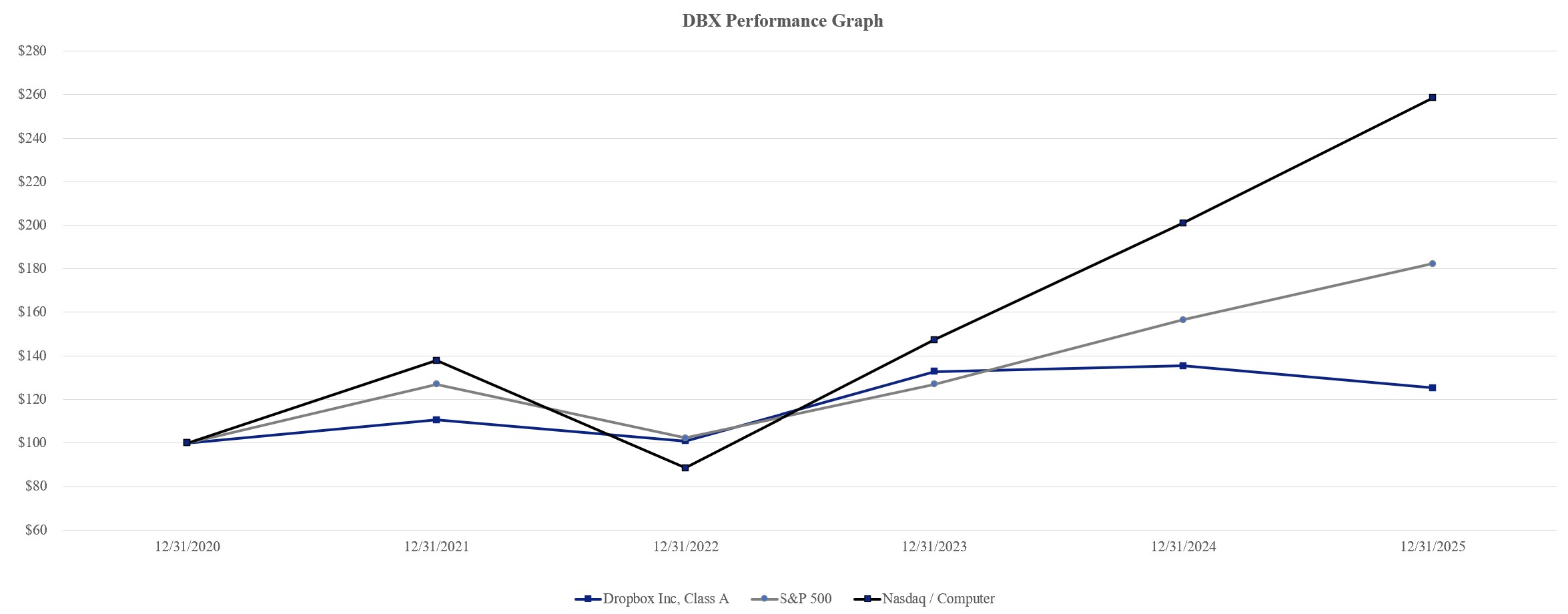
*Returns are based on historical results and are not necessarily indicative of future performance. See the disclosure in Part I, Item 1A, “Risk Factors.”
Unregistered Sales of Equity Securities
None.
ITEM 6. RESERVED
48
ITEM 7. MANAGEMENT’S DISCUSSION AND ANALYSIS OF FINANCIAL CONDITION AND RESULTS OF OPERATIONS
The following discussion and analysis of our financial condition and results of operations should be read in conjunction with the consolidated financial statements and related notes thereto included elsewhere in this Annual Report on Form 10-K. This discussion contains forward-looking statements that involve risks and uncertainties. Our actual results could differ materially from those discussed below. Factors that could cause or contribute to such differences include, but are not limited to, those identified below and those discussed in the section titled “Risk Factors” included elsewhere in this Annual Report on Form 10-K. For a comparison of our results of operations for the fiscal years ended December 31, 2024 and 2023 see Item 7, Management’s Discussion and Analysis of Financial Condition and Results of Operations, of our Annual Report on Form 10-K for the fiscal year ended December 31, 2024, filed with the SEC on February 21, 2025.
Overview
Our modern economy runs on knowledge. Today, knowledge lives in the cloud as digital content, and Dropbox is where businesses and individuals can create, access, and share this content globally. We serve more than 700 million registered users across approximately 180 countries.
Since our founding in 2007, our market opportunity grew as we’ve expanded from keeping files in sync to keeping teams in sync. In a world where using technology at work can be fragmented and distracting, Dropbox makes it easy to focus on the work that matters.
By solving these universal problems, we’ve become invaluable to our users. The popularity of our platform allows us to scale efficiently. We’ve built a thriving global business with 18.08 million paying users.
Our Subscription Plans
We generate revenue from individuals, families, teams, and organizations by selling subscriptions to our platform, which serve the varying needs of our diverse customer base. Our subscriptions include individual licenses through our Plus, Simple, Professional or Essentials plans, or multiple licenses through our Family plan or our Standard, Advanced, Business, Business Plus and Enterprise team plans. We also offer Dash, our AI-powered universal search tool, which we offer to teams at an additional cost. Each team or family represents a separately billed deployment that is managed through a single administrative dashboard. Teams must have a minimum of three users, but can also have more than tens of thousands of users. Families can have up to six users. Customers can choose between an annual or monthly plan, with a small number of large organizations on multi-year plans. A majority of our customers opt for our annual plan, although we have seen and may continue to see an increase in customers opting for our monthly plans. We typically bill our customers at the beginning of their respective terms and recognize revenue ratably over the term of the subscription period. International customers can pay in U.S. dollars or a select number of foreign currencies.
Our premium subscription plans, such as Professional and Advanced, provide more functionality than our other subscription plans and have higher per user prices. Our team subscription plans offer robust capabilities for businesses, and the vast majority of Dropbox Business teams purchase our Standard or Advanced subscription plans. While our Enterprise subscription plan offers more opportunities for customization, companies can subscribe to any of these team plans for their business needs.
We offer FormSwift, our cloud-based service that gives individuals and businesses a simple solution to create, complete, edit, and save critical business forms and agreements. Customers can choose between annual or monthly subscriptions based on their individual or business needs. We typically bill FormSwift customers at the beginning of their respective terms and recognize revenue ratably over the subscription period. FormSwift primarily sells within the United States, and the majority of its sales are in U.S. dollars. We made the strategic decision to significantly reduce investments in FormSwift at the beginning of 2025, which has negatively impacted our annual recurring revenue ("ARR"), revenue and paying users in 2025.
We also offer DocSend as our secure document sharing and analytics solution. DocSend offers paid subscription plans, including a Personal plan designed for individuals and Standard, Advanced, Advanced Data Rooms and Enterprise plans designed for business users and teams. Similar to Dropbox plans, pricing of DocSend's plans is based on the number of licenses purchased. Customers can choose between an annual or monthly plan, with a small number of large organizations on multi-year plans. We typically bill DocSend customers at the beginning of their respective terms and recognize revenue ratably over the subscription period. DocSend primarily sells within the United States, and the majority of sales are in U.S. dollars.
49
We also offer Dropbox Sign, as our e-signature solution. Dropbox Sign has several product lines, and the pricing and revenue generated from each product line varies. Product lines are primarily priced based on the number of licenses purchased (similar to Dropbox plans), while some are priced based on a customer’s transaction volume. Depending on the product purchased, teams must have a minimum number of licenses, but can also have hundreds of users. Customers can choose between an annual or monthly plan, with a small number of large organizations on multi-year plans. We typically bill Dropbox Sign customers at the beginning of their respective terms and recognize revenue ratably over the subscription period. Dropbox Sign products are offered globally, with pricing primarily denominated in U.S. dollars.
Our Business Model
Drive new signups
We acquire users efficiently and at relatively low costs through word-of-mouth referrals, direct in-product referrals, and sharing of content. Anyone can create a Dropbox account for free through our website or app and be up and running in minutes. These users often share and collaborate with other non-registered users, attracting new signups into our network.
Increase conversion of registered users to our paid subscription plans
We generate over 90% of our revenue from self-serve channels—users who purchase a subscription through our app or website. To grow our recurring revenue base, we actively encourage our registered users to convert to one of our paid plans based on the functionality that best suits their needs. We do this via in-product prompts and notifications, time-limited free trials of paid subscription plans, email campaigns, and lifecycle marketing. We use these tactics in combination with the goal of generating increased recurring revenues from our existing user base.
Upgrade and expand existing customers
We offer a range of paid subscription plans, from Plus, Simple, Professional, and Essentials for individuals to Standard, Advanced, Business, Business Plus and Enterprise for teams. We analyze usage patterns within our network and run hundreds of targeted marketing campaigns to encourage paying users to upgrade their plans. We prompt individual subscribers who collaborate with others on Dropbox to purchase our Standard, Advanced or Business, and Business Plus plans for a better team experience, and we also encourage existing Dropbox Business teams to purchase additional licenses or to upgrade to premium subscription plans. We also aim to offer additional products that expand our content collaboration capabilities, such as through our acquisitions of Dropbox Sign, DocSend and Reclaim.
Recent Developments
Impact of Macroeconomic Factors on our Business
Our overall performance depends in part on worldwide economic and geopolitical conditions and their impact on customer behavior. Uncertain economic conditions including inflation, fluctuations in interest rates, fluctuations in foreign exchange rates, impacts of tariffs and retaliatory actions, geopolitical issues, changes in government administration policy positions, and other conditions may adversely impact our results of operations and financial performance.
During the year ended December 31, 2025, our overall performance exceeded expectations, with business trends reflecting steady execution amid ongoing macroeconomic uncertainty. We saw better than expected improvements in customer retention and engagement, particularly across our Individual plans. While Teams performance showed signs of stabilization, it continues to be affected by cautious customer spend amid broader macroeconomic uncertainty. Additionally, DocSend delivered strong growth, while Sign modestly exceeded expectations.
Due to our subscription-based business model, any impact of the current macroeconomic environment on our business, particularly as a result of changes in our customer behavior, may not be fully reflected in our results of operations until future periods, if at all. For a further discussion of the potential impacts of the macroeconomic environment on our business, see “Risk Factors” included in Part I, Item 1A. of this report.
50
Key Business Metrics
We review a number of operating and financial metrics, including the following key metrics to evaluate our business, measure our performance, identify trends affecting our business, formulate business plans, and make strategic decisions.
Total annual recurring revenue
We primarily focus on total annual recurring revenue (“Total ARR”) as the key indicator of the trajectory of our business performance. Total ARR represents the amount of revenue that we expect to recur annually, enables measurement of the progress of our business initiatives, and serves as an indicator of future growth. In addition, Total ARR is less subject to variations in short-term trends that may not appropriately reflect the health of our business; however, the changes in ARR throughout the year could be subject to seasonality. Total ARR is a performance metric and should be viewed independently of revenue and deferred revenue, and is not intended to be a substitute for, or combined with, any of these items.
Total ARR consists of contributions from all of our revenue streams, including subscriptions and add-ons. We calculate Total ARR as the number of users who have active paid licenses for access to our platform as of the end of the period, multiplied by their annualized subscription price. We first include ARR related to acquired companies in our total ARR in the period of the acquisition. We adjust the exchange rates used to calculate Total ARR on an annual basis at the beginning of each fiscal year.
Our ARR fluctuates and may decrease in some periods as compared to prior periods. In the near term, ARR has experienced and may continue to experience a slight decline, reflecting our strategic decision to significantly reduce investments in FormSwift at the beginning of 2025 as well as our plan to wind down operations by the end of 2026.
Total ARR decreased for the period ended December 31, 2025, compared to the period ended December 31, 2024 primarily driven by our strategic decision to significantly reduce our investment in FormSwift at the beginning of 2025 and a challenging operating environment across our Teams plans, partially offset by growth in Individuals plans.
The below tables set forth our Total ARR using the exchange rates set at the beginning of the applicable year, as well as on a constant currency basis relative to the exchange rates used in 2025.
| As of December 31, | |||||||||||
| 2025 | 2024 | ||||||||||
| (In millions) | |||||||||||
| Total ARR | $ | 2,526 | $ | 2,574 | |||||||
| As of December 31, | |||||||||||
| Constant Currency | 2025 | 2024 | |||||||||
| (In millions) | |||||||||||
| Total ARR | $ | 2,526 | $ | 2,571 | |||||||
Revaluing our ending Total ARR for fiscal 2025 using exchange rates set at the beginning of fiscal 2026, Total ARR at the end of fiscal 2025 would be $2,562 million.
Paying users
We define paying users as the number of users who have active paid licenses for access to our platform as of the end of the period. One person would count as multiple paying users if the person had more than one active license. For example, a 50-person Dropbox Enterprise team would count as 50 paying users, and an individual Dropbox Plus user would count as one paying user. If that individual Dropbox Plus user was also part of the 50-person Dropbox Enterprise team, we would count the individual as two paying users. We first include paying users related to acquired companies among our paying users in the period of the acquisition.
For DocSend, FormSwift and Reclaim, we define paying users as the number of users who have active paid licenses for access to our platform as of the end of the period.
51
Dropbox Sign has several product lines and the pricing and revenue generated from each product line varies, with some product lines priced based on the number of licenses purchased (similar to Dropbox plans), while others are priced based on a customer’s transaction volume. For purposes of Dropbox Sign results, we include as paying users either (i) the number of users who have active paid licenses for access to the Dropbox Sign platform as of the period end for those products that are priced based on the number of licenses purchased (which is the same method we use to evaluate existing Dropbox plans) or (ii) the number of customers for those products that are priced based on transaction volumes.
The number of paying users as of December 31, 2025 declined as compared to December 31, 2024, largely due to reduced outbound sales activity following our 2024 reduction in workforce, continued pressure on our Teams plans and our strategic decision to significantly reduce our investments in FormSwift at the beginning of 2025, offset by growth in Simple. We expect that the total number of paying users will continue to fluctuate from period to period and may continue to decrease in some periods as compared to prior periods.
The below table sets forth the number of paying users as of December 31, 2025 and 2024.
| As of December 31, | |||||||||||
| 2025 | 2024 | ||||||||||
| (In millions) | |||||||||||
| Paying users | 18.08 | 18.22 | |||||||||
Average revenue per paying user
We define average revenue per paying user, or ARPU, as our revenue for the period presented divided by the average paying users during the same period. For interim periods, we use annualized revenue, which is calculated by dividing the revenue for the particular period by the number of days in that period and multiplying this value by 365 days. Average paying users are calculated based on adding the number of paying users as of the beginning of the period to the number of paying users as of the end of the period, and then dividing by two.
The average revenue per paying user for the year ended December 31, 2025 decreased as compared to the year ended December 31, 2024 as a result of our strategic decision to significantly reduce our investment in FormSwift and an increased mix of sales towards our lower priced plans.
The below table sets forth our ARPU for the years ended December 31, 2025 and 2024.
| Year Ended December 31, | |||||||||||
| 2025 | 2024 | ||||||||||
| ARPU | $ | 138.91 | $ | 140.23 | |||||||
52
Non-GAAP Financial Measure
In addition to our results determined in accordance with U.S. generally accepted accounting principles, or GAAP, we believe that free cash flow, or FCF, a non-GAAP financial measure, is useful in evaluating our liquidity.
Free cash flow
We define FCF as GAAP net cash provided by operating activities less capital expenditures. We believe that FCF is a liquidity measure and that it provides useful information regarding cash provided by operating activities and cash used for investments in property and equipment required to maintain and grow our business. FCF is presented for supplemental informational purposes only and should not be considered a substitute for financial information presented in accordance with GAAP. FCF has limitations as an analytical tool, and it should not be considered in isolation or as a substitute for analysis of other GAAP financial measures, such as net cash provided by operating activities. Some of the limitations of FCF are that FCF does not reflect our future contractual commitments, excludes investments made to acquire assets under finance leases, includes capital expenditures, and may be calculated differently by other companies in our industry, limiting its usefulness as a comparative measure.
Our FCF increased for the year ended December 31, 2025, compared to the year ended December 31, 2024, primarily due to an increase in cash provided by operating activities. The increase in cash provided by operating activities was primarily due to ongoing operating efficiency initiatives and payments related to our reduction in workforce in the fourth quarter of 2024, offset by increased foreign tax and accounts payable payments, and lease termination payments related to the partial termination of our lease for our San Francisco, California corporate headquarters.
We expect our FCF to fluctuate in the near term due to ongoing operating efficiency initiatives and variability in interest payments for any additional draws on our term loan facility, as well as fluctuations in market interest rates. We expect to continue purchasing infrastructure equipment to support our user base and expect a one-time incremental investment related to the build-out of our new San Francisco, California headquarters given we will vacate our current San Francisco, California headquarters due to recent sublease activity. See Note 16, "Subsequent Events" to our consolidated financial statements included elsewhere in this Annual Report on Form 10-K. We anticipate that our capital expenditures will generally remain consistent in future periods as we continue to invest in our internal infrastructure, network and security. The timing of our operating expenses as described below, may cause FCF to vary from period to period as a percentage of revenue.
The following is a reconciliation of FCF to the most comparable GAAP measure, net cash provided by operating activities:
| Year Ended December 31, | |||||||||||
| 2025 | 2024 | ||||||||||
| (In millions) | |||||||||||
| Net cash provided by operating activities | 951.8 | 894.1 | |||||||||
| Capital expenditures | (21.0) | (22.5) | |||||||||
| Free cash flow | $ | 930.8 | $ | 871.6 | |||||||
53
Components of Our Results of Operations
Revenue
We generate revenue from sales of subscriptions to our platform.
Revenue is recognized ratably over the related contractual term generally beginning on the date that our platform is made available to a customer. Our subscription agreements typically have monthly or annual contractual terms, although a small percentage have multi-year contractual terms. Our agreements are generally non-cancelable. We typically bill in advance for monthly contracts and annually in advance for contracts with terms of one year or longer. Amounts that have been billed are initially recorded as deferred revenue until the revenue is recognized.
Our revenue is driven primarily by conversions and upsells to our paid plans. We also generate revenue from transaction based products and fees from the referral of users to our partners. We generate over 90% of our revenue from self-serve channels. No customer represented more than 1% of our revenue in the periods presented.
Our revenue growth is impacted by both the number of paying users and our ability to increase the average revenue per paying user. Our overall paying user growth rate has declined, and we expect growth in paying users to fluctuate from period to period in the future. If we do not successfully reverse the trend of decreasing average revenue per paying user, for example through increased sales of our higher-priced subscription plans, or otherwise offset slower growth or declines in paying users, we expect our revenue and revenue growth rate to continue decreasing.
Cost of revenue and gross margin
Cost of revenue. Our cost of revenue consists primarily of expenses associated with the storage, delivery, and distribution of our platform for both paying users and free users. These costs, which we refer to as infrastructure costs, include depreciation of our servers located in co-location facilities that we lease and operate, rent and facilities expense for those datacenters, network and bandwidth costs, support and maintenance costs for our infrastructure equipment, and payments to third-party datacenter service providers. Cost of revenue also includes salaries, bonuses, employer payroll taxes and benefits, travel-related expenses, expenses related to our reduction in workforce in the fourth quarter of 2024, such as severance, benefits and other related items, and stock-based compensation, which we refer to as employee-related costs, for employees whose primary responsibilities relate to supporting our infrastructure and delivering user support. Other non-employee costs included in cost of revenue include credit card fees related to processing customer transactions, and allocated overhead, such as facilities, including rent, utilities, depreciation on leasehold improvements and other equipment shared by all departments, and shared information technology costs. In addition, cost of revenue includes amortization of developed technologies, professional fees related to user support initiatives, and property taxes related to datacenter equipment.
We plan to continue increasing the capacity and enhancing the capability and reliability of our infrastructure to support user growth and increased use of our platform. We expect that cost of revenue will increase in absolute dollars in both the near term and long term.
Gross margin. Gross margin is gross profit expressed as a percentage of revenue. Our gross margin may fluctuate from period to period based on the timing of additional capital expenditures and the related depreciation expense, or other increases in our infrastructure costs, as well as revenue fluctuations. We expect gross margin to remain relatively constant in both the near term and long term.
Operating expenses
Research and development. Our research and development expenses consist primarily of employee-related costs for our engineering, product, and design teams, expenses related to our reduction in workforce in the fourth quarter of 2024, such as severance, benefits and other related items, compensation expenses related to key personnel from acquisitions and allocated overhead. These groups are responsible for the design, development, testing, delivery of new technologies and features, and support of our self-serve platform. We continue to focus our product development efforts on adding new features and enhancing the functionality and ease of use of our offerings. Additionally, research and development expenses include internal development-related third-party hosting fees. We have expensed almost all of our research and development costs as they were incurred.
We expect that research and development costs will decrease in absolute dollars and as a percentage of revenue in both the near term and long term as we continue to drive operating efficiencies across the business, partially offset by ongoing investment in key growth initiatives.
54
Sales and marketing. Our sales and marketing expenses relate to both self-serve and outbound sales activities, and consist primarily of employee-related costs, expenses related to our reduction in workforce in the fourth quarter of 2024, such as severance, benefits and other related items, advertising costs, brand marketing costs, lead generation costs, sponsorships and allocated overhead. Sales commissions earned by our outbound sales team and the related payroll taxes, as well as commissions earned by third-party resellers that we consider to be incremental and recoverable costs of obtaining a contract with a customer, are deferred and are typically amortized over an estimated period of benefit of five years. Additionally, sales and marketing expenses include non-employee costs related to app store fees, fees payable to third-party sales representatives and amortization of acquired customer relationships.
We expect that sales and marketing expenses will remain consistent in absolute dollars in the near term and could fluctuate in the long term as we seek to grow our user base and increase our brand awareness while also retaining flexibility to invest in growth.
General and administrative. Our general and administrative expenses consist primarily of employee-related costs for our legal, finance, human resources, and other administrative teams, as well as certain executives. In addition, general and administrative expenses include expenses related to our reduction in workforce in the fourth quarter of 2024, such as severance, benefits and other related items, allocated overhead, outside legal, accounting and other professional fees, and non income-based taxes.
We expect to incur additional general and administrative expenses to support the growth of the Company. We expect that general and administrative expenses will fluctuate in absolute dollars in future periods and remain relatively constant in both the near term and the long term as a percentage of revenue.
Net (gain) loss on real estate assets
Net (gain) loss on real estate assets consists of gains and losses related to real estate and lease activity, including impairment charges. See Note 9, "Leases" to our consolidated financial statements included elsewhere in this Annual Report on Form 10-K.
Interest (expense) income, net
Interest (expense) income, net consists primarily of interest expense related to our term loan facility, finance lease obligations for infrastructure and amortization of debt issuance costs, offset by interest income earned on our investments classified as cash and cash equivalents, and short-term investments. We expect that interest (expense), income, net may fluctuate in both the near term and the long term, depending on the timing and magnitude of any additional draws on our term loan facility, as well as changes in market interest rates.
Other income, net
Other income, net consists of other non-operating gains or losses, including those related to gains or losses on sale of assets, foreign currency transaction gains and losses, lease arrangements, which include sublease income, and gains and losses related to our short-term investments.
Provision for income taxes
Provision for income taxes consists of U.S. federal, state and foreign jurisdiction income taxes. For 2025 and 2024, the difference between the U.S. statutory rate and our effective tax rate is primarily due to the jurisdictional mix of earnings, tax credits, state income taxes, stock-based compensation, and changes to our unrecognized tax benefits.
55
Results of Operations
The following tables set forth our results of operations for the periods presented:
| Year Ended December 31, | |||||||||||
| 2025 | 2024 | ||||||||||
| (In millions) | |||||||||||
| Revenue | $ | 2,521.0 | $ | 2,548.2 | |||||||
Cost of revenue(1)(2) | 500.8 | 445.1 | |||||||||
| Gross profit | 2,020.2 | 2,103.1 | |||||||||
| Operating expenses: | |||||||||||
Research and development(1)(2) | 732.0 | 914.9 | |||||||||
Sales and marketing(1)(2) | 369.9 | 460.7 | |||||||||
General and administrative(1)(2) | 230.5 | 241.2 | |||||||||
Net (gain) loss on real estate assets(3) | (1.3) | 0.1 | |||||||||
| Total operating expenses | 1,331.1 | 1,616.9 | |||||||||
| Income from operations | 689.1 | 486.2 | |||||||||
| Interest (expense) income, net | (78.6) | 13.9 | |||||||||
| Other income, net | 7.1 | 9.7 | |||||||||
| Income before income taxes | 617.6 | 509.8 | |||||||||
| Provision for income taxes | (109.2) | (57.5) | |||||||||
| Net income | $ | 508.4 | $ | 452.3 | |||||||
(1) Includes stock-based compensation as follows:
| Year Ended December 31, | |||||||||||
| 2025 | 2024 | ||||||||||
| (In millions) | |||||||||||
| Cost of revenue | $ | 20.6 | $ | 22.9 | |||||||
| Research and development | 211.2 | 247.6 | |||||||||
| Sales and marketing | 20.7 | 23.7 | |||||||||
| General and administrative | 48.3 | 52.3 | |||||||||
| Total stock-based compensation | $ | 300.8 | $ | 346.5 | |||||||
(2) Includes expenses related to the Company's reduction in workforce such as severance, benefits and other related items during the years ended December 31, 2025 and 2024. See Note 1, "Description of the Business and Summary of Significant Accounting Policies - Reduction in Workforce" to the Company's consolidated financial statements included elsewhere in this Annual Report on Form 10-K.
(3) See Note 9, "Leases" to the Company's consolidated financial statements included elsewhere in this Annual Report on Form 10-K.
56
The following table sets forth our results of operations for each of the periods presented as a percentage of revenue:
| Year Ended December 31, | |||||||||||
| 2025 | 2024 | ||||||||||
| (As a % of revenue)* | |||||||||||
| Revenue | 100 | % | 100 | % | |||||||
Cost of revenue(1)(2) | 20 | 17 | |||||||||
| Gross profit | 80 | 83 | |||||||||
| Operating expenses: | |||||||||||
Research and development(1)(2) | 29 | 36 | |||||||||
Sales and marketing(1)(2) | 15 | 18 | |||||||||
General and administrative(1)(2) | 9 | 9 | |||||||||
Net (gain) loss on real estate assets(3) | — | — | |||||||||
| Total operating expenses | 53 | 63 | |||||||||
| Income from operations | 27 | 19 | |||||||||
| Interest (expense) income, net | (3) | 1 | |||||||||
| Other income, net | — | — | |||||||||
| Income before income taxes | 24 | 20 | |||||||||
| Provision for income taxes | (4) | (2) | |||||||||
| Net income | 20 | % | 18 | % | |||||||
(1) Includes stock-based compensation as a percentage of revenue as follows:
| Year Ended December 31, | |||||||||||
| 2025 | 2024 | ||||||||||
| (As a % of revenue)* | |||||||||||
| Cost of revenue | 1 | % | 1 | % | |||||||
| Research and development | 8 | 10 | |||||||||
| Sales and marketing | 1 | 1 | |||||||||
| General and administrative | 2 | 2 | |||||||||
| Total stock-based compensation | 12 | % | 14 | % | |||||||
(2) Includes expenses related to the Company's reduction in workforce such as severance, benefits and other related items during the years ended December 31, 2025 and 2024. See Note 1, "Description of the Business and Summary of Significant Accounting Policies - Reduction in Workforce" to the Company's consolidated financial statements included elsewhere in this Annual Report on Form 10-K.
(3) See Note 9, "Leases" to the Company's consolidated financial statements included elsewhere in this Annual Report on Form 10-K.
*Percentages may not foot due to rounding.
57
Comparison of the years ended December 31, 2025 and 2024,
Revenue
| Year Ended December 31, | |||||||||||||||||||||||
| 2025 | 2024 | $ Change | % Change | ||||||||||||||||||||
| (In millions) | |||||||||||||||||||||||
| Revenue | $ | 2,521.0 | $ | 2,548.2 | $ | (27.2) | (1.1) | % | |||||||||||||||
Revenue decreased $27.2 million or 1.1% during the year ended December 31, 2025, as compared to the year ended December 31, 2024, primarily due to our strategic decision to significantly reduce our investment in FormSwift and a challenging Teams environment, offset by growth in our Individuals plans. Revenue was positively impacted by changes in foreign exchange rates across multiple currencies.
Cost of revenue, gross profit, and gross margin
| Year Ended December 31, | |||||||||||||||||||||||
| 2025 | 2024 | $ Change | % Change | ||||||||||||||||||||
| (In millions) | |||||||||||||||||||||||
| Cost of revenue | $ | 500.8 | $ | 445.1 | $ | 55.7 | 12.5 | % | |||||||||||||||
| Gross profit | 2,020.2 | 2,103.1 | (82.9) | (3.9) | % | ||||||||||||||||||
| Gross margin | 80 | % | 83 | % | |||||||||||||||||||
Cost of revenue increased $55.7 million or 12.5% during the year ended December 31, 2025, as compared to the year ended December 31, 2024. This increase was primarily driven by a $53.1 million increase in infrastructure costs, including costs associated with adding equipment in support of our data center refresh cycle and data center facilities costs. Additionally, we saw a smaller benefit in depreciation expense compared to the 2024 period as a result of the change in useful lives from four to five years of certain infrastructure and component assets which was effective January 1, 2024.
Our gross margin decreased during the year ended December 31, 2025 compared to the year ended December 31, 2024, primarily due to a 12.5% increase in our cost of revenue as described above and a 1.1% decrease in revenue during the period.
Research and development
| Year Ended December 31, | |||||||||||||||||||||||
| 2025 | 2024 | $ Change | % Change | ||||||||||||||||||||
| (In millions) | |||||||||||||||||||||||
| Research and development | $ | 732.0 | $ | 914.9 | $ | (182.9) | (20.0) | % | |||||||||||||||
Research and development expenses decreased $182.9 million or 20.0% during the year ended December 31, 2025, as compared to the year ended December 31, 2024, primarily due to decreases of $147.8 million in employee-related costs driven by a decrease in headcount and $32.0 million in allocated overhead.
Sales and marketing
| Year Ended December 31, | |||||||||||||||||||||||
| 2025 | 2024 | $ Change | % Change | ||||||||||||||||||||
| (In millions) | |||||||||||||||||||||||
| Sales and marketing | $ | 369.9 | $ | 460.7 | $ | (90.8) | (19.7) | % | |||||||||||||||
Sales and marketing expenses decreased $90.8 million or 19.7% during the year ended December 31, 2025, as compared to the year ended December 31, 2024, primarily due to a decrease of $52.3 million related to advertising due to our strategic
58
decision to significantly reduce our investments in FormSwift and other marketing related expenses as well as a decrease of $31.8 million in employee-related costs driven by a decrease in headcount.
General and administrative
| Year Ended December 31, | |||||||||||||||||||||||
| 2025 | 2024 | $ Change | % Change | ||||||||||||||||||||
| (In millions) | |||||||||||||||||||||||
| General and administrative | $ | 230.5 | $ | 241.2 | $ | (10.7) | (4.4) | % | |||||||||||||||
General and administrative expenses decreased $10.7 million or 4.4% during the year ended December 31, 2025, as compared to the year ended December 31, 2024, primarily due to decreases of $7.4 million in outside services and $6.5 million in allocated overhead.
Net (gain) loss on real estate assets
| Year Ended December 31, | |||||||||||||||||||||||
| 2025 | 2024 | $ Change | % Change | ||||||||||||||||||||
| (In millions) | |||||||||||||||||||||||
Net (gain) loss on real estate assets | $ | (1.3) | $ | 0.1 | $ | (1.4) | (1,400) | % | |||||||||||||||
Net gain on real estate assets was $1.3 million for the year ended December 31, 2025, primarily resulting from a reduction of the liability for unrecoverable common area maintenance costs related to our San Francisco, California corporate headquarters due to recent sublease activity. Net loss on real estate assets was $0.1 million for the year ended December 31, 2024, primarily due to changes in the corporate real estate market, which impacted our subleasing strategy in conjunction with our Virtual First work model.
Interest (expense) income, net
Interest (expense) income, net changed by $92.5 million during the year ended December 31, 2025, as compared to the year ended December 31, 2024, primarily due to an increase in interest expense related to our term loan facility entered into in the fourth quarter of 2024.
Other income, net
Other income, net decreased by $2.6 million during the year ended December 31, 2025, as compared to the year ended December 31, 2024, primarily due to a $2.0 million increase in foreign currency transaction losses.
Provision for income taxes
Provision for income taxes increased $51.7 million during the year ended December 31, 2025, as compared to the year ended December 31, 2024, primarily due to an increase in income before taxes, a reduction in tax credits, and increases to our unrecognized tax benefits in the current year, as compared to reductions to our uncertain tax positions in the prior year due to an effective settlement with a foreign taxing authority.
On July 4, 2025, the OBBBA was enacted in the U.S. The OBBBA includes significant provisions, such as the permanent extension of certain expiring provisions of the Tax Cuts and Jobs Act, modifications to the international tax framework, and the restoration of favorable tax treatment for certain business provisions. OBBBA reduced our U.S. cash tax payments in 2025, but increased tax expense, primarily due to limits to the availability of certain credits and deductions resulting from the reinstatement of immediate expensing for U.S. research expenditures.
59
Liquidity and Capital Resources
As of December 31, 2025, we had cash and cash equivalents of $891.3 million and short-term investments of $146.9 million, which were held for working capital purposes. Our cash, cash equivalents, and short-term investments consist primarily of cash, money market funds, corporate notes and obligations, U.S. Treasury securities, asset-backed securities, U.S. agency obligations, supranational securities, and municipal securities. As of December 31, 2025, $413.8 million of our cash and cash equivalents was held by our foreign subsidiaries. We do not expect to incur material taxes in the event we repatriate any of these amounts. Our cash is held at several large financial institutions and our investments are focused on the preservation of capital, fulfillment of our liquidity needs, and maximization of investment performance within the parameters set forth in our investment policy and subject to market conditions. The investment policy sets forth credit rating minimums, permissible allocations, and limits our exposure to specific investment types. We believe these policies mitigate our exposure to risk concentrations.
We have historically financed our operations primarily through cash generated from our operations, the Notes (as defined below) issuance, borrowings from our term loan facility, equity issuances, and finance leases for our infrastructure-related assets in co-location facilities that we directly lease and operate. We enter into finance leases in part to better match the timing of payments for infrastructure-related assets with that of cash received from our paying users. In our business model, some of our registered users convert to paying users over time, and consequently there is a lag between initial investment in infrastructure assets and cash received from some of our users. We also have delayed draw term loan features as part of the term loan facility for additional working capital flexibility, as described below.
In February 2021, we issued approximately $1.4 billion in aggregate principal amount of the 2026 Notes and the 2028 Notes (together the "Notes"), comprised of $695.8 million in aggregate principal amount of 2026 Notes and $693.3 million in aggregate principal amount of 2028 Notes. The net proceeds from the issuance of the 2026 Notes and 2028 Notes were $684.8 million, net of debt issuance costs, and $682.3 million, net of debt issuance costs, respectively. The 2026 Notes mature on March 1, 2026 and the 2028 Notes mature on March 1, 2028. The Notes of each series do not bear regular interest and the principal does not accrete. The Notes of each series may bear special interest as the remedy relating to our failure to comply with certain of our reporting obligations. These Notes can be converted or repurchased prior to maturity if certain conditions are met.
In December 2024, we entered into a secured five-year term loan facility in an aggregate principal amount of up to $2.0 billion, consisting of initial term loans and initial delayed draw term loan commitments (the "initial delayed draw term loans") each in an aggregate principal amount of up to $1.0 billion, respectively. The terms of the initial Credit Agreement also provide for a secured letter of credit facility in an aggregate amount of up to $35.0 million. In September 2025, we entered into the First Amendment to the term loan facility which provided for additional secured delayed draw term loan commitments in an aggregate principal amount of up to $700.0 million (the "2025 delayed draw term loans"). The 2025 delayed draw term loans may be borrowed solely for the purpose of prepaying, repaying, repurchasing, redeeming, exchanging or settling upon conversion the 2026 Notes. We expect to pay the 2026 Notes using proceeds from the loans prior to or at maturity in 2026.
The initial term loans and initial delayed draw term loans have a maturity date of December 11, 2029 and the 2025 delayed draw term loans have a maturity date of September 9, 2030. Quarterly principal payments for the initial term loans and initial delayed draw term loans began on March 31, 2025 and on the last business day of the quarter after the funding of such loans, respectively, and will continue on the last business day of each quarter thereafter, equal to 0.25% of the original principal amount of such term loans or such greater percentage as may be required to make the initial delayed draw term loans fungible with any then-outstanding term loans. Quarterly repayments of 0.25% of the original principal amount of the 2025 delayed draw term loans are required beginning on the last business day of the quarter after the funding of such loans and continuing thereafter. As of December 31, 2025, we had $1,488.3 million of outstanding initial term loans and initial delayed draw term loans, no outstanding 2025 delayed draw term loans, and $1,200.0 million available to draw on the term loan facility. As of December 31, 2025, $17.5 million letters of credit were issued under the letter of credit facility.
Interest on borrowings under the term loan facility accrues at either an alternate base rate plus a margin of 2.75% or a term SOFR rate plus a margin of 3.75% (further described in Note 8 "Debt") at our option. Pursuant to the terms of the Amended Credit Agreement, we are required to pay a quarterly commitment fee that accrues at a rate of 1.00% per annum on both the unused portion of the initial delayed draw term loan commitments and the unused portion of the 2025 delayed draw term loans. The 2025 delayed draw term loans commitment fees started accruing on the unused portion three months after the effective date of the First Amendment.
The term loan facility permits the Company, subject to satisfaction of certain conditions, including obtaining commitments from new or existing lenders, to add new term loan facilities or increase the term loan commitments under the term loan agreement, in each case, subject to certain limits. Additionally, the Amended Credit Agreement contains customary
60
representations and warranties, customary affirmative and negative covenants, and customary events of default. Failure to comply with these covenants may result in a portion of the outstanding term loan debt becoming due immediately. We were in compliance with all covenants under the term loan facility as of December 31, 2025.
As of December 31, 2025, we have utilized a significant portion of our U.S. federal, state and foreign net operating losses. Future utilization of remaining net operating loss and research credit carryforwards are subject to statutory limits.
We believe our existing cash and cash equivalents, together with our short-term investments, cash provided by operations and amounts available under the term loan facility, will be sufficient to meet our needs for the foreseeable future. In addition to the Notes and obligations under the term loan facility discussed above, as of December 31, 2025, we have cash commitments due to additional known contractual obligations. Our cash commitments due to known contractual obligations primarily relate to operating and finance lease arrangements. As of December 31, 2025, we additionally had $91.4 million of commitments with third-party vendors for services related to our infrastructure, infrastructure warranty contracts, and asset retirement obligations for office modifications, with terms of 11 years or less.
Our operating lease arrangements consist of leases for our offices and datacenters with terms of 11 years or less. As of December 31, 2025, future non-cancelable minimum rental payments related to operating leases were $646.1 million, which includes $162.9 million of future contractual rent payments allocated to non-lease components, and excludes rent payments from our subtenants and variable operating expenses. As of December 31, 2025, we are entitled to non-cancelable rent payments from our subtenants of $65.9 million, which will be collected over the next 8 years. Our finance lease arrangements primarily consist of leases for our infrastructure with terms of 4 years or less. As of December 31, 2025, future non-cancelable minimum rental payments under finance leases were$373.1 million. Refer to Note 9, "Leases", for more information.
Our principal uses of cash in recent periods have been funding our operations, repurchases of our Class A common stock, the satisfaction of tax withholding obligations in connection with the settlement of restricted stock units ("RSUs") and restricted stock awards ("RSAs"), making principal payments on our finance lease obligations, and capital expenditures. Our Board of Directors has authorized three separate $1.2 billion Class A common stock repurchase programs since February 2022, with authorizations in February 2022, July 2023 and December 2024. We completed the February 2022, July 2023 and December 2024 authorizations during the three months ended March 31, 2024, March 31, 2025, and December 31, 2025 respectively. In August 2025, our Board of Directors authorized a new repurchase program of up to an additional $1.5 billion of the outstanding shares of our Class A common stock. Share repurchases are made from time-to-time in private transactions or open market purchases as permitted by securities laws and other legal requirements and are subject to a review of the circumstances in place at that time, including prevailing market prices. The program does not obligate us to repurchase any specific number of shares and has no specified time limit; it may be discontinued at any time. During the year ended December 31, 2025, we repurchased and subsequently retired 60.4 million shares of our Class A common stock for an aggregate amount of $1.7 billion. This amount includes the 1% excise tax under the Inflation Reduction Act, as well as repurchase execution costs incurred in connection with our share repurchase program. The pace of our share repurchases may fluctuate due to various circumstances, including market conditions, our stock price, and other strategic investments.
Our future capital requirements will depend on many factors including our revenue growth rate, subscription renewal activity, billing frequency, the timing and extent of spending to support further infrastructure development and research and development efforts, the timing and extent of additional capital expenditures to invest in infrastructure equipment to support our user base, our ability to sublease space at office locations where we have unused spaces, the satisfaction of tax withholding obligations for the release of restricted stock units and awards, investments in sales and marketing, the expansion of international operations, the introduction of new product capabilities and enhancement of our platform, the continuing market acceptance of our platform, and the volume, timing, and amount of our share repurchases. In addition, we have and may in the future enter into arrangements to acquire or invest in complementary businesses, services, and technologies, including intellectual property rights. In light of all these circumstances, we may be required to seek additional equity or debt financing, or we may decide to do so opportunistically. In the event that additional financing is required or desired from outside sources, we may not be able to raise it on terms acceptable to us or at all. If we are unable to raise additional capital when desired, our business, results of operations, and financial condition could be materially and adversely affected.
61
Our cash flow activities were as follows for the periods presented:
| Year Ended December 31, | |||||||||||
| 2025 | 2024 | ||||||||||
| (In millions) | |||||||||||
| Net cash provided by operating activities | $ | 951.8 | $ | 894.1 | |||||||
| Net cash provided by investing activities | 111.9 | 443.8 | |||||||||
| Net cash used in financing activities | (1,530.7) | (586.6) | |||||||||
| Effect of exchange rate changes on cash and cash equivalents | 12.4 | (5.7) | |||||||||
| Net (decrease) increase in cash and cash equivalents | $ | (454.6) | $ | 745.6 | |||||||
Operating activities
Our largest source of operating cash is cash collections from our paying users for subscriptions to our platform. Our primary uses of cash from operating activities are for employee-related expenditures, infrastructure-related costs, and marketing expenses. Net cash provided by operating activities is impacted by our net income adjusted for certain non-cash items, including stock-based compensation, depreciation and amortization expenses, as well as the effect of changes in operating assets and liabilities.
For the year ended December 31, 2025, net cash provided by operating activities was $951.8 million, which primarily consisted of our net income of $508.4 million, adjusted for stock-based compensation expense of $300.8 million, depreciation and amortization expenses of $157.4 million, and net cash outflow of $126.8 million from operating assets and liabilities. The outflow from operating assets and liabilities was primarily due to the payment of our 2024 corporate bonus, the payment for the third tranche termination fee for the partial termination of our lease for our San Francisco, California corporate headquarters, and payments related to our operating leases.
The increase of $57.7 million in net cash provided by operating activities during the year ended December 31, 2025, compared to the year ended December 31, 2024, was primarily due to an increase of $73.0 million in net income, as adjusted for stock-based compensation, depreciation and amortization expenses, and other non-cash (gains) losses, partially offset by an increase of $15.3 million in cash outflows from changes in operating assets and liabilities. The increase in cash outflows is primarily driven by an increase in foreign tax and accounts payable payments, and an increase in termination fee payments related to the partial termination of our lease for our San Francisco, California corporate headquarters, offset by the payments related to our reduction in workforce in the fourth quarter of 2024.
Investing activities
Net cash provided by investing activities is primarily impacted by net investment activity, which includes sales, maturities, and purchases of short-term investments, cash paid for acquisitions, and for purchasing infrastructure equipment in co-location facilities that we directly lease and operate.
For the year ended December 31, 2025, net cash provided by investing activities was $111.9 million, which primarily related to $124.8 million in investment activity inflows, driven by the maturities of short-term investments. The increase was partially offset by cash paid for acquisitions of $13.1 million.
The decrease of $331.9 million in net cash provided by investing activities during the year ended December 31, 2025, compared to the year ended December 31, 2024, was primarily due to a decrease of $368.3 million in net investment activity inflows and a decrease in cash receipts from equipment rebates of $15.2 million, offset by a decrease of $44.7 million in cash paid for acquisitions.
Financing activities
Net cash used in financing activities is primarily impacted by cash used for repurchases of common stock, tax withholding obligations for the release of restricted stock units and restricted stock awards, principal payments on finance lease obligations for our infrastructure equipment, principal payments on amounts drawn upon the term loan facility, payments of debt issuance costs and loan commitment fees related to the term loan facility, and payments of acquisition-related indemnity holdback amounts, offset by proceeds from the term loan facility.
62
For the year ended December 31, 2025, net cash used in financing activities was $1,530.7 million, which primarily consisted of $1,713.9 million for the repurchase of our common stock, $151.0 million for the satisfaction of tax withholding obligations for the release of restricted stock units and awards, $128.6 million in principal payments on finance lease obligations, $11.6 million in principal payments against the term loan facility, and $21.6 million in payments of debt issuance costs and loan commitment fees under the term loan facility. The outflow was offset by $500.0 million in proceeds from the term loan facility.
The increase of $944.1 million in net cash used in financing activities during the year ended December 31, 2025, compared to the year ended December 31, 2024, was primarily due to a decrease of $500.0 million in proceeds from the term loan facility, an increase of $472.3 million in repurchases of our common stock, and an increase of $11.6 million in principal payments against the term loan facility, offset by a decrease of $28.5 million in payments of debt issuance costs and loan commitment fees and a decrease of $13.6 million in cash paid for the release of acquisition-related indemnity holdback payments after the acquisition date in accordance with the merger agreement.
Significant Impacts of Stock-Based Compensation
Co-Founder Grant
In December 2017, the Board of Directors approved the grant to Drew Houston, the Company's Co-Founder and Chief Executive Officer, of 10.3 million shares of Class A common stock in the form of RSAs (the "Co-Founder Grant"). This Co-Founder Grant has service-based, market-based, and performance-based vesting conditions. The Co-Founder Grant is excluded from Class A common stock issued and outstanding until the satisfaction of these vesting conditions. The Co-Founder Grant also provides the holder with certain stockholder rights, such as the right to vote the shares with the other holders of Class A common stock and a right to cumulative declared dividends.
The Co-Founder Grant is eligible to vest over the ten-year period following the date the Company’s shares of Class A common stock commenced trading on the Nasdaq Global Select Market in connection with the Company’s IPO. The Co-Founder Grant is comprised of nine tranches that are eligible to vest based on the achievement of stock price goals, each of which are referred to as a Stock Price Target, measured over a consecutive thirty-day trading period during the Performance Period. The Performance Period began on January 1, 2019.
| Company Stock Price Target | Shares Eligible to Vest for Mr. Houston | ||||||||||
| $30.00 | 2,066,667 | ||||||||||
| $37.50 | 1,033,334 | ||||||||||
| $45.00 | 1,033,334 | ||||||||||
| $52.50 | 1,033,333 | ||||||||||
| $60.00 | 1,033,333 | ||||||||||
| $67.50 | 1,033,333 | ||||||||||
| $75.00 | 1,033,333 | ||||||||||
| $82.50 | 1,033,333 | ||||||||||
| $90.00 | 1,033,333 | ||||||||||
The Performance Vesting Condition for the Co-Founder Grant was satisfied on the date the Company’s shares of Class A common stock commenced trading on the Nasdaq Global Select Market in connection with the Company’s IPO, which was March 23, 2018.
The first tranche of the Co-Founder Grant, or 2.1 million shares of Class A common stock, vested in the fourth quarter of 2021. The stock-based compensation expense for the Co-Founder Grant was recognized utilizing the accelerated attribution method over the requisite service period identified as the derived service period over which the market conditions are expected to be achieved, and is not reversed if the market conditions are not satisfied. As of December 31, 2024, the Company had fully recognized all related stock-based compensation expense.
63
Critical Accounting Estimates
Our consolidated financial statements and the related notes thereto included elsewhere in this Annual Report on Form 10-K are prepared in accordance with generally accepted accounting principles, or GAAP, in the United States. The preparation of consolidated financial statements also requires us to make estimates and assumptions that affect the reported amounts of assets, liabilities, revenue, costs and expenses, and related disclosures. We base our estimates on historical experience and on various other assumptions that we believe to be reasonable under the circumstances. Actual results could differ significantly from the estimates made by management. To the extent that there are differences between our estimates and actual results, our future financial statement presentation, financial condition, results of operations, and cash flows will be affected.
While our significant accounting policies are more fully described in Note 1 “Description of the Business and Summary of Significant Accounting Policies” to our Consolidated Financial Statements in Part II, Item 8 of this Annual Report on Form 10-K, we believe that the accounting policies described below involve a greater degree of judgment and estimation uncertainty.
Income Taxes
Deferred income tax balances reflect the effects of temporary differences between the financial reporting and tax bases of our assets and liabilities using enacted tax rates expected to apply when taxes are actually paid or recovered. In addition, deferred tax assets are recorded for net operating loss and credit carryforwards.
A valuation allowance is provided against deferred tax assets unless it is more likely than not that they will be realized based on all available positive and negative evidence. Such evidence, which requires management's judgment, includes, but is not limited to, recent cumulative earnings or losses, expectations of future taxable income by taxing jurisdiction, and the carry-forward periods available for the utilization of deferred tax assets. Any changes in our assessment of the realizability of deferred tax assets would result in a corresponding increase or decrease to income tax expense in the period in which such change is recorded.
We are subject to income taxes in the United States and various foreign jurisdictions and are required to make judgments and estimates in determining our provision for income taxes, including the recognition and measurement of uncertain tax positions. We recognize the tax benefit of an uncertain tax position only if it is more likely than not that the position will be sustained upon examination by the applicable taxing authority, based on the technical merits of the position. The evaluation of uncertain tax positions can require significant judgment and may involve assumptions regarding the interpretation and application of complex tax laws, and the resolution of issues with taxing authorities. These judgments may change as a result of new information, including changes in tax law, regulations, or interpretations thereof, the outcome of tax audits, or refinements to our estimates. Although we believe that our estimates related to uncertain tax positions are reasonable, the ultimate outcome of these matters may differ from our estimates. Any such differences could materially affect our provision for income taxes, effective tax rate, and cash flows in the period in which the matter is resolved.
Refer to Note 14, “Income Taxes” to the Consolidated Financial Statements in Part II, Item 8 of this Annual Report on Form 10-K for more information.
Recent Accounting Pronouncements
See Note 1, “Description of the Business and Summary of Significant Accounting Policies” to our consolidated financial statements included elsewhere in this Annual Report on Form 10-K for recently adopted accounting pronouncements as of the date of this Annual Report on Form 10-K.
64
ITEM 7A. QUANTITATIVE AND QUALITATIVE DISCLOSURES ABOUT MARKET RISK
Interest rate risk
We had cash and cash equivalents of $891.3 million and short-term investments of $146.9 million as of December 31, 2025. We hold our cash and cash equivalents and short-term investments for working capital purposes. Our cash, cash equivalents, and short-term investments consist primarily of cash, money market funds, corporate notes and obligations, U.S. Treasury securities, asset-backed securities, U.S. agency obligations, supranational securities, and municipal securities. The primary objectives of our investment activities are the preservation of capital, the fulfillment of liquidity needs, and the control of cash and investments. We do not enter into investments for trading or speculative purposes. Our cash equivalents and our portfolio of debt securities are subject to market risk due to changes in interest rates.
As of December 31, 2025, a hypothetical increase in interest rates by 100 basis points would have had an immaterial impact on the market value of our investment portfolio. This estimate is based on a sensitivity model that measures market value changes when changes in interest rates occur.
Borrowings under the term loan facility bear interest, at our option, at either (a) an alternate base rate, which is defined as a fluctuating rate per annum equal to the greatest of (i) the prime rate then in effect, (ii) the federal funds rate then in effect, plus 0.50% per annum, and (iii) a term SOFR rate determined on the basis of a one-month interest period plus 1.00% per annum, in each case, plus a 2.75% margin, or (b) an overnight term SOFR rate (based on one, three or six month interest periods), plus a 3.75% margin. As of December 31, 2025, we had $1,488.3 million outstanding under the term loan facility. We do not have any other long-term debt or financial liabilities with floating interest rates that would subject us to interest rate fluctuations. For the year ended December 31, 2025, a hypothetical 100 basis point increase or decrease in interest rates would have resulted in a $10.9 million change in interest expense related to the term loan facility.
Foreign currency exchange risk
Our results of operations and cash flows are subject to fluctuations due to changes in foreign currency exchange rates relative to U.S. dollars, our reporting currency.
Most of our revenue is generated in U.S. dollars, with the remainder generated in Euros, British pounds sterling, Australian dollars, Canadian dollars, and Japanese yen.
Our expenses are generally denominated in the currencies in which our operations are located, which are primarily the United States and, to a lesser extent, Europe and Asia. The functional currency of Dropbox International Unlimited, our international headquarters and largest international entity, is denominated in U.S. dollars. Our results of operations and cash flows are, therefore, subject to fluctuations due to changes in foreign currency exchange rates in ways that are unrelated to our operating performance.
As exchange rates may fluctuate significantly between periods, revenue and operating expenses, when converted into U.S. dollars, may also experience significant fluctuations between periods. Volatile market conditions, including those arising from macroeconomic events, such as the volatility and uncertainty in the banking and financial services sector, fluctuating interest rates, tightening of credit markets, as well as geopolitical events have and may in the future result in significant changes in exchange rates, and in particular a weakening of foreign currencies relative to the U.S. dollar has and may in the future negatively affect our revenue expressed in U.S. dollars. Historically, a majority of our revenue and operating expenses have been denominated in U.S. dollars, Euros, and British pounds sterling. Although we are impacted by the exchange rate movements from a number of currencies relative to the U.S. dollar, our results of operations are particularly impacted by fluctuations in the U.S. dollar-Euro and U.S. dollar-British pounds sterling exchange rates. During the year ended December 31, 2025, 27% of our sales were denominated in currencies other than U.S. dollars. Our expenses, by contrast, are primarily denominated in U.S. dollars. As a result, any increase in the value of the U.S. dollar against these foreign currencies could cause our revenue to decline relative to our costs, thereby decreasing our margins.
Foreign currency transaction gains and losses were immaterial during the years ended December 31, 2025 and 2024. A hypothetical 10% change in foreign currency rates would not have resulted in material gains or losses for the years ended December 31, 2025 and 2024.
To date, we have not engaged in any hedging activities. As our international operations grow, we will continue to reassess our approach to managing risks relating to fluctuations in currency rates.
65
ITEM 8. FINANCIAL STATEMENTS AND SUPPLEMENTARY DATA
DROPBOX, INC.
INDEX TO CONSOLIDATED FINANCIAL STATEMENTS
| Page | |||||
Report of Independent Registered Public Accounting Firm (PCAOB ID: | |||||
66
REPORT OF INDEPENDENT REGISTERED PUBLIC ACCOUNTING FIRM
To the Stockholders and the Board of Directors of Dropbox, Inc.
Opinion on the Financial Statements
We have audited the accompanying consolidated balance sheets of Dropbox, Inc. (the Company) as of December 31, 2025 and 2024, the related consolidated statements of operations, comprehensive income, stockholders' deficit and cash flows for each of the three years in the period ended December 31, 2025, and the related notes (collectively referred to as the “consolidated financial statements”). In our opinion, the consolidated financial statements present fairly, in all material respects, the financial position of the Company at December 31, 2025 and 2024, and the results of its operations and its cash flows for each of the three years in the period ended December 31, 2025, in conformity with U.S. generally accepted accounting principles.
We also have audited, in accordance with the standards of the Public Company Accounting Oversight Board (United States) (PCAOB), the Company's internal control over financial reporting as of December 31, 2025, based on criteria established in Internal Control—Integrated Framework issued by the Committee of Sponsoring Organizations of the Treadway Commission (2013 framework), and our report dated February 20, 2026 expressed an unqualified opinion thereon.
Basis for Opinion
These financial statements are the responsibility of the Company's management. Our responsibility is to express an opinion on the Company’s financial statements based on our audits. We are a public accounting firm registered with the PCAOB and are required to be independent with respect to the Company in accordance with the U.S. federal securities laws and the applicable rules and regulations of the Securities and Exchange Commission and the PCAOB.
We conducted our audits in accordance with the standards of the PCAOB. Those standards require that we plan and perform the audit to obtain reasonable assurance about whether the financial statements are free of material misstatement, whether due to error or fraud. Our audits included performing procedures to assess the risks of material misstatement of the financial statements, whether due to error or fraud, and performing procedures that respond to those risks. Such procedures included examining, on a test basis, evidence regarding the amounts and disclosures in the financial statements. Our audits also included evaluating the accounting principles used and significant estimates made by management, as well as evaluating the overall presentation of the financial statements. We believe that our audits provide a reasonable basis for our opinion.
Critical Audit Matter
The critical audit matter communicated below is a matter arising from the current period audit of the financial statements that was communicated or required to be communicated to the audit committee and that: (1) relates to accounts or disclosures that are material to the financial statements and (2) involved our especially challenging, subjective or complex judgments. The communication of the critical audit matter does not alter in any way our opinion on the consolidated financial statements, taken as a whole, and we are not, by communicating the critical audit matter below, providing a separate opinion on the critical audit matter or on the accounts or disclosures to which it relates.
| Revenue from Contracts with Customers | |||||
| Description of the Matter | As described in Note 1 to the consolidated financial statements, the Company derives its revenue from the sale of subscriptions for access to its platform, which are recognized ratably over the related contractual term. Auditing the Company's revenue recognition is especially challenging due to the high volume of individually-low-monetary-value transactions that are processed through several applications responsible for initiation, processing, and recording. | ||||
67
| How We Addressed the Matter in Our Audit | We obtained an understanding, evaluated the design, and tested the operating effectiveness of the Company’s internal controls over revenue recognition. For example, with the assistance of IT professionals, we tested the internal controls over billing of subscriptions, reconciliation of billings to cash receipts, and revenue recognition. To test the Company’s accounting for revenue recognition, we performed substantive audit procedures that included, among others, testing the completeness and accuracy of the underlying data within the Company’s billing system, and by performing data analytics to evaluate the recognition of revenue and deferred revenue amounts. | ||||
/s/ | ||
| We have served as the Company’s auditor since 2013. | ||
February 20, 2026 | ||
68
REPORT OF INDEPENDENT REGISTERED PUBLIC ACCOUNTING FIRM
To the Stockholders and the Board of Directors of Dropbox, Inc.
Opinion on Internal Control Over Financial Reporting
We have audited Dropbox, Inc.’s internal control over financial reporting as of December 31, 2025, based on criteria established in Internal Control—Integrated Framework issued by the Committee of Sponsoring Organizations of the Treadway Commission (2013 framework) (the COSO criteria). In our opinion, Dropbox, Inc. (the Company) maintained, in all material respects, effective internal control over financial reporting as of December 31, 2025, based on the COSO criteria.
We also have audited, in accordance with the standards of the Public Company Accounting Oversight Board (United States) (PCAOB), the consolidated balance sheets of the Company as of December 31, 2025 and 2024, the related consolidated statements of operations, comprehensive income, stockholders’ deficit and cash flows for each of the three years in the period ended December 31, 2025, and the related notes and our report dated February 20, 2026 expressed an unqualified opinion thereon.
Basis for Opinion
The Company’s management is responsible for maintaining effective internal control over financial reporting and for its assessment of the effectiveness of internal control over financial reporting included in the accompanying Management’s Report on Internal Control Over Financial Reporting. Our responsibility is to express an opinion on the Company’s internal control over financial reporting based on our audit. We are a public accounting firm registered with the PCAOB and are required to be independent with respect to the Company in accordance with the U.S. federal securities laws and the applicable rules and regulations of the Securities and Exchange Commission and the PCAOB.
We conducted our audit in accordance with the standards of the PCAOB. Those standards require that we plan and perform the audit to obtain reasonable assurance about whether effective internal control over financial reporting was maintained in all material respects.
Our audit included obtaining an understanding of internal control over financial reporting, assessing the risk that a material weakness exists, testing and evaluating the design and operating effectiveness of internal control based on the assessed risk, and performing such other procedures as we considered necessary in the circumstances. We believe that our audit provides a reasonable basis for our opinion.
Definition and Limitations of Internal Control Over Financial Reporting
A company’s internal control over financial reporting is a process designed to provide reasonable assurance regarding the reliability of financial reporting and the preparation of financial statements for external purposes in accordance with generally accepted accounting principles. A company’s internal control over financial reporting includes those policies and procedures that (1) pertain to the maintenance of records that, in reasonable detail, accurately and fairly reflect the transactions and dispositions of the assets of the company; (2) provide reasonable assurance that transactions are recorded as necessary to permit preparation of financial statements in accordance with generally accepted accounting principles, and that receipts and expenditures of the company are being made only in accordance with authorizations of management and directors of the company; and (3) provide reasonable assurance regarding prevention or timely detection of unauthorized acquisition, use, or disposition of the company’s assets that could have a material effect on the financial statements.
Because of its inherent limitations, internal control over financial reporting may not prevent or detect misstatements. Also, projections of any evaluation of effectiveness to future periods are subject to the risk that controls may become inadequate because of changes in conditions, or that the degree of compliance with the policies or procedures may deteriorate.
/s/ Ernst & Young LLP
San Francisco, California
February 20, 2026
69
DROPBOX, INC.
CONSOLIDATED BALANCE SHEETS
(In millions, except for par value)
| As of December 31, | |||||||||||
| 2025 | 2024 | ||||||||||
| Assets | |||||||||||
| Current assets: | |||||||||||
| Cash and cash equivalents | $ | $ | |||||||||
| Short-term investments | |||||||||||
| Trade and other receivables, net | |||||||||||
| Prepaid expenses and other current assets | |||||||||||
| Total current assets | |||||||||||
| Property and equipment, net | |||||||||||
| Operating lease right-of-use asset | |||||||||||
| Intangible assets, net | |||||||||||
| Goodwill | |||||||||||
| Deferred tax assets | |||||||||||
| Other assets | |||||||||||
| Total assets | $ | $ | |||||||||
| Liabilities and stockholders' deficit | |||||||||||
| Current liabilities: | |||||||||||
| Accounts payable | $ | $ | |||||||||
| Accrued and other current liabilities | |||||||||||
| Accrued compensation and benefits | |||||||||||
| Operating lease liability | |||||||||||
| Finance lease obligation | |||||||||||
| Convertible senior notes, net, current | |||||||||||
| Term loan, net, current | |||||||||||
| Deferred revenue | |||||||||||
| Total current liabilities | |||||||||||
| Operating lease liability, non-current | |||||||||||
| Finance lease obligation, non-current | |||||||||||
| Convertible senior notes, net, non-current | |||||||||||
| Term loan, net, non-current | |||||||||||
| Other non-current liabilities | |||||||||||
| Total liabilities | |||||||||||
| Commitments and contingencies (Note 10) | |||||||||||
| Stockholders' deficit: | |||||||||||
Convertible preferred stock, $ | |||||||||||
Preferred stock, $ | |||||||||||
Common stock, $ | |||||||||||
| Additional paid-in-capital | |||||||||||
| Accumulated deficit | ( | ( | |||||||||
| Accumulated other comprehensive income (loss) | ( | ||||||||||
| Total stockholders' deficit | ( | ( | |||||||||
| Total liabilities and stockholders' deficit | $ | $ | |||||||||
See accompanying Notes to Consolidated Financial Statements.
70
DROPBOX, INC.
CONSOLIDATED STATEMENTS OF OPERATIONS
(In millions, except per share data)
| Year Ended December 31, | |||||||||||||||||
| 2025 | 2024 | 2023 | |||||||||||||||
| Revenue | $ | $ | $ | ||||||||||||||
Cost of revenue(1)(2) | |||||||||||||||||
| Gross profit | |||||||||||||||||
| Operating expenses: | |||||||||||||||||
Research and development(1)(2) | |||||||||||||||||
Sales and marketing(1)(2) | |||||||||||||||||
General and administrative(1)(2) | |||||||||||||||||
Net (gain) loss on real estate assets(3) | ( | ( | |||||||||||||||
| Total operating expenses | |||||||||||||||||
| Income from operations | |||||||||||||||||
| Interest (expense) income, net | ( | ||||||||||||||||
| Other income (loss), net | ( | ||||||||||||||||
| Income before income taxes | |||||||||||||||||
| Provision for income taxes | ( | ( | ( | ||||||||||||||
| Net income | $ | $ | $ | ||||||||||||||
| Net income per share-basic and diluted: | |||||||||||||||||
| Basic net income per share | $ | $ | $ | ||||||||||||||
| Diluted net income per share | $ | $ | $ | ||||||||||||||
| Weighted-average shares used in computing net income per share attributable to common stockholders, basic | |||||||||||||||||
| Weighted-average shares used in computing net income per share attributable to common stockholders, diluted | |||||||||||||||||
(1) Includes stock-based compensation as follows:
| Year Ended December 31, | |||||||||||||||||
| 2025 | 2024 | 2023 | |||||||||||||||
| Cost of revenue | $ | $ | $ | ||||||||||||||
| Research and development | |||||||||||||||||
| Sales and marketing | |||||||||||||||||
| General and administrative | |||||||||||||||||
| Total stock-based compensation | $ | $ | $ | ||||||||||||||
(2) Includes expenses related to the Company's reduction in workforce such as severance, benefits and other related items during the years ended December 31, 2025, 2024, and 2023. See Note 1, "Description of the Business and Summary of Significant Accounting Policies - Reduction in Workforce" for additional information.
(3) See Note 9, "Leases" for additional information.
See accompanying Notes to Consolidated Financial Statements.
71
DROPBOX, INC.
CONSOLIDATED STATEMENTS OF COMPREHENSIVE INCOME
(In millions)
| Year Ended December 31, | |||||||||||||||||
| 2025 | 2024 | 2023 | |||||||||||||||
| Net income | $ | $ | $ | ||||||||||||||
| Other comprehensive income (loss): | |||||||||||||||||
| Change in foreign currency translation adjustments | ( | ||||||||||||||||
| Change in net unrealized gains and losses on short-term investments | |||||||||||||||||
| Total other comprehensive income | $ | $ | $ | ||||||||||||||
| Comprehensive income | $ | $ | $ | ||||||||||||||
See accompanying Notes to Consolidated Financial Statements.
72
DROPBOX, INC.
CONSOLIDATED STATEMENTS OF STOCKHOLDERS' DEFICIT
(In millions)
| Convertible preferred stock | Class A and Class B common stock | Additional paid-in capital | Accumulated deficit | Accumulated other comprehensive loss | Total stockholders’ deficit | ||||||||||||||||||||||||||||||||||||||||||
| Shares | Amount | Shares | Amount | ||||||||||||||||||||||||||||||||||||||||||||
Balance at December 31, 2022 | $ | $ | $ | $ | ( | $ | ( | $ | ( | ||||||||||||||||||||||||||||||||||||||
| Release of restricted stock units and awards | — | — | — | — | — | — | — | ||||||||||||||||||||||||||||||||||||||||
| Shares withheld related to net share settlement of restricted stock units and awards | — | — | ( | — | ( | ( | — | ( | |||||||||||||||||||||||||||||||||||||||
| Repurchases of common stock | — | — | ( | — | ( | ( | — | ( | |||||||||||||||||||||||||||||||||||||||
| Exercise of stock options and awards | — | — | — | — | — | ||||||||||||||||||||||||||||||||||||||||||
| Stock-based compensation | — | — | — | — | — | — | |||||||||||||||||||||||||||||||||||||||||
| Other comprehensive loss | — | — | — | — | — | — | |||||||||||||||||||||||||||||||||||||||||
| Net income | — | — | — | — | — | — | |||||||||||||||||||||||||||||||||||||||||
Balance at December 31, 2023 | $ | $ | $ | $ | ( | $ | ( | $ | ( | ||||||||||||||||||||||||||||||||||||||
| Release of restricted stock units and awards | — | — | — | — | — | — | — | ||||||||||||||||||||||||||||||||||||||||
| Shares withheld related to net share settlement of restricted stock units and awards | — | — | ( | — | ( | ( | — | ( | |||||||||||||||||||||||||||||||||||||||
| Repurchases of common stock | — | — | ( | $ | — | $ | ( | $ | ( | $ | — | $ | ( | ||||||||||||||||||||||||||||||||||
| Exercise of stock options and awards | — | — | — | — | — | ||||||||||||||||||||||||||||||||||||||||||
| Stock-based compensation | — | — | — | — | — | — | |||||||||||||||||||||||||||||||||||||||||
| Other comprehensive income | — | — | — | — | — | — | |||||||||||||||||||||||||||||||||||||||||
| Net income | — | — | — | — | — | — | |||||||||||||||||||||||||||||||||||||||||
Balance at December 31, 2024 | $ | $ | $ | $ | ( | $ | ( | $ | ( | ||||||||||||||||||||||||||||||||||||||
| Release of restricted stock units and awards | — | — | — | — | — | — | — | ||||||||||||||||||||||||||||||||||||||||
| Shares withheld related to net share settlement of restricted stock units and awards | — | — | ( | — | ( | ( | — | ( | |||||||||||||||||||||||||||||||||||||||
| Repurchases of common stock | — | — | ( | — | ( | ( | — | ( | |||||||||||||||||||||||||||||||||||||||
| Exercise of stock options and awards | — | — | — | — | — | — | |||||||||||||||||||||||||||||||||||||||||
| Stock-based compensation | — | — | — | — | — | — | |||||||||||||||||||||||||||||||||||||||||
| Other comprehensive income | — | — | — | — | — | — | |||||||||||||||||||||||||||||||||||||||||
| Net income | — | — | — | — | — | — | |||||||||||||||||||||||||||||||||||||||||
Balance at December 31, 2025 | $ | $ | $ | $ | ( | $ | $ | ( | |||||||||||||||||||||||||||||||||||||||
See accompanying Notes to Consolidated Financial Statement
73
DROPBOX, INC.
CONSOLIDATED STATEMENTS OF CASH FLOWS
(In millions)
| Year Ended December 31, | |||||||||||||||||
| 2025 | 2024 | 2023 | |||||||||||||||
| Cash flow from operating activities | |||||||||||||||||
| Net income | $ | $ | $ | ||||||||||||||
| Adjustments to reconcile net income to net cash provided by operating activities: | |||||||||||||||||
| Depreciation and amortization | |||||||||||||||||
| Stock-based compensation | |||||||||||||||||
| Net (gain) loss on real estate assets | ( | ( | |||||||||||||||
| Amortization of debt issuance costs | |||||||||||||||||
| Net (gain) loss on equity investments | ( | ||||||||||||||||
| Amortization of deferred commissions | |||||||||||||||||
| Non-cash operating lease expense | |||||||||||||||||
| Deferred taxes | ( | ||||||||||||||||
| Other | ( | ( | |||||||||||||||
| Changes in operating assets and liabilities: | |||||||||||||||||
| Trade and other receivables, net | ( | ( | ( | ||||||||||||||
| Prepaid expenses and other current assets | ( | ( | ( | ||||||||||||||
| Other assets | |||||||||||||||||
| Accounts payable | ( | ( | |||||||||||||||
| Accrued and other current liabilities | ( | ( | ( | ||||||||||||||
| Accrued compensation and benefits | ( | ( | |||||||||||||||
| Deferred revenue | |||||||||||||||||
| Other non-current liabilities | ( | ( | |||||||||||||||
| Operating lease liabilities | ( | ( | ( | ||||||||||||||
| Tenant improvement allowance reimbursement | |||||||||||||||||
| Cash paid for lease termination | ( | ( | ( | ||||||||||||||
| Net cash provided by operating activities | |||||||||||||||||
| Cash flow from investing activities | |||||||||||||||||
| Capital expenditures | ( | ( | ( | ||||||||||||||
| Purchase of intangible assets | ( | ( | ( | ||||||||||||||
| Business combinations, net of cash acquired | ( | ( | |||||||||||||||
| Purchases of short-term investments | ( | ( | |||||||||||||||
| Proceeds from sales of short-term investments | |||||||||||||||||
| Proceeds from maturities of short-term investments | |||||||||||||||||
| Proceeds from sales of equity investments | |||||||||||||||||
| Cash receipts from equipment rebates | |||||||||||||||||
| Other | ( | ( | |||||||||||||||
| Net cash provided by investing activities | |||||||||||||||||
| Cash flow from financing activities | |||||||||||||||||
| Proceeds from term loan facility | |||||||||||||||||
| Payments of debt issuance costs and loan commitment fees | ( | ( | ( | ||||||||||||||
| Principal payments against term loan facility | ( | ||||||||||||||||
| Payments for taxes related to net share settlement of restricted stock units and awards | ( | ( | ( | ||||||||||||||
| Proceeds from issuance of common stock, net of taxes withheld | |||||||||||||||||
| Principal payments on finance lease obligations | ( | ( | ( | ||||||||||||||
| Common stock repurchases | ( | ( | ( | ||||||||||||||
| Payment of acquisition-related indemnification holdback | ( | ( | |||||||||||||||
| Net cash used in financing activities | ( | ( | ( | ||||||||||||||
| Effect of exchange rate changes on cash, cash equivalents, and restricted cash | ( | ||||||||||||||||
| Change in cash, cash equivalents, and restricted cash | ( | ||||||||||||||||
| Cash, cash equivalents, and restricted cash - beginning of period | |||||||||||||||||
| Cash, cash equivalents, and restricted cash - end of period | $ | $ | $ | ||||||||||||||
74
| Year Ended December 31, | |||||||||||||||||
| 2025 | 2024 | 2023 | |||||||||||||||
| Reconciliation of cash, cash equivalents, and restricted cash to amounts on condensed consolidated balance sheets - end of period | |||||||||||||||||
| Cash and cash equivalents | |||||||||||||||||
| Restricted cash, current, included in prepaid expenses and other current assets | |||||||||||||||||
| Restricted cash, non-current, included in other assets | |||||||||||||||||
| Total cash, cash equivalents, and restricted cash | $ | $ | $ | ||||||||||||||
| Supplemental cash flow data: | |||||||||||||||||
| Cash paid during the period for: | |||||||||||||||||
| Interest | $ | $ | $ | ||||||||||||||
| Income taxes | $ | $ | $ | ||||||||||||||
| Non-cash investing and financing activities: | |||||||||||||||||
| Property and equipment acquired under finance leases | $ | $ | $ | ||||||||||||||
See accompanying Notes to Consolidated Financial Statements.
75
DROPBOX, INC.
NOTES TO CONSOLIDATED FINANCIAL STATEMENTS
(Amounts in tables are in millions except per share data, or as otherwise noted)
Note 1. Description of the Business and Summary of Significant Accounting Policies
Business
Dropbox, Inc. (the “Company” or “Dropbox”) helps keep life organized and work moving. The Company was incorporated in May 2007 as Evenflow, Inc., a Delaware corporation, and changed its name to Dropbox, Inc. in October 2009. In March 2025, the Company reincorporated in the state of Nevada. The Company is headquartered in San Francisco, California.
Basis of presentation and consolidation
Use of estimates
The preparation of financial statements in conformity with GAAP requires management to make estimates and assumptions that affect the amounts reported and disclosed in the Company’s consolidated financial statements and accompanying notes. These estimates are based on information available as of the date of the consolidated financial statements. Management evaluates these estimates and assumptions on a regular basis. Actual results may differ materially from these estimates.
Financial information about segments and geographic areas
Foreign currency transactions
The assets and liabilities of the Company’s foreign subsidiaries are translated from their respective functional currencies into U.S. dollars at the exchange rates in effect at the balance sheet date. Revenue and expense amounts are translated at the average exchange rate for the period. Foreign currency translation gains and losses are recorded in other comprehensive income, net of tax.
Revenue recognition
The Company derives its revenue from the sale of subscriptions for access to its platform. The Company’s policy is to exclude sales and other indirect taxes when measuring the transaction price of its subscription agreements. The Company accounts for revenue contracts with customers through the following steps:
•Identification of the contract, or contracts, with a customer
•Identification of the performance obligations in the contract
•Determination of the transaction price
•Allocation of the transaction price to the performance obligations in the contract
•Recognition of revenue when, or as, the Company satisfies a performance obligation
76
DROPBOX, INC.
NOTES TO CONSOLIDATED FINANCIAL STATEMENTS
(Amounts in tables are in millions except per share data, or as otherwise noted)
The Company’s subscription agreements are generally non-cancelable and have monthly or annual contractual terms with a small percentage having multi-year contractual terms. Revenue is recognized ratably over the related contractual term beginning on the date that the platform is made available to a customer. Access to the platform represents a series of distinct services as the Company continually provides access to, and fulfills its obligation to the end customer over the subscription term. The series of distinct services represents a single performance obligation that is satisfied over time. The Company recognizes revenue ratably because the customer receives and consumes the benefits of the platform throughout the contract period.
The Company bills in advance for monthly contracts and typically bills annually in advance for contracts with terms of one year or longer . The Company also recognizes an immaterial amount of contract assets, or unbilled receivables, primarily related to consideration for services completed but not billed at the reporting date. Unbilled receivables are classified as receivables when the Company has the right to invoice the customer.
The Company records contract liabilities when cash payments are received or due in advance of performance to deferred revenue. Deferred revenue primarily relates to the advance consideration received from the customer.
The price of subscriptions is generally fixed at contract inception and therefore, the Company’s contracts do not contain a significant amount of variable consideration. As a result, the amount of revenue recognized in the periods presented from performance obligations satisfied (or partially satisfied) in previous periods was not material.
The Company recognized $725.5 million, $724.0 million and $701.6 million of revenue during the years ended December 31, 2025, 2024 and 2023, respectively, that was included in the deferred revenue balances at the beginning of their respective periods.
As of December 31, 2025, future estimated revenue related to performance obligations that were unsatisfied or partially unsatisfied was $800.9 million. The substantial majority of the unsatisfied performance obligations will be satisfied over the next twelve months .
Stock-based compensation
The Company grants RSUs to its employees and members of the Board of Directors under the 2008 Equity Incentive Plan (“2008 Plan”), the 2017 Equity Incentive Plan (“2017 Plan”), and the 2018 Equity Incentive Plan (“2018 Plan” and together with the 2008 Plan and 2017 Plan, the "Dropbox Equity Incentive Plans”). RSUs are subject to a service-based vesting condition over a four-year period, with vesting occurring quarterly, and have been the Company’s primary form of stock-based compensation for employees, with the exception of certain awards granted to the Company’s co-founder and certain executives. Compensation expense related to RSUs is recognized on a straight-line basis over the requisite service period, with forfeitures accounted for in the period in which they occur.
The Board of Directors determines the fair value of each share of underlying common stock based on the closing price of the Company's Class A common stock as reported on the Nasdaq Global Select Market on the date of the grant.
In December 2017, the Board of Directors approved the Co-Founder Grant of 10.3 million shares of Class A common stock in the form of RSAs to Drew Houston, the Company's co-founder and Chief Executive Officer. The grant is subject to service-based, market-based, and performance-based vesting conditions and is excluded from issued and outstanding Class A common stock until vesting. The Company estimated the grant date fair value using a Monte Carlo simulation model that incorporated the probability of not meeting stock price targets. The first tranche vested in the fourth quarter of 2021. Stock-based compensation expense for the Co-Founder Grant was recognized using the accelerated attribution method over the derived service period and will not be reversed if market conditions are unmet. As of December 31, 2024, the Company had fully recognized all related stock-based compensation expense. See Note 11, "Stockholders' Deficit," for additional information.
Cost of revenue
Cost of revenue consists primarily of expenses associated with the storage, delivery, and distribution of the Company’s platform for both paying users and free users. These costs, which are referred to as infrastructure costs, include depreciation of servers located in co-location facilities that the Company leases and operates, rent and facilities expense for those datacenters, network and bandwidth costs, support and maintenance costs for infrastructure equipment, and payments to third-party datacenter service providers. Cost of revenue also includes salaries, bonuses, benefits, travel-related expenses, and stock-based
77
DROPBOX, INC.
NOTES TO CONSOLIDATED FINANCIAL STATEMENTS
(Amounts in tables are in millions except per share data, or as otherwise noted)
compensation, which are referred to as employee-related costs, for employees whose primary responsibilities relate to supporting the Company’s infrastructure and delivering user support. Other non-employee costs included in cost of revenue include credit card fees related to processing customer transactions and allocated overhead, such as facilities, including rent, utilities, depreciation on leasehold improvements and other equipment shared by all departments, and shared information technology costs. In addition, cost of revenue includes amortization of developed technologies, professional fees related to user support initiatives, and property taxes related to datacenter equipment.
Reductions in Workforce
2024 Reduction in Workforce
In October 2024, the Company announced a global workforce reduction of approximately 20 % to streamline its team structure and better align with long-term growth and profitability objectives. As of December 31, 2025, total related cash expenditures were $65.2 million, which included the pro rata fiscal year 2024 annual employee bonus through October 30, 2024. The Company recognized $50.9 million of related expenses, primarily consisting of severance, employee benefits, and related costs.
These severance and related charges are included within the Company's consolidated statements of operations for the years ended December 31, 2025 and 2024 as follows:
| Year Ended December 31, | |||||||||||
| 2025 | 2024 | ||||||||||
| $ | $ | ||||||||||
| Total Charges | $ | $ | |||||||||
For the year ended December 31, 2025, changes in liabilities resulting from the severance charges and related costs were as follows:
| Severance and Related Costs | |||||
Balance as of December 31, 2024 | $ | ||||
| Charges | |||||
Cash payments(1) | ( | ||||
Balance as of December 31, 2025 | $ | ||||
(1) For the year ended December 31, 2025, total cash payments were $13.2 million when including the pro rata amount of the fiscal year 2024 annual employee bonus.
2023 Reduction in Workforce
On April 27, 2023, the Company announced a reduction of its global workforce by approximately 16 % to streamline its team structure in support of its long-term growth and profitability objectives. During the year ended December 31, 2023, the Company incurred $39.3 million in charges in connection with the reduction in workforce, primarily consisting of cash expenditures for severance payments, employee benefits and related costs.
These severance charges are included within the Company's consolidated statements of operations for the year ended December 31, 2023 as follows:
78
DROPBOX, INC.
NOTES TO CONSOLIDATED FINANCIAL STATEMENTS
(Amounts in tables are in millions except per share data, or as otherwise noted)
| $ | |||||
| Total Charges | $ | ||||
For the year ended December 31, 2023, there were no outstanding liabilities related to severance charges and related accruals.
Advertising and promotional expense
Advertising and promotional expenses are primarily included in sales and marketing expenses within the consolidated statements of operations and are expensed when incurred. Advertising and promotional expenses were $81.8 million, $142.6 million, and $131.7 million during the years ended December 31, 2025, 2024, and 2023, respectively.
Cash, cash equivalents, and restricted cash
Cash consists primarily of cash on deposit with banks and includes amounts in transit from payment processors for credit and debit card transactions, which typically settle within five business days. Cash equivalents include highly liquid investments purchased with an original maturity date of 90 days or less from the date of purchase.
Restricted cash relates to cash collateral used to secure outstanding letters of credit primarily for the Company’s office lease agreements. The Company had restricted cash of $14.6 million and $32.2 million as of December 31, 2025 and December 31, 2024, respectively.
The Company monitors its credit risk by considering factors such as historical experience, credit ratings, current economic conditions, and reasonable and supportable forecasts.
Short-term investments
The Company’s short-term investments are primarily comprised of corporate notes and obligations, U.S. Treasury securities, asset-backed securities, U.S. agency obligations, supranational securities, and municipal securities. The Company determines the appropriate classification of its short-term investments at the time of purchase and reevaluates such designation at each balance sheet date. The Company has classified and accounted for its short-term investments as available-for-sale securities as the Company may sell these securities at any time for use in its current operations or for other purposes, even prior to maturity. As a result, the Company classifies its short-term investments, including securities with stated maturities beyond twelve months, within current assets in the consolidated balance sheets.
Concentrations of risk
Financial instruments that potentially subject the Company to significant concentrations of credit risk consist primarily of cash, cash equivalents, accounts receivable, and short-term investments. Although the Company deposits its cash and cash equivalents with multiple well-established financial institutions, the deposits, at times, may exceed federally insured limits. The
79
DROPBOX, INC.
NOTES TO CONSOLIDATED FINANCIAL STATEMENTS
(Amounts in tables are in millions except per share data, or as otherwise noted)
Company has not experienced any losses on its deposits of cash and cash equivalents and management believes that the institutions where the Company has deposits are financially stable and, accordingly, minimal credit risk exists.
Trade accounts receivable are typically unsecured and are derived from revenue earned from customers located around the world. One distribution partner accounted for 47 % of total trade and other receivables, net as of December 31, 2025. Two distribution partners accounted for 11 % and 48 % of total trade and other receivables, net as of December 31, 2024. No customer accounted for more than 10% of the Company’s revenue in the periods presented.
The Company hosts its services and serves all of its users using a combination of its own custom-built infrastructure that it leases and operates in co-location facilities and third-party datacenter services such as Amazon Web Services ("AWS"). The Company's technology infrastructure, combined with select use of AWS resources, provides a distributed and scalable architecture on a global scale. The Company has designed its platform with multiple layers of redundancy to guard against data loss and deliver high availability.
Trade and other receivables, net
Trade and other receivables, net consists primarily of trade receivables that are recorded at the invoice amount, net of an allowance for expected credit losses.
The allowance for expected credit losses is based on the Company’s assessment of the collectability of accounts receivable. The Company assesses collectability by reviewing accounts receivable on a collective basis where similar characteristics exist and on an individual basis when the Company identifies specific customers with known disputes or collectability issues. The Company regularly reviews the adequacy of the allowance for expected credit losses by considering the age of each outstanding invoice, the collection history of each customer, and other relevant factors, including contractual term and current and future economic conditions. The Company's allowance for expected credit losses was immaterial as of December 31, 2025 and 2024, respectively.
Non-trade receivables
Deferred commissions, net
Deferred commissions, net included in prepaid and other current assets were $17.1 million and $21.3 million as of December 31, 2025 and 2024, respectively. Deferred commissions, net included in other assets were $18.4 million and $21.9 million as of December 31, 2025 and 2024, respectively.
Commissions related to new contracts are typically deferred and amortized over a period of benefit of five years . The period of benefit was estimated by considering factors such as historical customer attrition rates, the useful life of the Company’s technology, and the impact of competition in its industry. Commissions that are commensurate with renewal contracts are typically amortized over one year . Amortization of deferred commissions was $25.9 million, $30.3 million and $38.6 million for the years ended December 31, 2025, 2024 and 2023 respectively. Amortization of deferred commissions costs are included in sales and marketing expense in the accompanying consolidated statements of operations. There was no impairment loss in relation to the deferred costs for any period presented.
80
DROPBOX, INC.
NOTES TO CONSOLIDATED FINANCIAL STATEMENTS
(Amounts in tables are in millions except per share data, or as otherwise noted)
Property and equipment, net
Equipment is stated at cost less accumulated depreciation. Depreciation is computed using the straight-line method over the estimated useful life of the related asset, which is generally to seven years . Leasehold improvements are amortized on a straight-line basis over the shorter of their estimated useful lives or the term of the related lease.
The following table presents the estimated useful lives of property and equipment:
| Property and equipment | Useful life | |||||||
| Datacenter and other computer equipment | ||||||||
| Furniture and Fixtures | ||||||||
| Leasehold improvements | Lesser of estimated useful life or remaining lease term | |||||||
Lease obligations
The Company leases office space, datacenters, and equipment under non-cancelable finance and operating leases with various expiration dates through 2036. The Company determines if an arrangement contains a lease at inception.
Operating lease right-of-use assets and lease liabilities are recognized at the present value of the future lease payments at commencement date. The interest rate implicit in the Company’s operating leases is not readily determinable, and therefore an incremental borrowing rate is estimated to determine the present value of future payments. The estimated incremental borrowing rate factors in a hypothetical interest rate on a collateralized basis with similar terms, payments, and economic environments. Operating lease right-of-use assets also include any prepaid lease payments and lease incentives.
Certain of the operating lease agreements contain rent concession, rent escalation, and option to renew provisions. Rent concession and rent escalation provisions are considered in determining the single lease cost to be recorded over the lease term. Single lease cost is recognized on a straight-line basis over the lease term commencing on the date the Company has the right to use the leased property. The lease terms may include options to extend or terminate the lease. The Company generally uses the base, non-cancelable, lease term when recognizing the lease assets and liabilities, unless it is reasonably certain that the option will be exercised.
In addition, certain operating lease agreements contain tenant improvement allowances from its landlords. These allowances are accounted for as lease incentives and decrease the Company's right-of-use asset and reduce single lease cost over the lease term.
As part of the Company's Virtual First work model, Dropbox has retained a portion of its office space for in-person collaboration while the remainder will be subleased. The Company recorded a gain of $1.3 million during the year ended December 31, 2025, primarily resulting from a reduction of the liability for unrecoverable common area maintenance costs related to its San Francisco, California corporate headquarters due to recent sublease activity. See Note 16 "Subsequent Events" for additional information. The Company recorded total impairment charges of $0.1 million and $3.6 million during the years ended December 31, 2024 and 2023, respectively, related to real estate assets as a result of changes in the corporate real estate market which impacted the Company's subleasing strategy in conjunction with the Virtual First work model.
In the fourth quarter of 2023, the Company executed an amendment to partially terminate the lease ("the lease amendment") for its San Francisco, California corporate headquarters. As a result of the lease amendment, the Company recognized a one-time gain of $158.8 million in the fourth quarter of 2023 from the corresponding remeasurement of the lease liability and adjustment of the right-of-use asset (which was previously impaired), partially offset by an increase in the liability for unrecoverable common area maintenance costs.
The Company leases certain equipment from various third parties, through equipment finance leases. These leases either include a bargain purchase option, a full transfer of ownership at the completion of the lease term, or the terms of the leases are at least 75 percent of the useful lives of the assets and are therefore classified as finance leases. These leases are capitalized in property and equipment, net and the related amortization of assets under finance leases is included in depreciation and amortization expense in the Company’s consolidated statements of operations. Initial asset values and finance lease obligations are based on the present value of future minimum lease payments.
81
DROPBOX, INC.
NOTES TO CONSOLIDATED FINANCIAL STATEMENTS
(Amounts in tables are in millions except per share data, or as otherwise noted)
The Company finance lease agreements may contain lease and non-lease components. The non-lease components include payments for support related to infrastructure equipment obtained via finance leases, which are combined with the lease components and accounted for together as a single lease component.
Internal use software
The Company capitalizes certain costs related to developed or modified software solely for its internal use and cloud-based applications used to deliver its platform. The Company capitalizes costs during the application development stage once the preliminary project stage is complete, management authorizes and commits to funding the project, and it is probable that the project will be completed and that the software will be used to perform the function intended. Costs related to preliminary project activities and post implementation activities are expensed as incurred. Capitalized internal use software costs were not material to the Company’s consolidated financial statements during the years ended December 31, 2025, 2024 and 2023.
Business combinations
The Company uses best estimates and assumptions, including but not limited to, future expected cash flows, expected asset lives, and discount rates, to assign a fair value to the tangible and intangible assets acquired and liabilities assumed in business combinations as of the acquisition date. These estimates are inherently uncertain and subject to refinement. During the measurement period, which may be up to one year from the acquisition date, adjustments to the fair value of these tangible and intangible assets acquired and liabilities assumed may be recorded, with the corresponding offset to goodwill. Upon the conclusion of the measurement period or final determination of the fair value of assets acquired or liabilities assumed, whichever comes first, any subsequent adjustments are recorded to the Company’s consolidated statements of operations.
Long-lived assets, including goodwill and other acquired intangible assets, net
The Company evaluates the recoverability of its property and equipment and finite-lived intangible assets for possible impairment whenever events or circumstances indicate that the carrying amount of such assets may not be recoverable. The evaluation is performed at the lowest level for which identifiable cash flows are largely independent of the cash flows of other assets and liabilities. Recoverability of these assets is measured by comparing the carrying amounts to the future undiscounted cash flows the assets are expected to generate. If such review determines that the carrying amount of specific property and equipment or intangible assets is not recoverable, the carrying amount of such assets is reduced to its fair value.
The Company reviews goodwill for impairment at least annually in the fourth quarter, or more frequently if events or changes in circumstances would more likely than not reduce the fair value of its single reporting unit below its carrying value. At December 31, 2025, the single reporting unit had a negative carrying value of net assets. Goodwill allocated to the single reporting unit was $454.9 million at December 31, 2025.
The Company did not record any material impairment charges related to goodwill or intangible assets for the periods presented in these consolidated financial statements.
Income taxes
Deferred income tax balances reflect the effects of temporary differences between the financial reporting and tax bases of the Company’s assets and liabilities using enacted tax rates expected to apply when taxes are actually paid or recovered. In addition, deferred tax assets are recorded for net operating loss and credit carryforwards.
A valuation allowance is provided against deferred tax assets unless it is more likely than not that they will be realized based on all available positive and negative evidence. Such evidence includes, but is not limited to, recent cumulative earnings or losses, expectations of future taxable income by taxing jurisdiction, and the carry-forward periods available for the utilization of deferred tax assets.
82
DROPBOX, INC.
NOTES TO CONSOLIDATED FINANCIAL STATEMENTS
(Amounts in tables are in millions except per share data, or as otherwise noted)
The Company uses a two-step approach to recognizing and measuring uncertain income tax positions. The first step is to evaluate the tax position for recognition by determining if the weight of available evidence indicates it is more likely than not that the position will be sustained on audit. The second step is to measure the tax benefit as the largest amount, which is more than 50% likely of being realized upon ultimate settlement. The Company recognizes interest and penalties related to unrecognized tax benefits as income tax expense.
The Company evaluates its uncertain tax positions on a regular basis and evaluations are based on a number of factors, including changes in facts and circumstances, changes in tax law, correspondence with tax authorities during the course of an audit, and effective settlement of audit issues.
Fair value measurement
The Company applies fair value accounting for all financial assets and liabilities and non-financial assets and liabilities that are recognized or disclosed at fair value in the financial statements on a recurring basis. The Company defines fair value as the price that would be received from selling an asset or paid to transfer a liability in an orderly transaction between market participants at the measurement date. When determining fair value measurements for assets and liabilities, the Company considers the principal or most advantageous market in which it would transact and the market-based risk measurements or assumptions that market participants would use in pricing the asset or liability, such as risks inherent in valuation techniques, transfer restrictions, and credit risk. Fair value is estimated by applying the following hierarchy, which prioritizes the inputs used to measure fair value into three levels and bases the categorization within the hierarchy upon the lowest level of input that is available and significant to the fair value measurement:
Level 1—Quoted prices in active markets for identical assets or liabilities.
Level 2—Observable inputs other than quoted prices in active markets for identical assets and liabilities, quoted prices for identical or similar assets or liabilities in inactive markets, or other inputs that are observable or can be corroborated by observable market data for substantially the full term of the assets or liabilities.
Level 3—Inputs that are generally unobservable and typically reflect management’s estimate of assumptions that market participants would use in pricing the asset or liability.
Recently issued accounting pronouncements not yet adopted
In November 2024, the Financial Accounting Standards Board ("FASB") issued Accounting Standards Update ("ASU") 2024-03, Income Statement - Reporting Comprehensive Income - Expense Disaggregation Disclosures (Subtopic 220-40): Disaggregation of Income Statement Expenses, which requires disclosure of disaggregated information about the types of expenses (including employee compensation, depreciation, and amortization) in commonly presented expense captions in the statement of operations, as well as the total amount of selling expenses and, in annual periods, an entity’s definition of selling expenses. The amendments in ASU 2024-03 are effective for annual periods beginning after December 15, 2026, and interim periods within annual periods beginning after December 15, 2027, with early adoption permitted. The Company is currently evaluating the impact of this standard on the Company's consolidated financial statement disclosures.
In November 2024, the FASB issued ASU 2024-04, Debt - Debt with Conversion and Other Options (Subtopic 470-20): Induced Conversions of Convertible Debt Instruments, which clarifies the requirements for determining whether certain settlements of convertible debt instruments should be accounted for as an induced conversion. The amendments in ASU 2024-04 are effective for annual periods beginning after December 15, 2025, and interim periods within those annual reporting periods. Early adoption is permitted for all entities that have adopted the amendments in ASU 2020-06. The Company is currently evaluating the impact of this standard on the Company's consolidated financial statements.
In July 2025, the FASB issued ASU 2025-05, Financial Instruments - Credit Losses (Topic 326): Measurement of Credit Losses for Accounts Receivable and Contract Assets, which provides a practical expedient when estimating expected credit losses for current accounts receivable and current contract assets arising from transactions accounted for under Topic 606. The practical expedient allows companies to assume the current conditions as of the balance sheet date do not change for the remaining life of the asset when measuring credit losses. The amendments in ASU 2025-05 are effective for annual periods
83
DROPBOX, INC.
NOTES TO CONSOLIDATED FINANCIAL STATEMENTS
(Amounts in tables are in millions except per share data, or as otherwise noted)
beginning after December 15, 2025, and interim periods within those annual reporting periods. Early adoption is permitted. The Company is currently evaluating the impact of this standard on the Company's consolidated financial statements.
In September 2025, the FASB issued ASU 2025-06, Intangibles - Goodwill and Other - Internal-Use Software (Subtopic 350-40): Targeted Improvements to the Accounting for Internal-Use Software, which modernizes the accounting for internal-use software to current development practices, clarifies when to begin capitalizing costs, and enhances disclosure requirements. The amendments in ASU 2025-06 are effective for annual periods beginning after December 15, 2027, and interim periods within those annual reporting periods. Early adoption is permitted. The Company is currently evaluating the impact of this standard on the Company's consolidated financial statements.
In December 2025, the FASB issued ASU 2025-11, Interim Reporting (Topic 270): Narrow-Scope Improvements, which clarifies existing interim reporting disclosure requirements, including the form and content of interim financial statements, and establishes a principle requiring disclosure of material events and changes since the most recent annual reporting period. The amendments in ASU 2025-11 are effective for interim reporting periods within annual periods beginning after December 15, 2027. Early adoption is permitted. The Company is currently evaluating the impact of this standard on the Company’s consolidated financial statements and related disclosures.
Recently adopted accounting pronouncements
84
DROPBOX, INC.
NOTES TO CONSOLIDATED FINANCIAL STATEMENTS
(Amounts in tables are in millions except per share data, or as otherwise noted)
Note 2.Cash, Cash Equivalents and Short-Term Investments
The amortized cost, unrealized gains and losses and estimated fair value of the Company's cash, cash equivalents and short-term investments as of December 31, 2025 and 2024 consisted of the following:
| As of December 31, 2025 | |||||||||||||||||||||||
| Amortized Cost | Unrealized Gain | Unrealized Loss | Estimated Fair Value | ||||||||||||||||||||
| Cash | $ | $ | — | $ | — | $ | |||||||||||||||||
| Cash equivalents | |||||||||||||||||||||||
| Money market funds | — | — | |||||||||||||||||||||
| Total cash & cash equivalents | $ | $ | — | $ | — | $ | |||||||||||||||||
| Short-term investments | |||||||||||||||||||||||
| Corporate notes and obligations | ( | ||||||||||||||||||||||
| U.S. Treasury securities | ( | ||||||||||||||||||||||
| Municipal securities | ( | ||||||||||||||||||||||
| Asset backed securities | ( | ||||||||||||||||||||||
| U.S. agency obligations | |||||||||||||||||||||||
| Supranational Securities | |||||||||||||||||||||||
| Total short-term investments | ( | ||||||||||||||||||||||
| Total | $ | $ | $ | ( | $ | ||||||||||||||||||
| As of December 31, 2024 | |||||||||||||||||||||||
| Amortized Cost | Unrealized Gain | Unrealized Loss | Estimated Fair Value | ||||||||||||||||||||
| Cash | $ | $ | — | $ | — | $ | |||||||||||||||||
| Cash equivalents | |||||||||||||||||||||||
| Money market funds | — | — | |||||||||||||||||||||
| Total cash & cash equivalents | $ | $ | — | $ | — | $ | |||||||||||||||||
| Short-term investments | |||||||||||||||||||||||
| Corporate notes and obligations | ( | ||||||||||||||||||||||
| U.S. Treasury securities | ( | ||||||||||||||||||||||
| Municipal securities | ( | ||||||||||||||||||||||
| Asset backed securities | ( | ||||||||||||||||||||||
| U.S. agency obligations | ( | ||||||||||||||||||||||
| Supranational securities | ( | ||||||||||||||||||||||
| Total short-term investments | ( | ||||||||||||||||||||||
| Total | $ | $ | $ | ( | $ | ||||||||||||||||||
Included in cash and cash equivalents is cash in transit from payment processors for credit and debit card transactions of $8.1 million and $9.9 million as of December 31, 2025 and 2024, respectively.
All short-term investments were designated as available-for-sale securities as of December 31, 2025 and 2024.
The following table presents the contractual maturities of the Company’s short-term investments as of
December 31, 2025:
85
DROPBOX, INC.
NOTES TO CONSOLIDATED FINANCIAL STATEMENTS
(Amounts in tables are in millions except per share data, or as otherwise noted)
| As of December 31, 2025 | |||||||||||
| Amortized cost | Estimated fair value | ||||||||||
| Due within one year | $ | $ | |||||||||
| Due between one to three years | |||||||||||
| Due after three years | |||||||||||
| Total | $ | $ | |||||||||
The Company had 76 short-term investments in unrealized loss positions as of December 31, 2025. There were no material gains or losses from short-term investments that were reclassified out of accumulated other comprehensive income (loss) for the years ended December 31, 2025 or 2024.
As of December 31, 2025, the Company’s short-term investments portfolio consisted of six security types, four of which were in an unrealized loss position. The Company’s short-term investments had unrealized losses of approximately $1.0 million as of December 31, 2025. The following tables present the breakdown of the short-term investments that have been in a continuous unrealized loss position aggregated by investment category, as of December 31, 2025 and 2024:
| As of December 31, 2025 | |||||||||||||||||||||||||||||||||||
| Less than 12 months | More than 12 months | Total | |||||||||||||||||||||||||||||||||
| Fair Value | Gross Unrealized Losses | Fair Value | Gross Unrealized Losses | Fair Value | Gross Unrealized Losses | ||||||||||||||||||||||||||||||
| Corporate notes and obligations | $ | $ | $ | $ | ( | $ | $ | ( | |||||||||||||||||||||||||||
| U.S. Treasury securities | ( | ( | |||||||||||||||||||||||||||||||||
| Asset backed securities | ( | ( | |||||||||||||||||||||||||||||||||
| Municipal securities | ( | ( | |||||||||||||||||||||||||||||||||
| Total | $ | $ | $ | $ | ( | $ | $ | ( | |||||||||||||||||||||||||||
| As of December 31, 2024 | |||||||||||||||||||||||||||||||||||
| Less than 12 months | More than 12 months | Total | |||||||||||||||||||||||||||||||||
| Fair Value | Gross Unrealized Losses | Fair Value | Gross Unrealized Losses | Fair Value | Gross Unrealized Losses | ||||||||||||||||||||||||||||||
| Corporate notes and obligations | $ | $ | $ | $ | ( | $ | $ | ( | |||||||||||||||||||||||||||
| U.S. Treasury securities | ( | ( | ( | ||||||||||||||||||||||||||||||||
| Asset backed securities | ( | ( | |||||||||||||||||||||||||||||||||
| Municipal securities | ( | ( | ( | ||||||||||||||||||||||||||||||||
| U.S. agency obligations | ( | ( | |||||||||||||||||||||||||||||||||
| Supranational securities | ( | ( | |||||||||||||||||||||||||||||||||
| Total | $ | $ | ( | $ | $ | ( | $ | $ | ( | ||||||||||||||||||||||||||
Unrealized losses on short-term investments have not been recorded into income because management does not intend to sell nor will it be required to sell these securities prior to their anticipated recovery, and for which the decline in fair value is largely due to changes in interest rates. The credit ratings associated with the corporate notes and obligations are mostly unchanged, are highly rated and the issuers continue to make timely principal and interest payments.
The Company recorded interest income from its cash, cash equivalents, and short-term investments of $36.2 million, $39.0 million and $34.6 million during the years ended December 31, 2025, 2024 and 2023, respectively.
86
DROPBOX, INC.
NOTES TO CONSOLIDATED FINANCIAL STATEMENTS
(Amounts in tables are in millions except per share data, or as otherwise noted)
Note 3.Fair Value Measurements
The Company measures its financial instruments at fair value each reporting period using a fair value hierarchy that prioritizes the use of observable inputs and minimizes the use of unobservable inputs. A financial instrument’s classification within the fair value hierarchy is based upon the lowest level of input that is significant to the fair value measurement.
The following table presents information about the Company’s financial instruments that are measured at fair value on a recurring basis using the input categories discussed in Note 1:
| As of December 31, 2025 | |||||||||||||||||||||||
| Level 1 | Level 2 | Level 3 | Total | ||||||||||||||||||||
| Cash equivalents | |||||||||||||||||||||||
| Money market funds | $ | $ | $ | $ | |||||||||||||||||||
| Total cash equivalents | $ | $ | $ | $ | |||||||||||||||||||
| Short-term investments | |||||||||||||||||||||||
| Corporate notes and obligations | |||||||||||||||||||||||
| U.S. Treasury securities | |||||||||||||||||||||||
| Municipal securities | |||||||||||||||||||||||
| Asset backed securities | |||||||||||||||||||||||
| U.S. agency obligations | |||||||||||||||||||||||
| Supranational securities | |||||||||||||||||||||||
| Total short-term investments | |||||||||||||||||||||||
| Total | $ | $ | $ | $ | |||||||||||||||||||
| As of December 31, 2024 | |||||||||||||||||||||||
| Level 1 | Level 2 | Level 3 | Total | ||||||||||||||||||||
| Cash equivalents | |||||||||||||||||||||||
| Money market funds | $ | $ | $ | $ | |||||||||||||||||||
| Total cash equivalents | $ | $ | $ | $ | |||||||||||||||||||
| Short-term investments | |||||||||||||||||||||||
| Corporate notes and obligations | |||||||||||||||||||||||
| U.S. Treasury securities | |||||||||||||||||||||||
| Municipal securities | |||||||||||||||||||||||
| Asset backed securities | |||||||||||||||||||||||
| U.S. agency obligations | |||||||||||||||||||||||
| Supranational securities | |||||||||||||||||||||||
| Total short-term investments | |||||||||||||||||||||||
| Total | $ | $ | $ | $ | |||||||||||||||||||
The Company had no transfers between levels of the fair value hierarchy during the periods presented.
The carrying amounts of certain financial instruments, including cash and restricted cash held at banks, accounts receivable and accounts payable approximate fair value due to their short-term maturities and are excluded from the fair value table above.
The Company had $695.8 million in aggregate principal amount of 0 % convertible senior notes due in 2026 (the "2026 Notes"), and $693.3 million in aggregate principal amount of 0 % convertible senior notes due in 2028 (the "2028 Notes" and
87
DROPBOX, INC.
NOTES TO CONSOLIDATED FINANCIAL STATEMENTS
(Amounts in tables are in millions except per share data, or as otherwise noted)
together with the 2026 Notes, the "Notes"), outstanding as of December 31, 2025. Refer to Note 8 "Debt" for additional information.
The estimated fair value of the 2026 Notes and the 2028 Notes, based on a market approach as of December 31, 2025 was approximately $699.3 million and $701.6 million, respectively. The Notes were categorized as Level 2 instruments as the estimated fair value was determined based on the trading activity of the Notes in an over-the-counter market on the last business day of the period.
The Company had $1,488.3 million of term loans outstanding with a carrying value of $1,448.7 million as of December 31, 2025. Refer to Note 8 "Debt" for additional information. As of December 31, 2025, the fair value of the term loans approximated the carrying value as of such date. The term loans are categorized as Level 2 instruments as the estimated fair value was determined based on the borrowing rates currently available to the Company for bank loans with similar terms and maturities.
Note 4.Property and Equipment, Net
Property and equipment, net consisted of the following:
| As of December 31, | |||||||||||
| 2025 | 2024 | ||||||||||
| Datacenter and other computer equipment | $ | $ | |||||||||
| Furniture and fixtures | |||||||||||
| Leasehold improvements | |||||||||||
| Construction in progress | |||||||||||
| Total property and equipment | |||||||||||
| Accumulated depreciation | ( | ( | |||||||||
| Property and equipment, net | $ | $ | |||||||||
The Company leases certain infrastructure, computer equipment, and furniture from various third parties, through finance leases. Infrastructure assets as of December 31, 2025 and 2024 included a total of $485.5 million and $501.1 million, respectively, acquired under finance lease agreements. These leases are capitalized in property and equipment, and the related depreciation of assets under finance leases is included in depreciation expense. The accumulated depreciation of the equipment under finance leases totaled $183.8 million and $223.3 million as of December 31, 2025 and 2024, respectively.
Depreciation expense related to property and equipment was $131.6 million and $109.3 million for the years ended December 31, 2025 and 2024, respectively.
Note 5.Business Combinations
2024 Business Combination
On July 26, 2024, the Company completed the acquisition of Reclaim.ai Inc. (“Reclaim”) and entered into employment arrangements with its employees. Reclaim is an AI-powered calendar application that helps users optimize their schedules for better productivity, collaboration, and work-life balance. The Company paid $40.2 million in cash. The Company recorded $30.6 million of goodwill and $13.4 million of intangible assets resulting from the transaction. The goodwill is not expected to be deductible for income tax purposes.
88
DROPBOX, INC.
NOTES TO CONSOLIDATED FINANCIAL STATEMENTS
(Amounts in tables are in millions except per share data, or as otherwise noted)
Note 6.Intangible Assets
Intangible assets consisted of the following:
| As of December 31, | As of December 31, | Weighted- average remaining useful life (In years) As of December 31, | |||||||||||||||
| 2025 | 2024 | 2025 | |||||||||||||||
| Developed technology | $ | $ | |||||||||||||||
| Customer relationships | |||||||||||||||||
| Patents | |||||||||||||||||
| Software | |||||||||||||||||
| Trademarks and trade names | |||||||||||||||||
| Licenses | |||||||||||||||||
| Assembled workforce in asset acquisitions | |||||||||||||||||
| Other | |||||||||||||||||
| Total intangibles | |||||||||||||||||
| Accumulated amortization | ( | ( | |||||||||||||||
| Intangible assets, net | $ | $ | |||||||||||||||
Amortization expense was $25.9 million, $27.8 million and $30.4 million for the years ended December 31, 2025, 2024 and 2023, respectively.
Expected future amortization expense for intangible assets as of December 31, 2025 is as follows:
| Intangible assets | |||||
| 2026 | $ | ||||
| 2027 | |||||
| 2028 | |||||
| 2029 | |||||
| 2030 | |||||
| Thereafter | |||||
| Total | $ | ||||
Note 7.Goodwill
Balance at December 31, 2024 | $ | ||||
| Acquisitions | |||||
| Effect of foreign currency translation | |||||
Balance at December 31, 2025 | $ | ||||
89
DROPBOX, INC.
NOTES TO CONSOLIDATED FINANCIAL STATEMENTS
(Amounts in tables are in millions except per share data, or as otherwise noted)
Note 8.Debt
Term loan facility
During the fourth quarter of 2024, the Company entered into a secured five-year term loan facility under a Credit and Guaranty Agreement (the “initial Credit Agreement”), providing up to $2.0 billion in aggregate principal, consisting of $1.0 billion of initial term loans (the “initial term loans”) and $1.0 billion of initial delayed draw term loan commitments (the “initial delayed draw term loan commitments”). The initial Credit Agreement also includes a secured letter of credit facility of up to $35.0 million.
In the third quarter of 2025, the Company entered into Amendment No. 1 (the “First Amendment”) to its initial Credit Agreement (collectively, the “Amended Credit Agreement”) to add $700.0 million in delayed draw term loan commitments (the “2025 delayed draw term loans”). The Amended Credit Agreement now provides a secured term loan facility of $2.7 billion (collectively, the “term loan facility”). The term loan facility is guaranteed by certain material subsidiaries and secured by substantially all assets of the Company and such subsidiary guarantors.
In December 2024, the Company borrowed $1.0 billion of initial term loans under the facility. The term loans are measured at amortized cost on the consolidated balance sheets. Issuance costs of $27.6 million were deducted from the carrying value and are amortized and recognized as a component of interest expense over the five-year term using the effective interest method. Additional deferred issuance costs of $25.1 million and $8.4 million related to the initial delayed draw term loan commitments and 2025 delayed draw term loans, respectively, were recognized initially as deferred assets and are reclassified and presented as a reduction of the carrying value of the debt upon draw, and are amortized over the remaining term on an effective interest method basis from the time of draw. Issuance costs of $0.2 million related to the secured letter of credit facility were recognized as a prepaid asset and are amortized over the five-year access period on a straight-line basis.
The initial term loans and initial delayed draw term loans (if and when funded) shall have the same terms and shall be treated as a single fungible class of term loans for all purposes under the Amended Credit Agreement, except that interest on any initial delayed draw term loan shall commence from the applicable date of the draw. As of December 31, 2025, $500.0 million was drawn on the initial delayed draw term loan commitments and $500.0 million remained available. The remaining initial delayed draw term loan commitments are available through December 11, 2026 and draws must be at least $5.0 million. As of December 31, 2025, $17.5 million of letters of credit were issued and $17.5 million remains to be issued under the letter of credit facility. As of December 31, 2025, no amounts were drawn on the letter of credit facility.
The $700.0 million 2025 delayed draw term loan commitments are available through March 15, 2026, and the proceeds when drawn may be used solely to prepay, repay, repurchase, redeem, exchange, or settle upon conversion the 2026 Notes. As of December 31, 2025, no amounts were drawn on the 2025 delayed draw term loans.
Pursuant to the terms of the Amended Credit Agreement, the Company is required to pay quarterly commitment fees of 1.00 % per annum on the unused portions of both delayed draw term loan commitments. These fees will be capitalized each reporting period, as the draws are probable of occurring and will be reclassified against the carrying value of the respective debt upon draw and amortized over the respective debt terms on an effective interest method basis from the time of draw. The 2025 delayed draw term loan commitment fees started accruing on the unused portion three months after the effective date of the First Amendment. As of December 31, 2025, $4.8 million of deferred issuance costs related to commitment fees were reclassified and presented as a reduction of the carrying value of the related debt, with $5.5 million remaining as a deferred issuance cost asset related to the commitment fee.
The initial term loans mature on December 11, 2029, with quarterly principal payments of 0.25 % of the original principal amount or such greater percentage as may be required to make the initial delayed draw term loans fungible with any then-outstanding term loans. Quarterly principal payments began on March 31, 2025 and will continue on the last business day of each quarter thereafter. The 2025 delayed draw term loans mature on September 9, 2030, with quarterly repayments of 0.25 % of the original principal amount beginning on the last business day of the quarter after the funding of such loans and continuing thereafter. Prepayments are permitted at any time, in whole or in part, subject to premiums of 2.00 % of the aggregate principal amount prepaid on or within one year of the closing date for the initial Credit Agreement (or the effective date of the First Amendment in the case of the 2025 delayed draw term loans) and 1.00 % of such amount prepaid after one year but on or prior
90
DROPBOX, INC.
NOTES TO CONSOLIDATED FINANCIAL STATEMENTS
(Amounts in tables are in millions except per share data, or as otherwise noted)
to two years from the closing date for the initial Credit Agreement (or the effective date of the First Amendment in the case of the 2025 delayed draw term loans). Any amounts repaid or prepaid may not be reborrowed. Mandatory prepayments on the term loan facility may be required upon the occurrence of certain events as defined in the Amended Credit Agreement, which the Company considers remote as of December 31, 2025.
The following is a summary of the term loan facility as of December 31, 2025 and December 31, 2024:
| Term Loan | |||||
| December 31, 2025 | |||||
| Principal balance | $ | ||||
| Unamortized issuance costs | ( | ||||
| Carrying value, net | $ | ||||
| December 31, 2024 | |||||
| Principal balance | $ | ||||
| Unamortized issuance costs | ( | ||||
| Carrying value, net | $ | ||||
Borrowings under the term loan facility bear interest, at the Company’s option, at either (a) an alternate base rate, which is defined as a fluctuating rate per annum equal to the greatest of (i) the prime rate then in effect, (ii) the federal funds rate then in effect, plus 0.50 % per annum, and (iii) a term SOFR rate determined on the basis of a one-month interest period plus 1.00 % per annum, in each case, plus a 2.75 % margin, or (b) an overnight term SOFR rate (based on one, three, or six month interest periods), plus a 3.75 % margin. Interest is payable quarterly in arrears with respect to borrowings bearing interest at the alternate base rate on the last business day of an interest period, but at most monthly and at least quarterly, with respect to overnight and term SOFR rate borrowings.
Interest expense associated with the term loan facility for the years ended December 31, 2025 and 2024, was $93.2 million and $5.2 million, respectively, with such interest expense consisting of interest expense on the outstanding principal of the term loan facility and amortization of issuance costs.
The Amended Credit Agreement allows for additional term loan facilities or increased commitments, subject to certain conditions and limits. It includes customary representations and warranties, customary affirmative and negative covenants, and customary events of default. Failure to comply with these covenants may result in a portion of the outstanding term loan debt becoming due immediately. The Company was in compliance with all covenants under the term loan facility as of December 31, 2025.
Maturities on the Company’s term loan facility are as follows:
| Term Loan | |||||
| 2026 | $ | ||||
| 2027 | |||||
| 2028 | |||||
| 2029 | |||||
| 2030 and thereafter | |||||
| Total | $ | ||||
91
DROPBOX, INC.
NOTES TO CONSOLIDATED FINANCIAL STATEMENTS
(Amounts in tables are in millions except per share data, or as otherwise noted)
Convertible senior notes
During the first quarter of 2021, the Company issued $695.8 million aggregate principal amount of the 2026 Notes. Additionally, during the first quarter of 2021, the Company issued $693.3 million aggregate principal amount of the 2028 Notes. The Notes were issued in a private placement to qualified institutional buyers pursuant to Rule 144A under the Securities Act of 1933. The net proceeds from the sale of the Notes were approximately $1.4 billion after deducting offering and issuance costs related to the Notes.
The Notes of each series do not bear regular interest. The Notes of each series may bear special interest as the remedy relating to the Company’s failure to comply with certain of its reporting obligations. The Company has complied with these reporting obligations from the issuance date through December 31, 2025. The 2026 Notes will mature on March 1, 2026, and the 2028 Notes will mature on March 1, 2028, in each case, unless earlier converted, redeemed or repurchased.
The initial conversion rate for the 2026 Notes is 26.1458 shares of the Company’s Class A common stock per $1,000 principal amount of such Note, which is equivalent to an initial conversion price of approximately $38.25 per share. The initial conversion rate for the 2028 Notes is 28.2889 shares of Class A common stock per $1,000 principal amount of such Notes, which is equivalent to an initial conversion price of approximately $35.35 per share. The conversion rate for each series of Notes will be subject to adjustment upon the occurrence of certain specified events but will not be adjusted for accrued and unpaid special interest. In addition, upon the occurrence of a make-whole fundamental change (as defined in the relevant indentures governing the Notes) or a notice of redemption, the Company will, in certain circumstances, increase the conversion rate of the relevant series of Notes by a number of additional shares for a holder that elects to convert all or a portion of its Notes of such series in connection with such make-whole fundamental change or who elects to convert such Notes that are subject to such notice of redemption. The conversion rate for the 2026 Notes and the 2028 Notes shall not exceed 43.1406 shares per $1,000 principal amount of such Notes, subject to certain customary anti-dilution adjustments (as defined in the relevant indentures governing the Notes). There have been no changes to the initial conversion price of the Notes since issuance as of December 31, 2025.
Upon conversion, the principal portion of the Notes of the applicable series being converted will be settled in cash, and any amount in excess of the principal portion of such Notes will be settled in cash or shares of the Company’s Class A common stock or any combination thereof at the Company’s option. The if-converted value of the 2026 Notes and the 2028 Notes was below the principal value of the respective series of Notes as of December 31, 2025. For the majority of the year ended December 31, 2025, the conditions allowing holders of the Notes to convert during the following fiscal quarter were not met. However, beginning December 1, 2025, holders of the 2026 Notes may convert their Notes at any time until maturity, regardless of conditions. As of December 31, 2025, no Notes have been converted.
Prior to the close of business on the business day immediately preceding December 1, 2027, the 2028 Notes will be convertible only under the following circumstances: (1) during any calendar quarter commencing after June 30, 2021 (and only during such calendar quarter), if the last reported sale price of the Class A common stock for at least 20 trading days (whether or not consecutive) during the 30 consecutive trading day period ending on the last trading day of the immediately preceding calendar quarter is greater than or equal to 130 % of the conversion price for the 2028 Notes on each applicable trading day; (2) during the five business day period after any five consecutive trading day period in which, for each trading day of that period, the trading price per $1,000 principal amount of 2028 Notes for such trading day was less than 98 % of the product of the last reported sale price of the Class A common stock and the conversion rate for the 2028 Notes on each such trading day; (3) if the Company calls any or all of the 2028 Notes for redemption, the Notes may be converted at any time prior to the close of business on the second scheduled trading day immediately preceding the redemption date; or (4) upon the occurrence of specified corporate transactions.
On or after December 1, 2027, until the close of business on the second scheduled trading day immediately preceding the relevant maturity date, holders of the 2028 Notes may convert all or a portion of their Notes regardless of the foregoing conditions.
The Company may redeem for cash all or any part of the 2028 Notes, at its option, on or after March 6, 2025, if the last reported sale price of its Class A common stock has been at least 130 % of the conversion price for the 2028 Notes then in effect for at least 20 trading days (whether or not consecutive) during any 30 consecutive trading day period (including the last trading day of such period) ending on, and including, the trading day immediately preceding the date on which the Company provides
92
DROPBOX, INC.
NOTES TO CONSOLIDATED FINANCIAL STATEMENTS
(Amounts in tables are in millions except per share data, or as otherwise noted)
notice of redemption at a redemption price equal to 100 % of the principal amount of the 2028 Notes to be redeemed, plus any accrued and unpaid special interest to, but excluding, the redemption date. No sinking fund is provided for the 2028 Notes.
Upon the occurrence of a fundamental change (as defined in the relevant indentures governing the Notes) prior to the relevant maturity date, holders of the relevant series of Notes may require the Company to repurchase all or a portion of the Notes of such series for cash at a price equal to 100 % of the principal amount of the series of Notes to be repurchased, plus any accrued and unpaid special interest to, but excluding, the fundamental change repurchase date. Additionally, and upon events of default (as defined in the relevant indentures governing the Notes), the maturity of the Notes may be accelerated.
The Notes are the Company’s general unsecured obligations and will rank senior in right of payment to any existing and future indebtedness that is contractually subordinated to the Notes; rank equal in right of payment with the Company’s existing and future senior unsecured indebtedness that is not so subordinated; effectively rank junior in right of payment to any of the Company’s existing and future secured indebtedness to the extent of the value of the assets securing such indebtedness; and be structurally subordinated to all indebtedness and other liabilities (including trade payables) of subsidiaries of the Company.
In accounting for the Notes, issuance costs of $11.0 million and $11.0 million for the 2026 Notes and the 2028 Notes, respectively, were deducted from the carrying value of the Notes in the consolidated balance sheet. Issuance costs will be recognized as interest expense over the five-year term and seven-year term for the 2026 Notes and the 2028 Notes, respectively.
The following is a summary of the Notes as of December 31, 2025 and 2024.
| 2026 Notes | 2028 Notes | Total | |||||||||||||||
| December 31, 2025 | |||||||||||||||||
| Principal balance | $ | $ | $ | ||||||||||||||
| Unamortized issuance costs | ( | ( | ( | ||||||||||||||
| Carrying value, net | $ | $ | $ | ||||||||||||||
| December 31, 2024 | |||||||||||||||||
| Principal balance | $ | $ | $ | ||||||||||||||
| Unamortized issuance costs | ( | ( | ( | ||||||||||||||
| Carrying value, net | $ | $ | $ | ||||||||||||||
During the years ended December 31, 2025 and 2024, the Company recognized $2.2 1.6 0.32 % and 0.22 %, respectively, as of December 31, 2025.
Maturities on the Company's convertible debt are as follows:
| Convertible Debt | |||||
| 2026 | $ | ||||
| 2027 | |||||
| 2028 | |||||
| 2029 | |||||
| 2030 and thereafter | |||||
| Total | $ | ||||
93
DROPBOX, INC.
NOTES TO CONSOLIDATED FINANCIAL STATEMENTS
(Amounts in tables are in millions except per share data, or as otherwise noted)
Convertible Note Hedges and Warrants
Concurrent with the offering of the Notes, the Company entered into convertible note hedge transactions with certain counterparties whereby the Company had the option to purchase a total of approximately 18.2 million shares for note hedges expiring in March 2026 (the “2026 Note Hedges”) and 19.6 million shares for note hedges expiring in March 2028 (the “2028 Note Hedges”, together with the 2026 Note Hedges, the “Note Hedges”), respectively, of its Class A common stock at a price of approximately $38.25 and $35.35 per share, respectively. The aggregate cost of the convertible note hedge transactions was $265.3 million.
The Note Hedges, or a portion thereof, are exercisable upon conversion of the Notes and the satisfaction of certain conditions set forth in the Note Hedges. Additionally, the Note Hedges may be terminated and early settled upon the occurrence of certain events, including certain merger events, events of default, and upon a fundamental change (as defined in the relevant indentures for the Notes). The Note Hedges are settleable in cash, shares or a combination of cash and shares, at the option of the Company, and the settlement alternative will be the same as the settlement alternative of the conversion spread for the respective series of Notes.
The convertible note hedge transactions are expected generally to offset the potential dilution to the Class A common stock upon conversion of the relevant series of Notes and/or reduce any cash payments the Company is required to make in excess of the principal amount of such converted Notes, as the case may be, in the event that the market price per share of the Class A common stock, as measured under the terms of the convertible note hedge transactions, is greater than the applicable strike price of those convertible note hedge transactions. As of December 31, 2025, the Company’s stock price was below the exercise price of the respective Note Hedges.
In addition, the Company sold warrants to certain counterparties whereby the holders of the warrants had the option to purchase a total of approximately 18.1 million shares of Class A common stock underlying such warrants expiring in 2026 (the “2026 Warrants”) and 20.1 million shares of Class A common stock underlying such warrants expiring in 2028 (the “2028 Warrants”, together with the 2026 Warrants, the “Warrants”), respectively, at an initial strike price of $46.36 and $46.36 per share, respectively. The Company received aggregate cash proceeds of $202.9 million from the sale of these Warrants.
If the market price per share of the Company’s Class A common stock, as measured under the terms of the Warrants, exceeds the strike price of the Warrants, the Warrants could have a dilutive effect, unless the Company elects, subject to certain conditions, to settle the Warrants in cash. The Warrants are only exercisable on the applicable expiration dates in accordance with the terms of the Warrants. Subject to the other terms of the Warrants, the first expiration date applicable to the 2026 Warrants and to the 2028 Warrants is June 1, 2026, and June 1, 2028, respectively, and the final expiration date applicable to the 2026 Warrants and 2028 Warrants is August 10, 2026 and August 10, 2028, respectively. As of December 31, 2025, the Company’s Class A common stock price was below the exercise price of the Warrants.
Taken together, the purchase of the Note Hedges and the sale of the Warrants are intended to offset potential dilution from the conversion of the 2026 Notes and the 2028 Notes and/or reduce any cash payments the Company is required to make in excess of the principal amount of such converted Notes, as the case may be, and to effectively increase the overall conversion price from $38.25 per share to $46.36 per share and from $35.35 per share to $46.36 for the 2026 Notes and the 2028 Notes, respectively.
The Note Hedges and the Warrants are equity-classified instruments as a result of being indexed to the Company’s Class A common stock and meeting certain equity classification criteria, and the instruments will not be remeasured in subsequent periods as long as the instruments continue to meet these accounting criteria. The premium paid for the Note Hedges has been included as a net reduction to additional paid-in capital within stockholders’ deficit and the premium received for the Warrants has been included as a net increase to additional paid-in capital within stockholders' deficit.
94
DROPBOX, INC.
NOTES TO CONSOLIDATED FINANCIAL STATEMENTS
(Amounts in tables are in millions except per share data, or as otherwise noted)
Note 9.Leases
The Company has operating leases for corporate offices, datacenters, and finance leases for infrastructure and computer equipment. The Company’s leases have remaining lease terms of under 1 year to 11 years, some of which include options to extend the leases for up to 5 years.
The components of lease cost were as follows:
| Year Ended December 31, | |||||||||||
| 2025 | 2024 | ||||||||||
Operating lease cost (1) | $ | $ | |||||||||
| Finance lease cost: | |||||||||||
| Amortization of assets under finance lease | |||||||||||
| Interest | |||||||||||
| Total finance lease cost | $ | $ | |||||||||
(1) Is presented gross of sublease income and includes short-term leases, which are immaterial.
Other information related to leases was as follows:
| Year Ended December 31, | |||||||||||
| 2025 | 2024 | ||||||||||
| Supplemental Cash Flow Information: | |||||||||||
| Cash paid for amounts included in the measurement of lease liabilities: | |||||||||||
| Payments for operating leases included in cash from operating activities | $ | $ | |||||||||
| Payments for finance leases included in cash from operating activities | |||||||||||
| Payments for finance leases included in cash from financing activities | |||||||||||
| Assets obtained in exchange for lease obligations: | |||||||||||
| Operating leases | |||||||||||
| Finance leases | $ | $ | |||||||||
| As of December 31, | |||||||||||
| 2025 | 2024 | ||||||||||
| Weighted Average Remaining Lease Term (in years) | |||||||||||
| Operating leases | |||||||||||
| Finance leases | |||||||||||
| Weighted Average Discount Rate | |||||||||||
| Operating leases | % | % | |||||||||
| Finance leases | % | % | |||||||||
95
DROPBOX, INC.
NOTES TO CONSOLIDATED FINANCIAL STATEMENTS
(Amounts in tables are in millions except per share data, or as otherwise noted)
Future minimum lease payments under non-cancellable leases as of December 31, 2025 were as follows:
Operating leases(1) | Finance leases | ||||||||||
| 2026 | $ | $ | |||||||||
| 2027 | |||||||||||
| 2028 | |||||||||||
| 2029 | |||||||||||
| 2030 | |||||||||||
| Thereafter | |||||||||||
| Total future minimum lease payments | $ | $ | |||||||||
| Less imputed interest | ( | ( | |||||||||
| Total liability | $ | $ | |||||||||
The Company also has subleases for several floors of its corporate offices. The Company classifies its subleases as operating leases. The subleases have remaining lease terms of under 1 year to 8 years, some of which include tenant options to extend the sublease for up to approximately 4 years. Sublease income, which is recorded as a reduction of rental expense, was $11.4 million and $14.0 million during the years ended December 31, 2025 and 2024, respectively.
Future non-cancelable rent payments from the Company's subtenants as of December 31, 2025 were as follows:
| Operating leases | |||||
| 2026 | $ | ||||
| 2027 | |||||
| 2028 | |||||
| 2029 | |||||
| 2030 | |||||
| Thereafter | |||||
| Total future sublease rent payments, net | $ | ||||
In 2017, the Company signed a 15 year lease agreement for office space in San Francisco, California, to serve as its corporate headquarters which commenced in 2018. The Company's obligations under the lease are supported by a $17.5 million letter of credit. As of December 31, 2025, the Company's remaining minimum obligation under the lease for its headquarters was $138.6 million, which excludes $162.9 million of future payments allocated to non-lease components.
In the fourth quarter of 2020, the Company moved to a Virtual First work model pursuant to which remote work has become the primary experience for all of its employees. As part of the Virtual First work model, the Company retained a portion of its office space to be used for the Company’s team collaboration use and a portion was marketed for sublease. Subsequently, every quarter, the Company has evaluated its real estate portfolio for impairment under ASC 360. As part of this analysis, the Company reassesses its real estate asset groups and estimates the fair value of the office space to be subleased using current market conditions. Where the carrying value of the individual asset groups exceeds their fair value, an impairment charge will be recognized for the difference.
The Company recorded a gain of $1.3 million during the year ended December 31, 2025, primarily resulting from a reduction of the liability for unrecoverable common area maintenance costs related to its San Francisco, California corporate headquarters due to recent sublease activity. See Note 16 "Subsequent Events" for additional information. The Company recorded total impairment charges of $0.1 million and $3.6 million during the years ended December 31, 2024 and 2023, respectively, for right-of-use and other lease related assets.
96
DROPBOX, INC.
NOTES TO CONSOLIDATED FINANCIAL STATEMENTS
(Amounts in tables are in millions except per share data, or as otherwise noted)
In the fourth quarter of 2023, the Company amended its San Francisco corporate headquarters lease to surrender approximately 165,000 square feet of office space in exchange for aggregate termination payments of $79.0 million, payable in three tranches through January 2025. In January 2025, the Company completed the final tranche of the lease amendment, surrendering the remaining 59,000 square feet of space and paying the remaining $36.0 million termination fee.
As a result of the lease amendment, the Company recognized a one-time gain of $158.8 million in the fourth quarter of 2023 from the corresponding remeasurement of the lease liability and adjustment of the right-of-use asset (which was previously impaired), partially offset by an increase in the liability for unrecoverable common area maintenance costs. The gain was recorded within net (gain) loss on real estate assets in the consolidated statement of operations.
As of December 31, 2025, the Company's lease liability associated with its corporate headquarters lease was $108.2 million. The liability for unrecoverable common area maintenance costs totaled $26.7 million, compared to $51.7 million as of December 31, 2024. The liability for unrecoverable common area maintenance costs is recorded within accrued and other current liabilities and other liabilities.
Note 10.Commitments and Contingencies
Other commitments
Other commitments include payments to third-party vendors for services related to the Company's infrastructure, infrastructure warranty contracts, and asset retirement obligations for office modifications.
Future minimum payments under the Company's non-cancelable leases, finance lease obligations, and other commitments as of December 31, 2025, are as follows, and exclude non-cancelable rent payments from the Company's subtenants:
| Finance lease commitments | Operating lease commitments(1) | Other commitments(2) | |||||||||||||||
| Year ended December 31: | |||||||||||||||||
| 2026 | $ | $ | $ | ||||||||||||||
| 2027 | |||||||||||||||||
| 2028 | |||||||||||||||||
| 2029 | |||||||||||||||||
| 2030 | |||||||||||||||||
| Thereafter | |||||||||||||||||
| Future minimum payments | $ | $ | |||||||||||||||
| Less interest and taxes | ( | ||||||||||||||||
| Less current portion of the present value of minimum lease payments | ( | ||||||||||||||||
| Financing lease obligations, net of current portion | $ | ||||||||||||||||
(1) This balance includes short-term lease obligations and $162.9 million of future contractual rent payments allocated to non-lease components.
(2) This balance excludes indemnification and founder holdbacks related to our acquisitions.
Legal matters
From time-to-time, the Company is a party to a variety of claims, lawsuits, investigations, inquiries, and proceedings which arise in the ordinary course of business, including claims of alleged infringement of intellectual property rights, regulatory matters, and commercial disputes. The Company records a liability when it believes that it is probable that a loss will be incurred and the amount of loss or range of loss can be reasonably estimated. In its opinion, resolution of pending matters is not likely to have a material adverse impact on its consolidated results of operations, cash flows, or its financial position. Given the unpredictable nature of legal proceedings, the Company bases its estimate on the information available at the time of the
97
DROPBOX, INC.
NOTES TO CONSOLIDATED FINANCIAL STATEMENTS
(Amounts in tables are in millions except per share data, or as otherwise noted)
assessment. As additional information becomes available, the Company reassesses the potential liability and may revise the estimate.
Indemnification
The Company’s arrangements generally include certain provisions for indemnifying customers against liabilities if its products or services infringe a third party’s intellectual property rights. It is not possible to determine the maximum potential amount under these indemnification obligations due to the limited history of prior indemnification claims.
Note 11. Accrued and Other Current Liabilities
Accrued and other current liabilities consisted of the following:
| As of December 31, | |||||||||||
| 2025 | 2024 | ||||||||||
| Non-income taxes payable | $ | $ | |||||||||
| Accrued legal and other external fees | |||||||||||
| Acquisition indemnification holdbacks | |||||||||||
| Other accrued and current liabilities | |||||||||||
| Total accrued and other current liabilities | $ | $ | |||||||||
Note 12.Stockholders’ Deficit
Common stock
The Company’s articles of incorporation authorizes the issuance of Class A common stock, Class B common stock, and Class C common stock. Holders of Class A common stock, Class B common stock, and Class C common stock are entitled to dividends on a pro rata basis, when, as, and if declared by the Company’s Board of Directors, subject to the rights of the holders of the Company’s preferred stock. Holders of Class A common stock are entitled to one vote per share, holders of Class B common stock are entitled to 10 votes per share, and holders of Class C common stock are entitled to zero votes per share.
As of December 31, 2025, the Company had authorized 2,400.0 million shares of Class A common stock, 475.0 million shares of Class B common stock, and 800.0 million shares of Class C common stock, each at par value of $0.00001 1.7 million and 3.2 million shares into an equivalent number of shares of Class A common stock during the years ended December 31, 2025 and 2024, respectively.
As of December 31, 2025, 167.2 75.7 no 218.4 77.5 no 8.3
Preferred stock
The Company's Board of Directors has the authority, without further action by the Company's stockholders, to issue up to 240.0 million shares of undesignated preferred stock with rights and preferences, including voting rights, designated from time-to-time by the Board of Directors.
98
DROPBOX, INC.
NOTES TO CONSOLIDATED FINANCIAL STATEMENTS
(Amounts in tables are in millions except per share data, or as otherwise noted)
Stock repurchase program
In February 2022, the Board of Directors authorized a $1.2 billion share repurchase program, which the Company completed during the three months ended March 31, 2024. In July 2023, the Board of Directors authorized an additional $1.2 billion share repurchase program, which the Company completed during the three months ended March 31, 2025. In December 2024, the Board of Directors authorized a third $1.2 billion program, which the Company completed during the three months ended December 31, 2025. In August 2025, the Board of Directors authorized a fourth $1.5 billion share repurchase program, under which the Company continues to repurchase shares. Share repurchases are made from time-to-time in private transactions or open market purchases, as permitted by securities laws and other legal requirements and are subject to a review of the circumstances in place at that time, including prevailing market prices. The program does not obligate the Company to repurchase any specific number of shares and may be discontinued at any time.
During the year ended December 31, 2025, the Company repurchased and subsequently retired 60.4 million shares of its Class A common stock for an aggregate amount of $1.7 billion. During the year ended December 31, 2024, the Company repurchased and subsequently retired 49.5 million shares of its Class A common stock, for an aggregate amount of $1.2 billion. Included in the cost of treasury stock acquired pursuant to common share repurchases is the 1% excise tax imposed as part of the Inflation Reduction Act, in addition to repurchase execution costs incurred in connection with the Company’s share repurchase program.
Equity incentive plans
Under the 2018 Plan, the Company may grant stock-based awards to purchase or directly issue shares of common stock to employees, directors, and consultants. Options are granted at a price per share equal to the fair market value of the Company's common stock at the date of grant. Options granted are exercisable over a maximum term of 10 years from the date of grant and generally vest over a period of four years . RSUs and RSAs are also granted under the 2018 Plan. The 2018 Plan will terminate 10 years after the later of (i) its adoption or (ii) the most recent stockholder-approved increase in the number of shares reserved under the 2018 Plan, unless terminated earlier by the Company's Board of Directors. The 2018 Plan was adopted on March 22, 2018.
As of December 31, 2025, there were 24.9 million stock-based awards issued and outstanding and 131.0 million shares available for issuance under the Dropbox Equity Incentive Plans, Dropbox Sign's 2011 Equity Incentive Plan, DocSend's 2013 Stock Plan and DocSend's 2015 Stock Option and Grant Plan (collectively, the "Plans").
99
DROPBOX, INC.
NOTES TO CONSOLIDATED FINANCIAL STATEMENTS
(Amounts in tables are in millions except per share data, or as otherwise noted)
Stock option and restricted stock activity for the Plans was as follows for the years ended December 31, 2025 and 2024:
| Options outstanding | Restricted stock outstanding | ||||||||||||||||||||||||||||||||||||||||
| Number of shares available for issuance under the Plans | Number of shares outstanding under the Plans | Weighted- average exercise price per share | Weighted- average remaining contractual term (In years) | Aggregate intrinsic value | Number of shares outstanding under the Plans | Weighted- average grant date fair value per share | |||||||||||||||||||||||||||||||||||
| Balance as of December 31, 2023 | $ | $ | $ | ||||||||||||||||||||||||||||||||||||||
| Additional shares authorized | — | — | — | — | — | — | |||||||||||||||||||||||||||||||||||
| Options exercised and restricted stock units and awards released | — | ( | — | — | ( | ||||||||||||||||||||||||||||||||||||
| Options and restricted stock units and awards canceled | — | — | — | — | ( | ||||||||||||||||||||||||||||||||||||
| Shares withheld related to net share settlement of restricted stock units and awards | — | — | — | — | — | — | |||||||||||||||||||||||||||||||||||
| Options and restricted stock units and awards granted | ( | — | — | — | — | $ | |||||||||||||||||||||||||||||||||||
Balance at December 31, 2024 | $ | $ | $ | ||||||||||||||||||||||||||||||||||||||
| Additional shares authorized | — | — | — | — | — | — | |||||||||||||||||||||||||||||||||||
| Options exercised and restricted stock units and awards released | — | ( | — | — | ( | ||||||||||||||||||||||||||||||||||||
| Options and restricted stock units and awards canceled / expired | — | — | — | — | ( | ||||||||||||||||||||||||||||||||||||
| Shares withheld related to net share settlement of restricted stock units and awards | — | — | — | — | — | — | |||||||||||||||||||||||||||||||||||
| Options and restricted stock units and awards granted | ( | — | — | — | — | ||||||||||||||||||||||||||||||||||||
Balance as of December 31, 2025 | $ | $ | $ | ||||||||||||||||||||||||||||||||||||||
Vested at December 31, 2025 | $ | $ | $ | ||||||||||||||||||||||||||||||||||||||
Unvested at December 31, 2025 | $ | $ | $ | ||||||||||||||||||||||||||||||||||||||
The following table summarizes information about the pre-tax intrinsic value of options exercised during the years ended December 31, 2025 and 2024:
| Year Ended December 31, | |||||||||||
| 2025 | 2024 | ||||||||||
| Intrinsic value of options exercised | $ | $ | |||||||||
100
DROPBOX, INC.
NOTES TO CONSOLIDATED FINANCIAL STATEMENTS
(Amounts in tables are in millions except per share data, or as otherwise noted)
As of December 31, 2025, unamortized stock-based compensation related to unvested stock options, restricted stock awards, and RSUs was $636.7 million. The weighted-average period over which such compensation expense will be recognized if the requisite service is provided is approximately 2.8 years as of December 31, 2025.
Co-Founder Grant
In December 2017, the Board of Directors approved the Co-Founder Grant, consisting of 10.3 million shares of Class A common stock in the form of RSAs granted to Drew Houston, the Company’s co-founder and Chief Executive Officer. The Co-Founder Grant is subject to service-, market-, and performance-based vesting conditions and is excluded from issued and outstanding shares until vesting. Mr. Houston holds voting rights and rights to cumulative declared dividends prior to vesting.
The Co-Founder Grant vests over years following the Company’s IPO, based on the achievement of stock price targets during a consecutive thirty-day trading period within the Performance Period, which began on January 1, 2019.
The first tranche, or 2.1 million shares, vested in the fourth quarter of 2021. Stock-based compensation expense was recognized over the derived service period using the accelerated attribution method and will not be reversed if the market conditions are not met for the remaining tranches.
The Company recognized stock-based compensation expense related to the Co-Founder Grant of $2.4 million during the year ended December 31, 2024. The stock-based compensation expense related to the Co-Founder Grant was fully recognized as of the fourth quarter of 2024.
Note 13. Net Income Per Share
The Company computes net income per share using the two-class method required for multiple classes of common stock and participating securities. The rights, including the liquidation and dividend rights, of the Class A common stock and Class B common stock are substantially identical, other than voting rights. Accordingly, the Class A common stock and Class B common stock share equally in the Company’s net income and losses.
Basic net income per share is computed by dividing net income attributable to common stockholders by the weighted-average number of shares of the Class A and Class B common stock outstanding.
Diluted net income per share is computed by dividing net income attributable to common stockholders by the weighted-average number of diluted common shares outstanding. The computation of the diluted net income per share of Class A common stock assumes the conversion of the Company's Class B common stock to Class A common stock, while the diluted net income per share of Class B common stock does not assume the conversion of those shares to Class A common stock. The dilutive effect of potentially dilutive common shares is reflected in diluted earnings per share by application of the if-converted method for the 2026 Notes and the 2028 Notes, and by application of the treasury stock method for the Company's other potentially dilutive securities.
The numerators and denominators of the basic and diluted EPS computations for the Company's common stock are calculated as follows (in millions, except for per share amounts):
101
DROPBOX, INC.
NOTES TO CONSOLIDATED FINANCIAL STATEMENTS
(Amounts in tables are in millions except per share data, or as otherwise noted)
| Year Ended December 31, | |||||||||||||||||||||||||||||||||||
| 2025 | 2024 | 2023 | |||||||||||||||||||||||||||||||||
| Class A | Class B | Class A | Class B | Class A | Class B | ||||||||||||||||||||||||||||||
| Basic net income per share: | |||||||||||||||||||||||||||||||||||
| Numerator | |||||||||||||||||||||||||||||||||||
| Net income attributable to common stockholders | $ | $ | $ | $ | $ | $ | |||||||||||||||||||||||||||||
| Denominator | |||||||||||||||||||||||||||||||||||
| Weighted-average number of common shares outstanding used in computing basic net income per share | |||||||||||||||||||||||||||||||||||
| Net income per common share, basic | $ | $ | $ | $ | $ | $ | |||||||||||||||||||||||||||||
| Diluted net income per share: | |||||||||||||||||||||||||||||||||||
| Numerator | |||||||||||||||||||||||||||||||||||
| Net income attributable to common stockholders | $ | $ | $ | $ | $ | $ | |||||||||||||||||||||||||||||
| Reallocation of net income as a result of conversion of Class B to Class A common stock | |||||||||||||||||||||||||||||||||||
| Reallocation of net income to Class B common stock | ( | ( | ( | ||||||||||||||||||||||||||||||||
| Net income attributable to common stockholders for diluted EPS | $ | $ | $ | $ | $ | $ | |||||||||||||||||||||||||||||
| Denominator | |||||||||||||||||||||||||||||||||||
| Weighted-average number of common shares outstanding used in computing basic net income per share | |||||||||||||||||||||||||||||||||||
| Weighted-average effect of dilutive restricted stock units and awards and employee stock options | |||||||||||||||||||||||||||||||||||
| Conversion of Class B to Class A common stock | |||||||||||||||||||||||||||||||||||
| Weighted-average number of common shares outstanding used in computing diluted net income per share | |||||||||||||||||||||||||||||||||||
| Net income per common share, diluted | $ | $ | $ | $ | $ | $ | |||||||||||||||||||||||||||||
102
DROPBOX, INC.
NOTES TO CONSOLIDATED FINANCIAL STATEMENTS
(Amounts in tables are in millions except per share data, or as otherwise noted)
The weighted-average impact of potentially dilutive securities that were not included in the diluted per share calculations because they would be anti-dilutive was as follows:
| Year Ended December 31, | |||||||||||||||||
| 2025 | 2024 | 2023 | |||||||||||||||
| Restricted stock units and awards | |||||||||||||||||
| Co-Founder Grant | |||||||||||||||||
| Convertible Senior Notes | |||||||||||||||||
| Warrants | |||||||||||||||||
| Total | |||||||||||||||||
Note 14. Income Taxes
For the years ended December 31, 2025, 2024, and 2023, the Company’s income from continuing operations before provision for income taxes was as follows:
| Year Ended December 31, | |||||||||||||||||
| 2025 | 2024 | 2023 | |||||||||||||||
| Domestic | $ | $ | $ | ||||||||||||||
| Foreign | |||||||||||||||||
| Income before income taxes | $ | $ | $ | ||||||||||||||
The components of the provision for income taxes in the years ended December 31, 2025, 2024, and 2023, were as follows:
| Year Ended December 31, | |||||||||||||||||
| 2025 | 2024 | 2023 | |||||||||||||||
| Current: | |||||||||||||||||
| Federal | $ | ( | $ | ( | $ | ( | |||||||||||
| State | ( | ( | ( | ||||||||||||||
| Foreign | ( | ( | ( | ||||||||||||||
| Deferred: | |||||||||||||||||
| Federal | ( | ( | |||||||||||||||
| State | ( | ||||||||||||||||
| Foreign | ( | ( | |||||||||||||||
| Provision for income taxes | $ | ( | $ | ( | $ | ( | |||||||||||
On July 4, 2025, the OBBBA was enacted in the U.S. The OBBBA includes significant provisions, such as the permanent extension of certain expiring provisions of the TCJA, modifications to the international tax framework, and the restoration of favorable tax treatment for certain business provisions. The legislation reduced U.S. cash tax payments in 2025, but increased tax expense, primarily due to the reinstatement of immediate expensing for U.S. research expenditures, which decreased GILTI, eliminated the foreign-derived intangible income ("FDII") benefit, and lowered taxable income which limited the availability of certain credits.
103
DROPBOX, INC.
NOTES TO CONSOLIDATED FINANCIAL STATEMENTS
(Amounts in tables are in millions except per share data, or as otherwise noted)
A reconciliation of income taxes at the statutory federal income tax rate to the provision for income taxes included in the accompanying consolidated statements of operations is as follows:
| Year Ended December 31, | |||||||||||||||||||||||||||||||||||
| 2025 | 2024 | 2023 | |||||||||||||||||||||||||||||||||
| Amount | Percent | Amount | Percent | Amount | Percent | ||||||||||||||||||||||||||||||
| U.S. federal statutory tax rate | $ | ( | % | $ | ( | % | $ | ( | % | ||||||||||||||||||||||||||
State and local income taxes, net of federal benefit (1) | ( | % | ( | % | ( | % | |||||||||||||||||||||||||||||
| Foreign tax effects | |||||||||||||||||||||||||||||||||||
| Ireland | |||||||||||||||||||||||||||||||||||
| Statutory tax rate difference between Ireland and the U.S. | ( | % | ( | % | ( | % | |||||||||||||||||||||||||||||
| Other | ( | % | ( | % | ( | % | |||||||||||||||||||||||||||||
| Other foreign jurisdictions | ( | % | ( | % | ( | % | |||||||||||||||||||||||||||||
| Effect of cross-border tax laws | |||||||||||||||||||||||||||||||||||
| Global intangible low-taxed income | ( | % | ( | % | ( | % | |||||||||||||||||||||||||||||
| Foreign-derived intangible income | % | ( | % | ( | % | ||||||||||||||||||||||||||||||
| Other | ( | % | ( | % | ( | % | |||||||||||||||||||||||||||||
| Research and development tax credits | ( | % | ( | % | ( | % | |||||||||||||||||||||||||||||
| Nontaxable or nondeductible items | |||||||||||||||||||||||||||||||||||
| Stock-based compensation | ( | % | ( | % | ( | % | |||||||||||||||||||||||||||||
| Non-deductible compensation | ( | % | ( | % | ( | % | |||||||||||||||||||||||||||||
| Changes in unrecognized tax benefits | ( | % | ( | % | ( | % | |||||||||||||||||||||||||||||
| Other adjustments | % | ( | % | ( | % | ||||||||||||||||||||||||||||||
| Provision for income taxes | $ | ( | % | $ | ( | % | $ | ( | % | ||||||||||||||||||||||||||
(1) The states that contribute to the majority (greater than 50%) of the tax effect in this category include Georgia, Illinois, New Jersey, New York, Tennessee, Wisconsin for 2025, Florida, Georgia, Illinois, Maryland, New Jersey, New York, New York City, Virginia for 2024, and Florida, Georgia, Massachusetts, New York, New York City, Pennsylvania, Virginia for 2023.
Cash paid for income taxes (net of refunds) consisted of the following:
| As of December 31, | |||||||||||||||||
| 2025 | 2024 | 2023 | |||||||||||||||
| Federal | $ | $ | $ | ||||||||||||||
| State | |||||||||||||||||
| Foreign | |||||||||||||||||
| Ireland | |||||||||||||||||
| Other Foreign | |||||||||||||||||
| Cash paid for income taxes (net of refunds) | $ | $ | $ | ||||||||||||||
104
DROPBOX, INC.
NOTES TO CONSOLIDATED FINANCIAL STATEMENTS
(Amounts in tables are in millions except per share data, or as otherwise noted)
The significant components of the Company’s deferred tax assets and liabilities as of December 31, 2025 and 2024 were as follows:
| As of December 31, | |||||||||||
| 2025 | 2024 | ||||||||||
| Deferred tax assets: | |||||||||||
| Net operating loss carryforwards | $ | $ | |||||||||
| Research credit carryforwards | |||||||||||
| Stock-based compensation | |||||||||||
| Accruals and reserves | |||||||||||
| Lease liability | |||||||||||
| Convertible senior notes | |||||||||||
| Capitalized research expenditures | |||||||||||
| Other | |||||||||||
| Gross deferred tax assets | |||||||||||
| Valuation allowance | ( | ( | |||||||||
| Total deferred tax assets, net of valuation allowance | |||||||||||
| Deferred tax liabilities: | |||||||||||
| Fixed assets and intangible assets | |||||||||||
| Right-of-use assets | |||||||||||
| Other | |||||||||||
| Total deferred tax liability | |||||||||||
| Net deferred tax assets | $ | $ | |||||||||
The Company periodically evaluates the realizability of its net deferred tax assets based on all available evidence, both positive and negative. The realization of net deferred tax assets is dependent on the Company's ability to generate sufficient future taxable income during periods prior to the expiration of tax attributes to fully utilize these assets. As of December 31, 2025, the Company continues to maintain valuation allowances against its deferred tax assets in certain states and one foreign jurisdiction.
As of December 31, 2025, the Company had $13.1 million of federal, $70.3 million of state, and $28.1 million of foreign net operating loss carryforwards available to reduce future taxable income. Of the federal net operating loss carryforwards, $2.2 million will begin to expire in 2032 and $10.9 million will carryforward indefinitely, while state net operating losses begin to expire in 2032. The foreign net operating loss carryforwards will carryforward indefinitely.
As of December 31, 2025, the Company had research credit carryforwards of $218.7 million and $191.4 million for federal and state income tax purposes, respectively, of which $109.3 million and $53.4 million is the unrecognized tax benefit portion related to the research credit carryforwards for federal and state, respectively. The federal and state credit carryforwards will begin to expire in 2041 and 2030, respectively. The Company also had $2.7 million of foreign tax credit carryforwards which will begin to expire in 2035.
Under Section 382 and 383 of the Internal Revenue Code of 1986, as amended, or the Code, if a corporation undergoes an “ownership change,” the corporation’s ability to use its pre-change net operating loss carryforwards and other pre-change attributes, such as research tax credits, to offset its post-change income may be limited. In general, an “ownership change” will occur if there is a cumulative change in our ownership by “5-percent shareholders” that exceeds 50 percentage points over a rolling three-year period. Similar rules may apply under state tax laws. The Company has determined that it has experienced multiple ownership changes and, as a result, the annual utilization of its net operating loss carryforwards and other pre-change attributes will be subject to limitation. However, the Company does not expect that the annual limitations will significantly impact its ability to utilize its net operating loss or tax credit carryforwards prior to expiration.
105
DROPBOX, INC.
NOTES TO CONSOLIDATED FINANCIAL STATEMENTS
(Amounts in tables are in millions except per share data, or as otherwise noted)
As of December 31, 2025, the balance of unrecognized tax benefits was $178.3 million of which $118.2 million, if recognized, would affect the effective tax rate.
A reconciliation of the beginning and ending amount of unrecognized tax benefit is as follows:
| Year Ended December 31, | |||||||||||||||||
| 2025 | 2024 | 2023 | |||||||||||||||
| Balance of gross unrecognized tax benefits at the beginning of the fiscal year | $ | $ | $ | ||||||||||||||
| Gross increases related to prior period tax positions | |||||||||||||||||
| Gross decreases related to prior period tax positions | ( | ( | ( | ||||||||||||||
| Gross increases related to current period tax positions | |||||||||||||||||
| Reductions due to lapse in statute of limitations | ( | ( | |||||||||||||||
| Reductions due to settlements with taxing authorities | ( | ||||||||||||||||
| Balance of gross unrecognized tax benefits at the end of the fiscal year | $ | $ | $ | ||||||||||||||
The Company recognizes interest and penalties related to income tax matters as a component of income tax expense. As of December 31, 2025, the amount of accrued interest and penalties related to uncertain tax positions was $8.6 million. Net interest and penalties recognized/(released) for the years ended December 31, 2025, 2024, and 2023 was $3.6 million, $(1.6 ) million, and $1.3 million, respectively.
The Company is routinely under audit by federal, state, local, and foreign tax authorities, which may include examinations of the timing and amount of income and deductions and the allocation of income and deductions among various tax jurisdictions. The Internal Revenue Service (IRS) is currently examining the Company’s U.S. consolidated federal income tax returns for the tax years ending December 31, 2022 through December 31, 2024. Tax years 2010 and forward remain subject to examination by state taxing authorities. Ireland is the Company’s material foreign tax jurisdiction, and tax years 2016 and forward remain subject to examination by the Irish Revenue Commissioners.
During the fourth quarter of 2025, we changed our assertion regarding our intent to indefinitely reinvest undistributed earnings of our Irish subsidiary and determined that those earnings are no longer considered permanently reinvested. The deferred income tax impact of this change is not material.
106
DROPBOX, INC.
NOTES TO CONSOLIDATED FINANCIAL STATEMENTS
(Amounts in tables are in millions except per share data, or as otherwise noted)
Note 15. Segment Information and Geographic Areas
Segment Information
The Company’s chief operating decision-maker (“CODM”), the Chief Executive Officer, manages the Company's business activities as a single operating and reportable segment at the consolidated level. Accordingly, the CODM uses consolidated net income, as reported on the consolidated statements of operations, to allocate resources as part of the annual planning process and to assess the performance of the Company's single reportable segment, primarily by monitoring actual results versus the annual plan.
The significant expenses reviewed by the CODM are cost of revenue, research and development, sales and marketing, general and administrative, and stock-based compensation, as presented in the consolidated statements of operations. Cost of revenue, research and development, sales and marketing, and general and administrative expenses include depreciation and amortization expenses, which are disclosed in Note 4 "Property and Equipment, Net" and Note 6 "Intangible Assets", respectively. Other segment items consist of interest (expense) income, net, other income (loss), net, and provision for income taxes, as presented in the consolidated statements of operations.
The CODM does not evaluate segment performance using balance sheet information.
Geographic Areas
Long-lived assets and revenue by geographic region, based on the physical location of the operations recording the asset or the sale, are as follows:
Long-lived assets
The following table sets forth long-lived assets by geographic area:
| As of December 31, | |||||||||||
| 2025 | 2024 | ||||||||||
| United States | $ | $ | |||||||||
International (1) | |||||||||||
| Total property and equipment, net | $ | $ | |||||||||
Revenue
Revenue by geography is generally based on the address of the customer as defined in the Company’s subscription agreement. The following table sets forth revenue by geographic area for the years ended December 31, 2025, 2024 and 2023.
| Year Ended December 31, | |||||||||||||||||
| 2025 | 2024 | 2023 | |||||||||||||||
| United States | $ | $ | $ | ||||||||||||||
International (1) | |||||||||||||||||
| Total revenue | $ | $ | $ | ||||||||||||||
(1) No single country outside of the United States accounted for more than 10% of total revenue during the years ended December 31, 2025, 2024 and 2023 respectively.
107
DROPBOX, INC.
NOTES TO CONSOLIDATED FINANCIAL STATEMENTS
(Amounts in tables are in millions except per share data, or as otherwise noted)
Note 16. Subsequent Events
108
ITEM 9. CHANGES IN AND DISAGREEMENTS WITH ACCOUNTANTS ON ACCOUNTING AND FINANCIAL DISCLOSURE
None.
ITEM 9A. CONTROLS AND PROCEDURES
Evaluation of Disclosure Controls and Procedures
Our management, with the participation of our principal executive officer and principal financial officer, has evaluated the effectiveness of our disclosure controls and procedures (as defined in Rules 13a-15(e) and 15d-15(e) under the Securities Exchange Act of 1934, as amended (the “Exchange Act”)), as of the end of the period covered by this Annual Report on Form 10-K. Based on such evaluation, our principal executive officer and principal financial officer have concluded that as of such date, our disclosure controls and procedures were effective at a reasonable assurance level.
Management's Report on Internal Control Over Financial Reporting
Our management is responsible for establishing and maintaining adequate internal control over financial reporting (as defined in Rules 13a-15(f) and 15d-15(f) under the Exchange Act) to provide reasonable assurance regarding the reliability of our financial reporting and the preparation of consolidated financial statements for external purposes in accordance with generally accepted accounting principles.
Our management, under the supervision of our Chief Financial Officer and Chief Executive Officer, conducted an evaluation of the effectiveness of our internal control over financial reporting based on the framework in Internal Control—Integrated Framework (2013), issued by the Committee of Sponsoring Organizations of the Treadway Commission. Based on this evaluation, management concluded that our internal control over financial reporting was effective as of December 31, 2025.
The effectiveness of our internal control over financial reporting as of December 31, 2025 has been audited by Ernst & Young LLP, an independent registered public accounting firm, as stated in their report, which is included in Item 8 of this Annual Report on Form 10-K.
Changes in Internal Control Over Financial Reporting
There was no change in our internal control over financial reporting (as defined in Rules 13a-15(d) and 15d-15(d) under the Exchange Act) that occurred during the quarter ended December 31, 2025 that has materially affected, or is reasonably likely to materially affect, our internal control over financial reporting.
Inherent Limitations on Effectiveness of Disclosure Controls and Procedures
Our management, including our principal executive officer and principal financial officer, do not expect that our disclosure controls and procedures or our internal control over financial reporting will prevent all errors and all fraud. A control system, no matter how well designed and operated, can provide only reasonable, not absolute, assurance that the objectives of the control system are met. Further, the design of a control system must reflect the fact that there are resource constraints, and the benefits of controls must be considered relative to their costs. Because of the inherent limitations in all control systems, no evaluation of controls can provide absolute assurance that all control issues and instances of fraud, if any, have been detected. These inherent limitations include the realities that judgments in decision-making can be faulty, and that breakdowns can occur because of a simple error or mistake. Additionally, controls can be circumvented by the individual acts of some persons, by collusion of two or more people or by management override of the controls. The design of any system of controls is also based in part upon certain assumptions about the likelihood of future events, and there can be no assurance that any design will succeed in achieving its stated goals under all potential future conditions; over time, controls may become inadequate because of changes in conditions, or the degree of compliance with policies or procedures may deteriorate. Due to inherent limitations in a cost-effective control system, misstatements due to error or fraud may occur and not be detected.
109
ITEM 9B. OTHER INFORMATION
Securities Trading Plans of Directors and Executive Officers
During our last fiscal quarter, the following officer, as defined in Rule 16a-1(f), adopted a “Rule 10b5-1 trading arrangement” as defined in Regulation S-K Item 408, as follows:
On December 10th, 2025 , Will Yoon , our Chief Legal Officer , adopted a Rule 10b5-1 trading arrangement providing for the sale from time-to-time of an aggregate of up to 29,027 shares of our Class A common stock, although we expect the total number of such shares sold will ultimately be less than this amount due to withholding for applicable taxes. The trading arrangement is intended to satisfy the affirmative defense in Rule 10b5-1(c). The duration of the trading arrangement is until May 31, 2026 , or earlier if all transactions under the trading arrangement are completed.
No other officers, as defined in Rule 16a-1(f), or directors adopted or terminated
ITEM 9C. DISCLOSURE REGARDING FOREIGN JURISDICTIONS THAT PREVENT INSPECTIONS
Not applicable
.
110
PART III
ITEM 10. DIRECTORS, EXECUTIVE OFFICERS AND CORPORATE GOVERNANCE
The information required by this item is incorporated by reference to our Proxy Statement relating to our 2026 Meeting of Stockholders. The Proxy Statement will be filed with the Securities and Exchange Commission within 120 days of the end of the fiscal year ended December 31, 2025.
We have adopted an insider trading policy governing the purchase, sale and other dispositions of our securities that applies to all personnel of Dropbox and of our subsidiaries, including directors, officers, and employees, to certain other covered persons. We believe that our insider trading policy is reasonably designed to promote compliance with insider trading laws, rules, and regulations, as well as applicable listing standards. A copy of our insider trading policy is filed as Exhibit 19.1 to this Annual Report on Form 10-K.
ITEM 11. EXECUTIVE COMPENSATION
The information required by this item is incorporated by reference to our Proxy Statement relating to our 2026 Meeting of Stockholders. The Proxy Statement will be filed with the Securities and Exchange Commission within 120 days of the end of the fiscal year ended December 31, 2025.
ITEM 12. SECURITY OWNERSHIP OF CERTAIN BENEFICIAL OWNERS AND MANAGEMENT AND RELATED STOCKHOLDER MATTERS
The information required by this item is incorporated by reference to our Proxy Statement relating to our 2026 Meeting of Stockholders. The Proxy Statement will be filed with the Securities and Exchange Commission within 120 days of the end of the fiscal year ended December 31, 2025.
ITEM 13. CERTAIN RELATIONSHIPS AND RELATED PARTY TRANSACTIONS, AND DIRECTOR INDEPENDENCE
The information required by this item is incorporated by reference to our Proxy Statement relating to our 2026 Meeting of Stockholders. The Proxy Statement will be filed with the Securities and Exchange Commission within 120 days of the end of the fiscal year ended December 31, 2025.
ITEM 14. PRINCIPAL ACCOUNTING FEES AND SERVICES
The information required by this item is incorporated by reference to our Proxy Statement relating to our 2026 Meeting of Stockholders. The Proxy Statement will be filed with the Securities and Exchange Commission within 120 days of the end of the fiscal year ended December 31, 2025.
111
PART IV
ITEM 15. EXHIBITS AND FINANCIAL STATEMENT SCHEDULES.
The following documents are filed as a part of this Annual Report on Form 10-K
(a)Financial statements
Our Consolidated Financial Statements are listed in the “Index to Consolidated Financial Statements” under Part II, Item 8 of this Annual Report on Form 10-K.
(b)Financial statement schedules.
All financial statement schedules not listed above have been omitted because the information called for is not required or is shown either in the consolidated financial statements or in the notes thereto.
(c)Exhibits
The documents listed in the Exhibit Index of this Annual Report on Form 10-K are incorporated by reference or are filed with this Annual Report on Form 10-K, in each case as indicated therein (numbered in accordance with Item 601 of Regulation S-K).
112
EXHIBIT INDEX
| Form | File Number | Exhibit | Filed with SEC | |||||||||||||||||||||||||||||
| Exhibit Number | Description | |||||||||||||||||||||||||||||||
| 2.1 | 8-K | 001-38484 | 2.1 | March 10, 2025 | ||||||||||||||||||||||||||||
| 3.1 | 8-K | 001-38434 | 3.1 | March 10, 2025 | ||||||||||||||||||||||||||||
| 3.2 | 8-K | 001-38434 | 3.2 | March 10, 2025 | ||||||||||||||||||||||||||||
| 4.1 | S-1/A | 333-223182 | 4.1 | March 12, 2018 | ||||||||||||||||||||||||||||
| 4.2 | S-1 | 333-223182 | 4.2 | February 23, 2018 | ||||||||||||||||||||||||||||
| 4.3 | 10-Q | 001-38434 | 4.3 | May 11, 2018 | ||||||||||||||||||||||||||||
| 4.4 | 8-K | 001-38434 | 4.1 | February 26, 2021 | ||||||||||||||||||||||||||||
| 4.5 | 8-K | 001-38434 | 4.2 | February 26, 2021 | ||||||||||||||||||||||||||||
| 4.6 | 8-K | 001-38434 | 4.3 | February 26, 2021 | ||||||||||||||||||||||||||||
| 4.7 | 8-K | 001-38434 | 4.4 | February 26, 2021 | ||||||||||||||||||||||||||||
| 4.8* | ||||||||||||||||||||||||||||||||
| 4.9 | 8-K | 001-38434 | 4.1 | March 10, 2025 | ||||||||||||||||||||||||||||
| 4.10 | 8-K | 001-38434 | 4.2 | March 10, 2025 | ||||||||||||||||||||||||||||
| 10.1+ | S-1 | 333-223182 | 10.1 | February 23, 2018 | ||||||||||||||||||||||||||||
| 10.2+ | 10-K | 001-38434 | 10.2 | February 21, 2025 | ||||||||||||||||||||||||||||
| 10.3+ | S-1/A | 333-223182 | 10.3 | March 21, 2018 | ||||||||||||||||||||||||||||
113
| Form | File Number | Exhibit | Filed with SEC | |||||||||||||||||||||||||||||
| 10.4+ | S-1/A | 333-223182 | 10.4 | March 21, 2018 | ||||||||||||||||||||||||||||
| 10.5+ | S-1/A | 333-223182 | 10.5 | March 21, 2018 | ||||||||||||||||||||||||||||
| 10.6+ | S-1/A | 333-223182 | 10.6 | March 21, 2018 | ||||||||||||||||||||||||||||
| 10.7+ | S-1/A | 333-223182 | 10.7 | March 21, 2018 | ||||||||||||||||||||||||||||
| 10.8+ | 10-K | 001-38434 | 10.8 | February 19, 2021 | ||||||||||||||||||||||||||||
| 10.9+ | S-1 | 333-223182 | 10.9 | February 23, 2018 | ||||||||||||||||||||||||||||
| 10.10+ | 10-K | 001-38434 | 10.10 | February 16, 2024 | ||||||||||||||||||||||||||||
| 10.11+ | S-1/A | 333-223182 | 10.12 | March 12, 2018 | ||||||||||||||||||||||||||||
| 10.12+ | 10-K | 001-38434 | 10.14 | February 21, 2020 | ||||||||||||||||||||||||||||
| 10.13+ | 10-Q | 001-38434 | 10.1 | August 7, 2020 | ||||||||||||||||||||||||||||
| 10.14 | S-1 | 333-223182 | 10.19 | February 23, 2018 | ||||||||||||||||||||||||||||
| 10.15 | 10-Q | 001-38434 | 10.2 | August 10, 2018 | ||||||||||||||||||||||||||||
| 10.16 | 8-K | 001-38434 | 10.1 | February 26, 2021 | ||||||||||||||||||||||||||||
| 10.17 | 8-K | 001-38434 | 10.2 | February 26, 2021 | ||||||||||||||||||||||||||||
| 10.18 | 8-K | 001-38434 | 10.3 | February 26, 2021 | ||||||||||||||||||||||||||||
| 10.19 | 8-K | 001-38434 | 10.4 | February 26, 2021 | ||||||||||||||||||||||||||||
| 10.20 | 8-K | 001-38434 | 10.5 | February 26, 2021 | ||||||||||||||||||||||||||||
| 10.21+ | 10-K | 001-38434 | 10.22 | February 21, 2020 | ||||||||||||||||||||||||||||
114
| Form | File Number | Exhibit | Filed with SEC | |||||||||||||||||||||||||||||
| 10.22 | 10-K | 001-38434 | 10.26 | February 18, 2022 | ||||||||||||||||||||||||||||
| 10.23 | 10-K | 001-38434 | 10.24 | February 16, 2024 | ||||||||||||||||||||||||||||
| 10.24 | 8-K | 001-38434 | 10.1 | December 11, 2024 | ||||||||||||||||||||||||||||
| 10.25+ | 10-Q | 001-38434 | 10.1 | May 9, 2025 | ||||||||||||||||||||||||||||
| 10.26+ | 10-Q | 001-38434 | 10.2 | May 9, 2025 | ||||||||||||||||||||||||||||
| 10.27+ | 10-Q | 001-38434 | 10.3 | May 9, 2025 | ||||||||||||||||||||||||||||
| 10.28 | 8-K | 001-38434 | 10.1 | September 9, 2025 | ||||||||||||||||||||||||||||
| 10.29+* | ||||||||||||||||||||||||||||||||
| 10.30*+ | ||||||||||||||||||||||||||||||||
| 19.1* | ||||||||||||||||||||||||||||||||
| 21.1* | ||||||||||||||||||||||||||||||||
| 23.1* | ||||||||||||||||||||||||||||||||
| 24.1* | ||||||||||||||||||||||||||||||||
| 31.1* | ||||||||||||||||||||||||||||||||
| 31.2* | ||||||||||||||||||||||||||||||||
| 32.1† | ||||||||||||||||||||||||||||||||
| 97.1 | 10-K | 001-38434 | 97.1 | February 16, 2024 | ||||||||||||||||||||||||||||
115
| Form | File Number | Exhibit | Filed with SEC | |||||||||||||||||||||||||||||
| 101 | The following financial statements from the Company's Annual Report on Form 10-K for the fiscal year ended December 31, 2025, formatted in Inline XBRL: (i) Consolidated Balance Sheets, (ii) Consolidated Statement of Operations, (iii) Consolidated Statements of Comprehensive Income, (iv) Consolidated Statement of Cash Flows, (v) Consolidated Statements of Stockholders' Deficit, and (vi) Notes to Consolidated Financial Statements. | |||||||||||||||||||||||||||||||
| 104 | Cover Page Interactive Data File (formatted as inline XBRL and contained in Exhibit 101) | |||||||||||||||||||||||||||||||
| * | Filed herewith. | ||||
| + | Indicates management contract or compensatory plan. | ||||
| † | The certifications attached as Exhibit 32.1 that accompany this Annual Report on Form 10-K are deemed furnished and not filed with the Securities and Exchange Commission and are not to be incorporated by reference into any filing of Dropbox, Inc. under the Securities Act of 1933, as amended, or the Securities Exchange Act of 1934, as amended, whether made before or after the date of this Annual Report on Form 10-K, irrespective of any general incorporation language contained in such filing. | ||||
ITEM 16. FORM 10-K SUMMARY
None.
116
SIGNATURES
Pursuant to the requirements of Section 13 or 15(d) of the Securities Exchange Act of 1934, as amended, the registrant has duly caused this Annual Report on Form 10-K to be signed on its behalf by the undersigned, thereunto duly authorized, in San Francisco, California, on February 20, 2026.
| DROPBOX, INC. | ||||||||
| By: | /s/ Andrew W. Houston | |||||||
| Andrew W. Houston | ||||||||
| Chief Executive Officer | ||||||||
POWER OF ATTORNEY
KNOW ALL PERSONS BY THESE PRESENTS, that each person whose signature appears below constitutes and appoints Andrew W. Houston and Ross Tennenbaum, and each of them, as his or her true and lawful attorney-in-fact and agent with full power of substitution and resubstitution, for such individual in any and all capacities, to sign any and all amendments to this Annual Report on Form 10-K, and to file the same, with all exhibits thereto and other documents in connection therewith, with the Securities and Exchange Commission, granting unto said attorneys-in-fact and agents, and each of them, full power and authority to do and perform each and every act and thing requisite and necessary to be done in connection therewith, as fully for all intents and purposes as he or she might or could do in person, hereby ratifying and confirming all that said attorneys-in-fact and agents, or any of them, or the individual’s substitute, may lawfully do or cause to be done by virtue hereof.
Pursuant to the requirements of the Securities Exchange Act of 1934, as amended, this report has been signed by the following persons on behalf of the Company and in the capacities and on the dates indicated.
117
| Signature | Title | Date | ||||||||||||
| /s/ Andrew W. Houston Andrew W. Houston | Chief Executive Officer and Chairman (Principal Executive Officer) | February 20, 2026 | ||||||||||||
| /s/ Ross Tennenbaum Ross Tennenbaum | Chief Financial Officer (Principal Financial Officer) | February 20, 2026 | ||||||||||||
| /s/ Sarah Schubach Sarah Schubach | Chief Accounting Officer (Principal Accounting Officer) | February 20, 2026 | ||||||||||||
| /s/ Andrew Moore Andrew Moore | Director | February 20, 2026 | ||||||||||||
| /s/ Abhay Parasnis Abhay Parasnis | Director | February 20, 2026 | ||||||||||||
| /s/ Karen A. Peacock Karen A. Peacock | Director | February 20, 2026 | ||||||||||||
| /s/ Lisa Campbell Lisa Campbell | Director | February 20, 2026 | ||||||||||||
| /s/ Michael Seibel Michael Seibel | Director | February 20, 2026 | ||||||||||||
| /s/ Paul E. Jacobs Paul E. Jacobs | Director | February 20, 2026 | ||||||||||||
| /s/ Warren Jenson Warren Jenson | Director | February 20, 2026 | ||||||||||||
118
Exhibit 4.8
DESCRIPTION OF CAPITAL STOCK
The following is a summary of information concerning the capital stock of Dropbox, Inc. (“us,” “our,” “we,” or the “Company”), and certain provisions of our articles of incorporation (the “Articles”) and bylaws (the “Bylaws”) currently in effect. This summary does not purport to be complete and is qualified in its entirety by the provisions of our Articles and Bylaws, as well as the applicable provisions of the Nevada Revised Statutes (the “NRS”). We encourage you to read our Articles, Bylaws and the applicable portions of the NRS carefully.
General
Our Articles authorize preferred stock, par value $0.00001 per share, and three classes of common stock: Class A common stock, par value $0.00001 per share, Class B common stock, par value $0.00001 per share and Class C common stock, par value $0.00001 per share. The rights of the three classes of common stock are identical, except as described below.
Our authorized capital stock consists of 3,915,000,000 shares, of which:
•2,400,000,000 shares are designated as Class A common stock;
•475,000,000 shares are designated as Class B common stock;
•800,000,000 shares are designated as Class C common stock; and
•240,000,000 shares are designated as preferred stock.
Common Stock
Voting Rights
Holders of our Class A common stock are entitled to one vote for each share held on all matters submitted to a vote of stockholders, holders of our Class B common stock are entitled to ten votes for each share held, and holders of our Class C common stock are not entitled to vote on any matter that is submitted to a vote of stockholders, except as otherwise required by law and subject to certain exceptions in our Articles. The holders of our Class A common stock and Class B common stock vote together as a single class, unless otherwise required by law or our Articles. Under our Articles, approval of the holders of a majority of the Class B common stock is required to increase the number of authorized shares of our Class B common stock. In addition, Nevada law could require holders of either our Class A common stock, our Class B common stock, or our Class C common stock to vote separately as a single class in the following circumstances:
•if we were to seek to amend our Articles to increase or decrease the par value of a class of stock, then that class would be required to vote separately to approve the proposed amendment; and
•if we were to seek to amend our Articles in a manner that alters or changes the powers, preferences, or special rights of a class of stock in a manner that affected its holders adversely, then that class would be required to vote separately to approve the proposed amendment.
Until the Final Conversion Date (as defined in the Articles), the affirmative vote of the holders of our Class B common stock have the right to vote as a separate class to:
•amend or modify any provision of the Articles inconsistent with, or otherwise alter, any provision of the Articles to modify the voting, conversion or other rights, powers, preferences, privileges or restrictions of the Class B common stock;
•reclassify any outstanding shares of Class A common stock or Class C common stock into shares having rights as to dividends or liquidation that are senior to the Class B common stock or, in the case of Class A common stock, the right to have more than one vote for each share thereof and, in the case of Class C common stock, the right to have any vote for any share thereof, except as required by law;
•subject to certain exceptions, issue any shares of Class B common stock;
•authorize, or issue any shares of, any class or series of capital stock of the Company having the right to more than one vote for each share thereof; or
•consummate a Liquidation Event (as defined in the Articles).
Our Articles and Bylaws provide that from and after the time that the Class B common stock no longer represents a majority of the combined voting power of our Class A common stock and Class B common stock (the “Voting Threshold Date”), the board of directors of the Company (the “Board of Directors”) will be classified; specifically, the Board of Directors will consist of three classes of approximately equal size, with the directors of each class to serve staggered, three-year terms. Only one class of directors will be subject to election by a plurality of the votes cast at each annual meeting of stockholders, with the directors comprising the other two classes continuing for the remainder of their respective three-year terms. Prior to the Voting Threshold Date, our directors will be elected annually for one-year terms. Stockholders do not have the ability to cumulate votes for the election of directors.
Dividends
Subject to the rights and preferences that may apply to the holders of any shares of preferred stock outstanding at the time, the holders of our common stock are entitled to receive dividends out of funds legally available if our Board of Directors, in its discretion, determines to issue dividends and then, only at such times and in such amounts as our Board of Directors may determine.
Preemptive or Similar Rights
Our common stock is not entitled to preemptive rights and is not subject to conversion, redemption, or sinking fund provisions, except to the extent that such a right may, from time to time, be set forth in a written agreement between the Company and a stockholder.
Liquidation Rights
If we become subject to a liquidation, dissolution, or winding-up, the assets legally available for distribution to our stockholders will be distributable ratably among the holders of our common stock and any participating series of our preferred stock outstanding at that time, subject to the prior satisfaction of all outstanding debt and liabilities and the preferential rights of, and the payment of liquidation preferences, if any, on, any outstanding shares of preferred stock.
Conversion of Class B Common Stock
Each share of Class B common stock is convertible at any time at the option of the holder into one fully paid and nonassessable share of Class A common stock. Shares of Class B common stock will automatically convert into shares of Class A common stock on the Final Conversion Date, upon sale or transfer, except for certain transfers described in our Articles, including, but not limited to, estate planning transfers where sole dispositive power and exclusive voting control with respect to the shares of Class B common stock are retained by the transferring holder and transfers between our co-founders. In addition, each outstanding share of Class B common stock held by a stockholder who is a natural person, or held by the Permitted Entities (as defined in the Articles) and Permitted Transferees (as defined in the Articles) of such natural person, will convert automatically into one share of Class A common stock upon the death of such natural person. In the event of the death or permanent and total disability of a co-founder, shares of Class B common stock held by such co-founder, his Permitted Entities, or Permitted Transferees will convert to Class A common stock; provided, that the conversion will be deferred for nine months, or up to 18 months from the last applicable death or disability to a date approved by a majority of our independent directors. Transfers between our co-founders are Permitted Transfers and will not result in conversion of the shares of Class B common stock that are transferred; provided, however, that, upon the death or total and permanent disability of the transferring co-founder, the transferred shares will convert to shares of Class A common stock following the deferral period of nine months, or up to 18 months, if approved by a majority of our independent directors.
Each share of Class B common stock will convert automatically into one share of Class A common stock upon (i) the date specified by affirmative vote of the holders of two-thirds of the then outstanding shares of Class B common stock, voting as a separate class, (ii) the date on which the outstanding shares of Class B common stock represent less than five percent of the aggregate number of shares of the then outstanding Class A common stock and Class B common stock, or (iii) the date that is nine months after the death or total disability of the last to die or become disabled of our co-founders; provided, that such date may be extended, but not for a total period of longer than 18 months from the last applicable death or disability, to a date approved by a majority of our independent directors then in office.
Conversion of Class C Common Stock
Shares of Class C common stock will convert automatically into fully paid and nonassessable shares of Class A common stock, on a share-for-share basis, following the conversion of all outstanding shares of Class B common stock into shares of Class A common stock, on the date or time specified by the holders of a majority of the outstanding shares of Class A common stock, voting as a separate class.
Preferred Stock
Our Board of Directors is authorized, subject to limitations prescribed by Nevada law, to issue preferred stock in one or more series, to establish from time to time the number of shares to be included in each series, and to fix the designation, powers, preferences, and rights of the shares of each series and any of such series’ qualifications, limitations, or restrictions, in each case, without further vote or action by our stockholders. Our Board of Directors may also increase or decrease the number of shares of any series of preferred stock, but not below the number of shares of that series then outstanding, without any further vote or action by our stockholders. Our Board of Directors may authorize the issuance of preferred stock with voting or conversion rights that could adversely affect the voting power or other rights of the holders of our common stock. The issuance of preferred stock, while providing flexibility in connection with possible acquisitions and other corporate purposes, could, among other things, have the
effect of delaying, deferring, or preventing a change in control of our company and might adversely affect the market price of our common stock and the voting and other rights of the holders of our common stock.
Anti-Takeover Effects of Nevada Law and Our Articles and Bylaws
Certain provisions of the NRS, our Articles, and our Bylaws, which are summarized below, may have the effect of delaying, deferring, or discouraging another person from acquiring control of us. Such provisions are also designed, in part, to encourage persons seeking to acquire control of us to negotiate first with our Board of Directors. We believe that the benefits of increased protection of our potential ability to negotiate with an unfriendly or unsolicited acquirer outweigh the disadvantages of discouraging a proposal to acquire us because negotiation of these proposals could result in an improvement of their terms.
Multi-Class Stock
As discussed above, our Articles provide for a multi-class common stock structure, which provides holders of Class B common stock, which includes our executive officers, employees, directors, and their affiliates, with significant influence over matters requiring stockholder approval, including the election of directors and significant corporate transactions, such as a merger or other sale of the Company or its assets.
Separate Class B Vote for Certain Transactions
Prior to the Final Conversion Date, our Class B common stock will have the right to vote as a separate class (in addition to any other vote required by the NRS or our Articles) on certain amendments to our Articles that affect the rights of our Class B common stock, including certain reclassifications, changes in voting rights of our Class A common stock or Class C common stock, issuances of Class B common stock other than those authorized pursuant to existing rights and equity awards outstanding as of the IPO Date (as defined in the Articles), the authorization of stock with more than one vote per share, and the consummation of a Liquidation Event.
Board of Director Vacancies
Our Articles and Bylaws authorize only our Board of Directors to fill vacant directorships, including vacant directorships caused by newly created seats. In addition, the number of directors constituting our entire Board of Directors is permitted to be set only by a resolution adopted by a majority vote of our entire Board of Directors. These provisions are meant to prevent a stockholder from increasing the size of our Board of Directors and then gaining control of our Board of Directors by filling the resulting vacancies with its own nominees. This will make it more difficult for stockholders to change the composition of our Board of Directors, which promotes continuity of management.
Classified Board of Directors
Our Articles and Bylaws provide that, from and after the Voting Threshold Date, our Board of Directors will be classified into three classes of directors.
Our classified board structure may discourage a third party from making a tender offer or otherwise attempting to obtain control of us, as it is more difficult and time consuming for stockholders to replace a majority of the directors on a classified board.
Stockholder Action; Special Meeting of Stockholders
Our Articles provide that, until the Voting Threshold Date, our stockholders may take action by written consent only if such action is first recommended or approved by the Board of Directors. Following the Voting Threshold Date, our stockholders will not be able to take action by written consent for any matter and may take action only at annual or special meetings. As a result, a holder controlling a majority of our capital stock will not be able to amend our Bylaws or remove directors without first holding a meeting of our stockholders called in accordance with our Bylaws, unless such action was previously approved by the Board of Directors. Our Bylaws further provide that special meetings of our stockholders may be called only by a majority of our Board of Directors, the Chairman of our Board of Directors, our Chief Executive Officer, the President of the Company (in the absence of a Chief Executive Officer), or, until the Final Conversion Date, holders of 30% of the combined voting power of our Class A common stock and Class B common stock, acting in compliance with our Bylaws, thereby limiting the ability of a stockholder to call a special meeting. These provisions might delay the ability of our stockholders to force consideration of a proposal or for our stockholders controlling a majority of our capital stock to take any action, including the removal of directors.
Advance Notice Requirements for Stockholder Proposals and Director Nominations
Our Bylaws provide advance notice procedures for stockholders seeking to bring business before our annual meeting of stockholders or to nominate candidates for election as directors at our annual meeting of stockholders. Our Bylaws also specify certain requirements regarding the form and content of a stockholder’s notice. These provisions might preclude our stockholders from bringing matters before our annual meeting of stockholders or from making nominations for directors at our annual meeting of stockholders if the proper procedures are not followed. These provisions may also discourage or deter a potential acquirer from conducting a solicitation of proxies to elect the acquirer’s own slate of directors or otherwise attempting to obtain control of our company.
No Cumulative Voting
Under the NRS, a corporation may provide in its articles of incorporation that its stockholders may cumulate votes in the election of directors. Our Articles do not provide for cumulative voting.
Amendment of Charter and Bylaws Provisions
Prior to the Final Conversion Date, any amendment to our Articles will require approval by holders of at least two-thirds of the voting power of our then outstanding capital stock. In addition, prior to the Final Conversion Date, any amendment that would amend or repeal, or adopt any provision inconsistent with, Article V of our Articles (or the related voting standard in the amendment article) must also be approved by the affirmative vote of a majority of the outstanding shares of our Class A common stock and a majority of the outstanding shares of our Class B common stock, each voting separately as a class. From and after the Final Conversion Date, certain amendments to our Articles will require the approval of two-thirds of the outstanding voting power of our common stock. Our Bylaws provide that approval of stockholders holding two-thirds of the voting power of our then outstanding capital stock, voting as a single class, is required for stockholders to amend or adopt any provision of our Bylaws.
Issuance of Undesignated Preferred Stock
Our Board of Directors have the authority, without further action by our stockholders, to issue up to 240,000,000 shares of undesignated preferred stock with rights and preferences, including voting rights, designated from time to time by our Board of Directors. The existence of authorized but unissued shares of preferred stock
would enable our Board of Directors to render more difficult or discourage an attempt to obtain control of us by means of a merger, tender offer, proxy contest, or other means.
Nevada Anti-Takeover Statutes
Notwithstanding any other provision in our Bylaws to the contrary, and in accordance with the NRS, the provisions of NRS 78.378 to 78.3793, inclusive (or any successor statutes thereto) relating to the acquisition of controlling interests in the Company do not apply to us or to any acquisitions of shares of our capital stock.
Exclusive Forum
Our Bylaws provide that, unless we expressly consent in writing to the selection of an alternative forum, the sole and exclusive forum for (1) any derivative action or proceeding brought on our behalf, (2) any action asserting a claim of breach of a fiduciary duty owed by any of our directors, officers, or other employees to us or our stockholders, (3) any action arising pursuant to any provision of the NRS or our Articles or Bylaws (as either may be amended from time to time), or (4) any other action asserting a claim that is governed by the internal affairs doctrine shall be the Eighth Judicial District Court of the State of Nevada, Clark County, Nevada, in all cases subject to the court having jurisdiction over indispensable parties named as defendants. Any person or entity purchasing or otherwise acquiring any interest in our securities shall be deemed to have notice of and consented to this provision. Although we believe these provisions benefit us by providing increased consistency in the application of Nevada law for the above-specified types of actions and proceedings, the provisions may have the effect of discouraging lawsuits against us or our directors and officers. Our Bylaws also provide that the federal district courts of the United States will be the exclusive forum for resolving any complaint asserting a cause of action arising under the Securities Act of 1933, as amended.
Listing
Our Class A common stock is listed on the Nasdaq Global Select Market under the symbol “DBX”.
Transfer Agent and Registrar
The transfer agent and registrar for our common stock is Computershare Trust Company, N.A. The transfer agent and registrar’s address is 144 Fernwood Avenue, Edison, NJ 08837.
Exhibit 10.29
December 3, 2025
Ross Tennenbaum
Offer of Employment by Dropbox, Inc.
Dear Ross:
On behalf of Dropbox, Inc. (“Dropbox”), we are pleased to offer you full-time employment in US - Washington - Seattle Metro, USA commencing on December 16, 2025, unless otherwise agreed to by you and Dropbox.1 Dropbox is a Virtual First company which means that your primary work experience will be remote. You will initially have the position of Chief Financial Officer, Level MGR9 and will initially report to the CEO. The terms of this Agreement are as follows:
1.Compensation.
Salary. Your starting annualized salary will be $550,000.00 per year, paid in accordance with Dropbox’s normal payroll procedures.
Dropbox will pay you the below start bonus on your first regular pay date (subject to your continuous full-time employment through that date) through regular payroll and subject to normal withholding. You agree to repay the full Start Bonus if, before your 1-year anniversary, your employment ends for any reason or you reduce your hours below full-time.
Start Bonus:
Start Bonus:
$350,000.00 | ||
Bonus. You will be eligible to receive an annual bonus of 100% of your base salary, contingent upon Dropbox's annual performance and your annual performance rating. No bonus will be earned or received unless you're still employed on the payment date. If you have been employed by Dropbox for less than a year, any bonus earned will be prorated. If you start on or after November 1 of your starting year, you will not be eligible for the bonus for that year but will be eligible in future years, subject to the bonus policy.
Equity. We will recommend to the Dropbox Board of Directors (or its delegate) that you be granted restricted stock units (“RSUs”) with an approximate current value of $23,250,000.00
1 Nothing in this Agreement, including Section 10, requires that a change to your start date be in a writing signed by both parties. An electronic agreement to your new start date by both parties will be sufficient.
under Dropbox’s equity incentive plan, with the number of shares granted to be determined by the average closing price of Dropbox common stock for the month prior to the grant date (the “Grant”). The Grant will be subject to the terms of Dropbox’s Equity Award Grant Policy, equity incentive plan, and the Restricted Stock Unit Agreement between you and Dropbox. This Grant is further subject to the Board’s approval and the promise to recommend the approval does not create an obligation for Dropbox to issue any equity grant. Further details on the equity plan will be provided upon the Board’s (or its delegate’s) approval of the Grant.
2. Benefits. You and your family members will be eligible to participate in Dropbox’s standard employee benefits plans as they are provided to US - Washington - Seattle Metro, USA employees to the extent that you meet their eligibility criteria. This Section 2 does not create any obligation on the part of Dropbox to adopt or maintain any employee benefit plan or program at any time. Dropbox may amend or terminate, any employee benefit plan or program at any time.
3. Compliance with Applicable Law and Company Policies; Compensation Recovery. You must comply with applicable law, the Company’s Worldwide Code of Business Conduct and Ethics, and the Company’s corporate policies, as applicable, including without limitation, any compensation recovery policies maintained by the Company from time to time. Notwithstanding anything to the contrary herein, (i) compliance with applicable law, the Company’s Worldwide Code of Business Conduct and Ethics, and the Company’s corporate policies, as applicable, will be a pre-condition to earning, or vesting in, any incentive compensation, and (ii) any incentive compensation which is subject to the Company’s Incentive-Based Compensation Recovery Policy will not be earned or vested, even if already granted, paid or settled, until such policy ceases to apply to such compensation and any other conditions applicable to such compensation are satisfied.
4. Confidentiality. As an employee of Dropbox, you will have access to certain confidential information of Dropbox and you may, during the course of your employment, develop certain information or inventions that will be Dropbox property. To protect Dropbox’s interests, you will need to sign Dropbox's standard “Employee Invention Assignment and Confidentiality Agreement” (“EIACA”) as a condition of your employment. We do not want you to, and we direct you not to, bring with you any confidential or proprietary material of any former employer or other party or to violate any other obligations you may have to any former employer or other party. You represent that your signing of this offer letter, agreement(s) concerning equity incentives granted to you, if any, and Dropbox’s EIACA and your commencement of employment with Dropbox will not violate or conflict with the terms of any agreement currently in place between you and current or past employers or other parties.
5. Duty of Loyalty. During the period that you render services to Dropbox, you agree to not engage in any employment, business or activity that is in any way competitive with the business or proposed business of Dropbox. You will disclose to Dropbox in writing any other employment, business or activity that you are currently associated with or participate in
that competes or may compete with Dropbox. During the period that you render services to Dropbox, you will not assist any other person or organization in competing with Dropbox or in preparing to engage in competition with the business or proposed business of Dropbox.
6. At-Will Employment. If you decide to accept our offer, and we hope that you will, you will be an at-will employee of Dropbox, which means the employment relationship can be terminated by either you or Dropbox for any reason, at any time, with or without prior notice or cause. Any statements or representations to the contrary (and, indeed, any statements contradicting any provision in this letter) should be regarded by you as ineffective. Further, your participation in any equity or benefit program should not be regarded as assuring you of continuing employment for any period of time. Any modification or change in your at-will employment status may only occur by a written employment agreement signed by you and Dropbox’s Chief Executive Officer or his delegate. Dropbox reserves the right to modify the terms of your employment, as well as any of the terms set forth in this letter or in any other policy, letter or agreement.
7. Authorization to Work. Within three business days after starting your new position you will need to present documentation demonstrating that you have authorization to work in the United States. This offer of employment will be void if you fail to timely provide such authorization. If you have questions about this requirement, which applies to U.S. citizens and non-U.S. citizens alike, you may contact your supervisor.
8. Arbitration (Not applicable to Sexual Harassment or Discrimination Claims). Except as explained in this paragraph, you and Dropbox shall submit to mandatory and exclusive binding arbitration of any and all controversies or claims arising from, or relating to, your employment with Dropbox and/or the termination of your employment that are based upon any federal, state or local ordinance, statute, regulation or constitutional provision. The sole exceptions are claims for workplace sexual harassment and/or discrimination; claims under applicable workers’ compensation law; unemployment insurance claims; actions seeking provisional remedies pursuant to California Code of Civil Procedure Section 1281.8 or equivalent laws in other jurisdictions; and/or claims expressly prohibited by law from being subject to binding arbitration (the “Excluded Claims”). While you’re not required to arbitrate any of the Excluded Claims, you may choose to do so if you’d like once a dispute arises. It’s entirely up to you.
Also, you agree to submit any of the Excluded Claims to pre-suit mediation before filing any civil action alleging such claim(s). This way, the parties will have an early opportunity to try and reach an amicable resolution of their dispute. The mediation will be with a mutually selected neutral mediator from JAMS and Dropbox will pay all reasonable mediation fees. If either Dropbox or you bring both arbitrable and non-arbitrable claims in the same or related action, both agree that the non-arbitrable claims shall be stayed until the conclusion of arbitration, to the extent allowed by law.
THE PARTIES HEREBY WAIVE ANY RIGHTS THEY MAY HAVE TO TRIAL BY JURY IN REGARD TO CLAIMS SUBJECT TO ARBITRATION UNDER THIS AGREEMENT. You and Dropbox agree that the arbitrator shall have the sole authority to determine the arbitrability of all claims. You also agree that any arbitrable claims shall be resolved on an individual basis, and you agree to waive your right, to the extent allowed by applicable law, to consolidate any arbitrable claims with the claims of any other person in a class or collective action. This Agreement does not restrict your right to file administrative claims you may bring before any government agency where, as a matter of law, the parties may not restrict your ability to file such claims (including, but not limited to, the National Labor Relations Board, the Equal Employment Opportunity Commission, and the Department of Labor). However, the parties agree that, to the fullest extent permitted by law and consistent with this Agreement, arbitration shall be the exclusive remedy for the subject matter of such administrative claims. Such arbitration shall be governed by the Federal Arbitration Act and conducted through the American Arbitration Association in the city closest to your work location where the AAA has an office, before a single neutral arbitrator, in accordance with the employment arbitration rules in effect at that time; alternatively, the parties may mutually agree on a location for arbitration through the AAA. The AAA Employment Arbitration Rules and Mediation may be found and reviewed at http://www.adr.org and click on “Rules and Procedures.” If you are unable to access these rules, please let the Recruiter know and they will provide you a hardcopy. The arbitrator shall issue a written decision that contains the essential findings and conclusions on which the decision is based. You shall bear only those costs of arbitration you would otherwise bear had you brought a claim covered by this Agreement in court. Judgment upon the determination or award rendered by the arbitrator may be entered in any court having jurisdiction thereof.
9. Background Check. This offer and your employment are contingent upon satisfactory verification of criminal, education, and employment background. You will not be able to begin your employment until the verification has been completed, and this offer may be rescinded based upon information obtained from your background check, consistent with the applicable law.
10.Complete Agreement. This Agreement and the EIACA constitute the entire agreement relating to your employment and supersedes all prior offers, written or oral, with respect to your employment by Dropbox. Except as otherwise stated above, this Agreement may only be modified by an agreement in writing signed by both parties.
11.Governing Law. This Agreement, except to the extent governed by the Federal Arbitration Act, will be governed by the law of the state in which you work for Dropbox.
12.Acceptance. This offer will remain open until December 10, 2025 and is contingent upon you beginning continuous full-time employment by the commencement date above and in the location identified above. This offer, except to the extent governed by the Federal Arbitration Act, will be governed by US - Washington - Seattle Metro, USA law. Your
signature will acknowledge that you have read and understood and agree to the terms of this offer and any attachments.
We look forward to welcoming you to Dropbox.
Very truly yours,
/s/ Drew Houston
Drew Houston
Chief Executive Officer
I have read and understood this offer letter and hereby acknowledge, accept and agree to the terms as set forth above and further acknowledge that no other commitments were made to me as part of my employment offer except as specifically set forth herein.
/s/ Ross Tennenbaum ____________________________________ Ross Tennenbaum | 12/5/2025 ___________________________________ Date Signed | ||||
Exhibit 10.30
DROPBOX, INC.
INDEMNIFICATION AGREEMENT
This Indemnification Agreement (this “Agreement”) is dated as of [___________ ____, _____] and is between Dropbox, Inc., a Nevada corporation (the “Company”), and [_______] (“Indemnitee”).
RECITALS
A. Indemnitee’s service to the Company substantially benefits the Company.
B. Individuals are reluctant to serve as directors or officers of corporations or in certain other capacities unless they are provided with adequate protection through insurance or indemnification against the risks of claims and actions against them arising out of such service.
C. Indemnitee does not regard the protection currently provided by applicable law, the Company’s governing documents and any insurance as adequate under the present circumstances, and Indemnitee may not be willing to serve as a director or officer without additional protection.
D. In order to induce Indemnitee to continue to provide services to the Company, it is reasonable, prudent and necessary for the Company to contractually obligate itself to indemnify, and to advance expenses on behalf of, Indemnitee as permitted by applicable law.
E. This Agreement is a supplement to and in furtherance of the indemnification provided in the Company’s articles of incorporation and bylaws, and any resolutions adopted pursuant thereto, and this Agreement shall not be deemed a substitute therefor, nor shall this Agreement be deemed to limit, diminish or abrogate any rights of Indemnitee thereunder.
The parties therefore agree as follows:
1.Definitions.
(a)A “Change in Control” shall be deemed to occur upon the earliest to occur after the date of this Agreement of any of the following events:
(i)Acquisition of Stock by Third Party. Any Person (as defined below) becomes the Beneficial Owner (as defined below), directly or indirectly, of securities of the Company representing fifteen percent (15%) or more of the combined voting power of the Company’s then outstanding securities;
(ii)Change in Board Composition. During any period of two consecutive years (not including any period prior to the execution of this Agreement), individuals who at the beginning of such period constitute the Company’s board of directors, and any new directors (other than a director designated by a person who has entered into an agreement with the Company to effect a transaction described in Sections 1(a)(i), 1(a)(iii) or 1(a)(iv)) whose election by the board of directors or nomination for election by the Company’s stockholders was approved by a vote of at least two-thirds of the directors then still in office who either were directors at the beginning of the period or whose election or nomination for election was previously so approved, cease for any reason to constitute at least a majority of the members of the Company’s board of directors;
(iii)Corporate Transactions. The effective date of a merger or consolidation of the Company with any other entity, other than a merger or consolidation which would result in the voting securities of the Company outstanding immediately prior to such merger or consolidation continuing to represent (either by remaining outstanding or by being converted into voting securities of the surviving entity) more than 50% of the combined voting power of the voting securities of the surviving entity outstanding immediately after such merger or consolidation and with the power to elect at least a majority of the board of directors or other governing body of such surviving entity;
(iv)Liquidation. The approval by the stockholders of the Company of a complete liquidation of the Company or an agreement for the sale or disposition by the Company of all or substantially all of the Company’s assets; and
(v)Other Events. Any other event of a nature that would be required to be reported in response to Item 6(e) of Schedule 14A of Regulation 14A (or in response to any similar item on any similar schedule or form) promulgated under the Securities Exchange Act of 1934, as amended, whether or not the Company is then subject to such reporting requirement, except the completion of the Company’s initial public offering shall not be considered a Change in Control.
For purposes of this Section 1(a), the following terms shall have the following meanings:
(1)“Person” shall have the meaning as set forth in Sections 13(d) and 14(d) of the Securities Exchange Act of 1934, as amended; provided, however, that “Person” shall exclude (i) the Company, (ii) any trustee or other fiduciary holding securities under an employee benefit plan of the Company, and (iii) any corporation owned, directly or indirectly, by the stockholders of the Company in substantially the same proportions as their ownership of stock of the Company.
(2)“Beneficial Owner” shall have the meaning given to such term in Rule 13d-3 under the Securities Exchange Act of 1934, as amended; provided, however, that “Beneficial Owner” shall exclude any Person otherwise becoming a Beneficial Owner by reason of (i) the stockholders of the Company approving a merger of the Company with another entity or (ii) the Company’s board of directors approving a sale of securities by the Company to such Person.
(b)“Corporate Status” describes the status of a person who is or was a director, trustee, general partner, managing member or manager (of a limited liability company), officer, employee, agent or fiduciary of the Company or any other Enterprise.
(c)“Disinterested Director” means a director of the Company who is not and was not a party to the Proceeding in respect of which indemnification is sought by Indemnitee.
(d)“Enterprise” means the Company and any other corporation, partnership, limited liability company, joint venture, trust, employee benefit plan or other enterprise of which Indemnitee is or was serving at the request of the Company as a director, trustee, general partner, managing member or manager, officer, employee, agent or fiduciary.
(e)“Expenses” include all reasonable and actually incurred attorneys’ fees, retainers, court costs, transcript costs, fees and costs of experts, witness fees, travel expenses, duplicating costs, printing and binding costs, telephone or other electronic communication charges, postage, delivery service fees, and all other disbursements or expenses of the types customarily incurred in connection with prosecuting, defending, preparing to prosecute or defend, investigating, being or preparing to be a witness in, or otherwise participating in, a Proceeding. Expenses also include (i) Expenses incurred in connection with any appeal resulting from any Proceeding, including without limitation the premium, security for, and other costs relating to any cost bond, supersedeas bond or other appeal bond or their equivalent, and (ii) for purposes of Section 12(d), Expenses incurred by Indemnitee in connection with the interpretation, enforcement or defense of Indemnitee’s rights under this Agreement or under any directors’ and officers’ liability insurance policies maintained by the
-2-
Company. Expenses, however, shall not include amounts paid in settlement by Indemnitee or the amount of judgments or fines against Indemnitee.
(f)“Independent Counsel” means a law firm, or a partner or member of a law firm, that is experienced in matters of corporation law and neither presently is, nor in the past five years has been, retained to represent (i) the Company or Indemnitee in any matter material to either such party (other than as Independent Counsel with respect to matters concerning Indemnitee under this Agreement, or other indemnitees under similar indemnification agreements), or (ii) any other party to the Proceeding giving rise to a claim for indemnification hereunder. Notwithstanding the foregoing, the term “Independent Counsel” shall not include any person who, under the applicable standards of professional conduct then prevailing, would have a conflict of interest in representing either the Company or Indemnitee in an action to determine Indemnitee’s rights under this Agreement.
(g)“Proceeding” means any threatened, pending or completed action, suit, arbitration, mediation, alternate dispute resolution mechanism, investigation, inquiry, administrative hearing or proceeding, whether brought in the right of the Company or otherwise and whether of a civil, criminal, administrative or investigative nature, including any appeal therefrom and including without limitation any such Proceeding pending as of the date of this Agreement, in which Indemnitee was, is or will be involved as a party, a potential party, a non-party witness or otherwise by reason of (i) the fact that Indemnitee is or was a director or officer of the Company, (ii) any action taken by Indemnitee, or any action or inaction on Indemnitee’s part, in each instance while acting as a director or officer of the Company, or (iii) the fact that he or she is or was serving at the request of the Company as a director, trustee, general partner, managing member or manager, officer, employee, agent or fiduciary of the Company or any other Enterprise, in each case whether or not serving in such capacity at the time any liability or Expense is incurred for which indemnification or advancement of expenses can be provided under this Agreement.
(h)“NRS” means the Nevada Revised Statutes, as amended from time to time.
(i)Reference to “other enterprises” shall include employee benefit plans; references to “fines” shall include any excise taxes assessed on a person with respect to any employee benefit plan; references to “serving at the request of the Company” shall include any service as a director, officer, employee or agent of the Company which imposes duties on, or involves services by, such director, officer, employee or agent with respect to an employee benefit plan, its participants or beneficiaries; and a person who acted in good faith and in a manner he or she reasonably believed to be in the best interests of the participants and beneficiaries of an employee benefit plan shall be deemed to have acted in a manner “not opposed to the best interests of the Company” as referred to in this Agreement.
2.Indemnity in Third-Party Proceedings. The Company shall indemnify Indemnitee in accordance with the provisions of this Section 2 if Indemnitee is, or is threatened to be made, a party to or a participant in any Proceeding, other than a Proceeding by or in the right of the Company to procure a judgment in its favor. Pursuant to this Section 2, Indemnitee shall be indemnified to the fullest extent permitted by applicable law against all Expenses, judgments, fines and amounts paid in settlement actually and reasonably incurred by Indemnitee or on his or her behalf in connection with such Proceeding or any claim, issue or matter therein, if Indemnitee [(a) is not liable pursuant to NRS 78.138 or (b)] acted in good faith and in a manner he or she reasonably believed to be in or not opposed to the best interests of the Company and, with respect to any criminal action or proceeding, had no reasonable cause to believe that his or her conduct was unlawful.
3.Indemnity in Proceedings by or in the Right of the Company. The Company shall indemnify Indemnitee in accordance with the provisions of this Section 3 if Indemnitee is, or is threatened to be made, a party to or a participant in any Proceeding by or in the right of the Company to procure a judgment in its favor. Pursuant to this Section 3, Indemnitee shall be indemnified to the fullest extent permitted by applicable law against all Expenses actually and reasonably incurred by Indemnitee or on Indemnitee’s behalf in connection with such Proceeding or any claim, issue or matter therein, if Indemnitee [(a) is not liable pursuant to NRS 78.138 or (b)] acted in good faith and in a manner he or she reasonably believed to be in or
-3-
not opposed to the best interests of the Company. \No indemnification for Expenses shall be made under this Section 3 in respect of any claim, issue or matter as to which Indemnitee shall have been adjudged by a court of competent jurisdiction to be liable to the Company, unless and only to the extent that the court in which the Proceeding was brought shall determine upon application that, despite the adjudication of liability but in view of all the circumstances of the case, Indemnitee is fairly and reasonably entitled to indemnification for such expenses as t such court shall deem proper.
4.Indemnification for Expenses of a Party Who is Wholly or Partly Successful. To the extent that Indemnitee is a party to or a participant in and is successful (on the merits or otherwise) in defense of any Proceeding or any claim, issue or matter therein, the Company shall indemnify Indemnitee against all Expenses actually and reasonably incurred by Indemnitee or on Indemnitee’s behalf in connection therewith. For purposes of this section, the termination of any claim, issue or matter in such a Proceeding by dismissal, with or without prejudice, shall be deemed to be a successful result as to such claim, issue or matter.
5.Indemnification for Expenses of a Witness. To the extent that Indemnitee is, by reason of his or her Corporate Status, a witness in any Proceeding to which Indemnitee is not a party, Indemnitee shall be indemnified to the extent permitted by applicable law against all Expenses actually and reasonably incurred by Indemnitee or on Indemnitee’s behalf in connection therewith.
6.Additional Indemnification.
(a)Notwithstanding any limitation in Sections 2, 3 or 4, the Company shall indemnify Indemnitee to the fullest extent permitted by applicable law (including, without limitation, NRS 78.751(3)) if Indemnitee is, or is threatened to be made, a party to or a participant in any Proceeding (including a Proceeding by or in the right of the Company to procure a judgment in its favor) against all Expenses, judgments, fines and amounts paid in settlement actually and reasonably incurred by Indemnitee or on his or her behalf in connection with the Proceeding or any claim, issue or matter therein.
(b)For purposes of Section 6(a), the meaning of the phrase “to the fullest extent permitted by applicable law” shall include, but not be limited to:
(i)the fullest extent permitted by the provision of the NRS (including, without limitation, NRS 78.751(3)) that authorizes or contemplates additional indemnification by agreement, or the corresponding provision of any amendment to or replacement of the NRS; and
(ii)the fullest extent authorized or permitted by any amendments to or replacements of the NRS adopted after the date of this Agreement that increase the extent to which a corporation may indemnify its officers and directors.
7.Exclusions. Notwithstanding any provision in this Agreement, the Company shall not be obligated under this Agreement to make any indemnity in connection with any Proceeding (or any part of any Proceeding):
(a)for which payment has actually been made to or on behalf of Indemnitee under any statute, insurance policy, indemnity provision, vote or otherwise, except with respect to any excess beyond the amount paid;
(b)for an accounting or disgorgement of profits pursuant to Section 16(b) of the Securities Exchange Act of 1934, as amended, or similar provisions of federal, state or local statutory law or common law, if Indemnitee is held liable therefor (including pursuant to any settlement arrangements);
(c)for any reimbursement of the Company by Indemnitee of any bonus or other incentive-based or equity-based compensation or of any profits realized by Indemnitee from the sale of securities of the Company, as required in each case under the Securities Exchange Act of 1934, as amended (including any such reimbursements that arise from an accounting restatement of the Company pursuant to
-4-
Section 304 of the Sarbanes-Oxley Act of 2002 (the “Sarbanes-Oxley Act”), or the payment to the Company of profits arising from the purchase and sale by Indemnitee of securities in violation of Section 306 of the Sarbanes-Oxley Act), if Indemnitee is held liable therefor (including pursuant to any settlement arrangements);
(d)initiated by Indemnitee, including any Proceeding (or any part of any Proceeding) initiated by Indemnitee against the Company or its directors, officers, employees, agents or other indemnitees, unless (i) the Company’s board of directors authorized the Proceeding (or the relevant part of the Proceeding) prior to its initiation, (ii) the Company provides the indemnification, in its sole discretion, pursuant to the powers vested in the Company under applicable law, (iii) otherwise authorized in Section 12 or (iv) otherwise required by applicable law; [or]
(e)if prohibited by applicable law (including, without limitation, NRS 78.751(3)(a))[; or
(f)to the extent such Proceeding relates to Indemnitee in his or her capacity as a stockholder of the Company or by reason of Indemnitee’s assertion of rights as a stockholder of the Company].
8.Advances of Expenses. The Company shall advance the Expenses incurred by Indemnitee in connection with any Proceeding prior to its final disposition, and such advancement shall be made as soon as reasonably practicable, but in any event no later than 90 days, after the receipt by the Company of a written statement or statements requesting such advances from time to time (which shall include invoices received by Indemnitee in connection with such Expenses but, in the case of invoices in connection with legal services, any references to legal work performed or to expenditure made that would cause Indemnitee to waive any privilege accorded by applicable law shall not be included with the invoice). Advances shall be unsecured and interest free and made without regard to Indemnitee’s ability to repay such advances. Indemnitee hereby undertakes to repay any advance to the extent that it is ultimately determined that Indemnitee is not entitled to be indemnified by the Company, and no other form of undertaking shall be required other than the execution of this Agreement. This Section 8 shall not apply to the extent advancement is prohibited by law and shall not apply to any Proceeding (or any part of any Proceeding) for which indemnity is not permitted under this Agreement, but shall apply to any Proceeding (or any part of any Proceeding) referenced in Section 7(b) or 7(c) prior to a determination that Indemnitee is not entitled to be indemnified by the Company.
9.Procedures for Notification and Defense of Claim.
(a)Indemnitee shall notify the Company in writing of any matter with respect to which Indemnitee intends to seek indemnification or advancement of Expenses as soon as reasonably practicable following the receipt by Indemnitee of notice thereof. The written notification to the Company shall include, in reasonable detail, a description of the nature of the Proceeding and the facts underlying the Proceeding. The failure by Indemnitee to notify the Company will not relieve the Company from any liability which it may have to Indemnitee hereunder or otherwise than under this Agreement, and any delay in so notifying the Company shall not constitute a waiver by Indemnitee of any rights, except to the extent that such failure or delay materially prejudices the Company.
(b)If, at the time of the receipt of a notice of a Proceeding pursuant to the terms hereof, the Company has directors’ and officers’ liability insurance in effect that may be applicable to the Proceeding, the Company shall give prompt notice of the commencement of the Proceeding to the insurers in accordance with the procedures set forth in the applicable policies. The Company shall thereafter take all commercially reasonable action to cause such insurers to pay, on behalf of Indemnitee, all amounts payable as a result of such Proceeding in accordance with the terms of such policies.
(c)In the event the Company may be obligated to make any indemnity in connection with a Proceeding, the Company shall be entitled to assume the defense of such Proceeding with counsel approved by Indemnitee, which approval shall not be unreasonably withheld, conditioned or delayed, upon the delivery to Indemnitee of written notice of its election to do so. After delivery of such notice, approval of such counsel by Indemnitee and the retention of such counsel by the Company, the Company will not be liable to Indemnitee for any fees or expenses of counsel subsequently incurred by Indemnitee with respect to the same
-5-
Proceeding. Notwithstanding the Company’s assumption of the defense of any such Proceeding, the Company shall be obligated to pay the fees and expenses of Indemnitee’s separate counsel to the extent (i) the employment of separate counsel by Indemnitee is authorized by the Company, (ii) counsel for the Company or Indemnitee shall have reasonably concluded that there is a conflict of interest between the Company and Indemnitee in the conduct of any such defense such that Indemnitee needs to be separately represented, (iii) the Company is not financially or legally able to perform its indemnification obligations, or (iv) the Company shall not have retained, or shall not continue to retain, counsel to defend such Proceeding. Regardless of any provision in this Agreement, Indemnitee shall have the right to employ counsel in any Proceeding at Indemnitee’s personal expense. The Company shall not be entitled, without the consent of Indemnitee, to assume the defense of any claim brought by or in the right of the Company.
(d)Indemnitee shall give the Company such information and cooperation in connection with the Proceeding as may be reasonably appropriate.
(e)The Company shall not be liable to indemnify Indemnitee for any settlement of any Proceeding (or any part thereof) without the Company’s prior written consent, which shall not be unreasonably withheld, conditioned or delayed.
(f)The Company shall not settle any Proceeding (or any part thereof) in a manner that imposes any penalty or liability on Indemnitee without Indemnitee’s prior written consent, which shall not be unreasonably withheld, conditioned or delayed.
10.Procedures upon Application for Indemnification.
(a)To obtain indemnification, Indemnitee shall submit to the Company a written request, including therein or therewith such documentation and information as is reasonably available to Indemnitee and as is reasonably necessary to determine whether and to what extent Indemnitee is entitled to indemnification following the final disposition of the Proceeding. The Company shall, as soon as reasonably practicable after receipt of such a request for indemnification, advise the board of directors that Indemnitee has requested indemnification. Any delay in providing the request will not relieve the Company from its obligations under this Agreement, except to the extent such failure is prejudicial.
(b)Upon written request by Indemnitee for indemnification pursuant to Section 10(a), a determination with respect to Indemnitee’s entitlement thereto shall be made in the specific case (i) if a Change in Control shall have occurred, by Independent Counsel in a written opinion to the Company’s board of directors, a copy of which shall be delivered to Indemnitee or (ii) if a Change in Control shall not have occurred, (A) by a majority vote of the Disinterested Directors, even though less than a quorum of the Company’s board of directors, (B) by a committee of Disinterested Directors designated by a majority vote of the Disinterested Directors, even though less than a quorum of the Company’s board of directors, (C) if there are no such Disinterested Directors or, if such Disinterested Directors so direct, by Independent Counsel in a written opinion to the Company’s board of directors, a copy of which shall be delivered to Indemnitee or (D) if so directed by the Company’s board of directors, by the stockholders of the Company. If it is determined that Indemnitee is entitled to indemnification, payment to Indemnitee shall be made within thirty days after such determination. Indemnitee shall cooperate with the person, persons or entity making the determination with respect to Indemnitee’s entitlement to indemnification, including providing to such person, persons or entity upon reasonable advance request any documentation or information that is not privileged or otherwise protected from disclosure and that is reasonably available to Indemnitee and reasonably necessary to such determination. Any costs or expenses (including attorneys’ fees and disbursements) actually and reasonably incurred by Indemnitee in so cooperating with the person, persons or entity making such determination shall be borne by the Company, to the extent permitted by applicable law.
(c)In the event the determination of entitlement to indemnification is to be made by Independent Counsel pursuant to Section 10(b), the Independent Counsel shall be selected as provided in this Section 10(c). If a Change in Control shall not have occurred, the Independent Counsel shall be selected by the Company’s board of directors, and the Company shall give written notice to Indemnitee advising him or her of
-6-
the identity of the Independent Counsel so selected. If a Change in Control shall have occurred, the Independent Counsel shall be selected by Indemnitee (unless Indemnitee shall request that such selection be made by the Company’s board of directors, in which event the preceding sentence shall apply), and Indemnitee shall give written notice to the Company advising it of the identity of the Independent Counsel so selected. In either event, Indemnitee or the Company, as the case may be, may, within ten days after such written notice of selection shall have been given, deliver to the Company or to Indemnitee, as the case may be, a written objection to such selection; provided, however, that such objection may be asserted only on the ground that the Independent Counsel so selected does not meet the requirements of “Independent Counsel” as defined in Section 1 of this Agreement, and the objection shall set forth with particularity the factual basis of such assertion. Absent a proper and timely objection, the person so selected shall act as Independent Counsel. If such written objection is so made and substantiated, the Independent Counsel so selected may not serve as Independent Counsel unless and until such objection is withdrawn or a court has determined that such objection is without merit. If, within 20 days after the later of (i) submission by Indemnitee of a written request for indemnification pursuant to Section 10(a) hereof and (ii) the final disposition of the Proceeding, the parties have not agreed upon an Independent Counsel, either the Company or Indemnitee may petition the court having jurisdiction over the Proceeding for resolution of any objection which shall have been made by the Company or Indemnitee to the other’s selection of Independent Counsel and for the appointment as Independent Counsel of a person selected by the court or by such other person as the court shall designate, and the person with respect to whom all objections are so resolved or the person so appointed shall act as Independent Counsel under Section 10(b) hereof. Upon the due commencement of any judicial proceeding or arbitration pursuant to Section 12(a) of this Agreement, the Independent Counsel shall be discharged and relieved of any further responsibility in such capacity (subject to the applicable standards of professional conduct then prevailing).
(d)The Company agrees to pay the reasonable fees and expenses of any Independent Counsel.
11.Presumptions and Effect of Certain Proceedings.
(a)In making a determination with respect to entitlement to indemnification hereunder, the person, persons or entity making such determination shall, to the fullest extent not prohibited by law, presume that Indemnitee is entitled to indemnification under this Agreement, and the Company shall, to the fullest extent not prohibited by law, have the burden of proof to overcome that presumption by clear and convincing evidence.
(b)The termination of any Proceeding or of any claim, issue or matter therein, by judgment, order, settlement or conviction, or upon a plea of nolo contendere or its equivalent, shall not (except as otherwise expressly provided in this Agreement) of itself adversely affect the right of Indemnitee to indemnification or create a presumption that Indemnitee did not act in good faith and in a manner which he or she reasonably believed to be in or not opposed to the best interests of the Company or, with respect to any criminal Proceeding, that Indemnitee had reasonable cause to believe that his or her conduct was unlawful.
(c)For purposes of any determination of good faith, Indemnitee shall be deemed to have acted in good faith to the extent Indemnitee relied in good faith on (i) the records or books of account of the Enterprise, including financial statements, (ii) information supplied to Indemnitee by the officers of the Enterprise in the course of their duties, (iii) the advice of legal counsel for the Enterprise or its board of directors or counsel selected by any committee of the board of directors or (iv) information or records given or reports made to the Enterprise by an independent certified public accountant, an appraiser, investment banker or other expert selected with reasonable care by the Enterprise or its board of directors or any committee of the board of directors. The provisions of this Section 11(c) shall not be deemed to be exclusive or to limit in any way the other circumstances in which Indemnitee may be deemed to have met any applicable standard of conduct.
-7-
(d)Neither the knowledge, actions nor failure to act of any other director, officer, agent or employee of the Enterprise shall be imputed to Indemnitee for purposes of determining the right to indemnification under this Agreement.
12.Remedies of Indemnitee.
(a)Subject to Section 12(e), in the event that (i) a determination is made pursuant to Section 10 of this Agreement that Indemnitee is not entitled to indemnification under this Agreement, (ii) advancement of Expenses is not timely made pursuant to Section 8 or 12(d) of this Agreement, (iii) no determination of entitlement to indemnification shall have been made pursuant to Section 10 of this Agreement within 90 days after the later of the receipt by the Company of the request for indemnification or the final disposition of the Proceeding, (iv) payment of indemnification pursuant to this Agreement is not made (A) within thirty days after a determination has been made that Indemnitee is entitled to indemnification or (B) with respect to indemnification pursuant to Sections 4, 5 and 12(d) of this Agreement, within thirty days after receipt by the Company of a written request therefor, or (v) the Company or any other person or entity takes or threatens to take any action to declare this Agreement void or unenforceable, or institutes any litigation or other action or proceeding designed to deny, or to recover from, Indemnitee the benefits provided or intended to be provided to Indemnitee hereunder, Indemnitee shall be entitled to an adjudication by the Eighth Judicial District Court of the State of Nevada of his or her entitlement to such indemnification or advancement of Expenses. Alternatively, Indemnitee, at his or her option, may seek an award in arbitration with respect to his or her entitlement to such indemnification or advancement of Expenses, to be conducted by a single arbitrator pursuant to the Commercial Arbitration Rules of the American Arbitration Association. Indemnitee shall commence such proceeding seeking an adjudication or an award in arbitration within 180 days following the date on which Indemnitee first has the right to commence such proceeding pursuant to this Section 12(a). The Company shall not oppose Indemnitee’s right to seek any such adjudication or award in arbitration in accordance with this Agreement.
(b)Neither (i) the failure of the Company, its board of directors, any committee or subgroup of the board of directors, Independent Counsel or stockholders to have made a determination that indemnification of Indemnitee is proper in the circumstances because Indemnitee has met the applicable standard of conduct under this Agreement, nor (ii) an actual determination by the Company, its board of directors, any committee or subgroup of the board of directors, Independent Counsel or stockholders that Indemnitee has not met the applicable standard of conduct, shall create a presumption that Indemnitee has or has not met the applicable standard of conduct. In the event that a determination shall have been made pursuant to Section 10 of this Agreement that Indemnitee is not entitled to indemnification, any judicial proceeding or arbitration commenced pursuant to this Section 12 shall be conducted in all respects as a de novo trial, or arbitration, on the merits, and Indemnitee shall not be prejudiced by reason of that adverse determination. In any judicial proceeding or arbitration commenced pursuant to this Section 12, the Company shall, to the fullest extent not prohibited by law, have the burden of proving Indemnitee is not entitled to indemnification or advancement of Expenses, as the case may be, by clear and convincing evidence.
(c)To the fullest extent not prohibited by law, the Company shall be precluded from asserting in any judicial proceeding or arbitration commenced pursuant to this Section 12 that the procedures and presumptions of this Agreement are not valid, binding and enforceable and shall stipulate in any such court or before any such arbitrator that the Company is bound by all the provisions of this Agreement. If a determination shall have been made pursuant to Section 10 of this Agreement that Indemnitee is entitled to indemnification, the Company shall be bound by such determination in any judicial proceeding or arbitration commenced pursuant to this Section 12, absent (i) a misstatement by Indemnitee of a material fact, or an omission of a material fact necessary to make Indemnitee’s statements not materially misleading, in connection with the request for indemnification, or (ii) a prohibition of such indemnification under applicable law.
(d)To the extent not prohibited by law, the Company shall indemnify Indemnitee against all Expenses that are incurred by Indemnitee in connection with any action for indemnification or advancement of Expenses from the Company under this Agreement or under any directors’ and officers’ liability insurance policies maintained by the Company to the extent Indemnitee is successful in such action, and, if requested by Indemnitee, shall (as soon as reasonably practicable, but in any event no later than 90 days, after receipt by the
-8-
Company of a written request therefor) advance such Expenses to Indemnitee, subject to the provisions of Section 8.
(e)Notwithstanding anything in this Agreement to the contrary, no determination as to entitlement to indemnification shall be required to be made prior to the final disposition of the Proceeding.
13.Contribution. To the fullest extent permissible under applicable law, if the indemnification provided for in this Agreement is unavailable to Indemnitee, the Company, in lieu of indemnifying Indemnitee, shall contribute to the amounts incurred by Indemnitee, whether for Expenses, judgments, fines or amounts paid or to be paid in settlement, in connection with any claim relating to an indemnifiable event under this Agreement, in such proportion as is deemed fair and reasonable in light of all of the circumstances of such Proceeding in order to reflect (i) the relative benefits received by the Company and Indemnitee as a result of the events and transactions giving rise to such Proceeding; and (ii) the relative fault of Indemnitee and the Company (and its other directors, officers, employees and agents) in connection with such events and transactions.
14.Non-exclusivity. The rights of indemnification and to receive advancement of Expenses as provided by this Agreement shall not be deemed exclusive of any other rights to which Indemnitee may at any time be entitled under applicable law, the Company’s articles of incorporation or bylaws, any agreement, a vote of stockholders or a resolution of directors, or otherwise. To the extent that a change in Nevada law, whether by statute or judicial decision, permits greater indemnification or advancement of Expenses than would be afforded currently under the Company’s articles of incorporation and bylaws and this Agreement, it is the intent of the parties hereto that Indemnitee shall enjoy by this Agreement the greater benefits so afforded by such change, subject to the restrictions expressly set forth herein or therein. Except as expressly set forth herein, no right or remedy herein conferred is intended to be exclusive of any other right or remedy, and every other right and remedy shall be cumulative and in addition to every other right and remedy given hereunder or now or hereafter existing at law or in equity or otherwise. Except as expressly set forth herein, the assertion or employment of any right or remedy hereunder, or otherwise, shall not prevent the concurrent assertion or employment of any other right or remedy.
15.Reserved.
16.No Duplication of Payments. The Company shall not be liable under this Agreement to make any payment of amounts otherwise indemnifiable hereunder (or for which advancement is provided hereunder) if and to the extent that Indemnitee has otherwise actually received payment for such amounts under any insurance policy, contract, agreement or otherwise.
17.Insurance. To the extent that the Company maintains an insurance policy or policies providing liability insurance for directors, trustees, general partners, managing members, officers, employees, agents or fiduciaries of the Company or any other Enterprise, Indemnitee shall be covered by such policy or policies to the same extent as the most favorably-insured persons under such policy or policies in a comparable position.
18.Subrogation. In the event of any payment under this Agreement, the Company shall be subrogated to the extent of such payment to all of the rights of recovery of Indemnitee, who shall execute all papers required and take all action necessary to secure such rights, including execution of such documents as are necessary to enable the Company to bring suit to enforce such rights.
19.Services to the Company. Indemnitee agrees to serve as a director or officer of the Company or, at the request of the Company, as a director, trustee, general partner, managing member or manager, officer, employee, agent or fiduciary of another Enterprise, for so long as Indemnitee is duly elected or appointed or until Indemnitee tenders his or her resignation or is removed from such position. Indemnitee may at any time and for any reason resign from such position (subject to any other contractual obligation or any obligation imposed by operation of law), in which event the Company shall have no obligation under this Agreement to continue Indemnitee in such position. This Agreement shall not be deemed an employment contract between
-9-
the Company (or any of its subsidiaries or any Enterprise) and Indemnitee. Indemnitee specifically acknowledges that any employment with the Company (or any of its subsidiaries or any Enterprise) is at will, and Indemnitee may be discharged at any time for any reason, with or without cause, with or without notice, except as may be otherwise expressly provided in any executed, written employment contract between Indemnitee and the Company (or any of its subsidiaries or any Enterprise), any existing formal severance policies adopted by the Company’s board of directors or, with respect to service as a director or officer of the Company, the Company’s articles of incorporation or bylaws or the NRS. No such document shall be subject to any oral modification thereof.
20.Duration. This Agreement shall continue in effect until the later of (a) ten years after the date that Indemnitee shall have ceased to serve as a director or an officer of the Company or as a director, trustee, general partner, managing member or manager, officer, employee, agent or fiduciary of any other Enterprise, as applicable, (b) for as long as Indemnitee may be subject to any Proceeding, even after Indemnitee has ceased to serve as a director or officer of the Company or as a director, trustee, general partner, managing member or manager, officer, employee, agent or fiduciary of any other Enterprise, as applicable.
21.Successors. This Agreement shall be binding upon the Company and its successors and assigns, including any direct or indirect successor, by purchase, merger, consolidation or otherwise, to all or substantially all of the business or assets of the Company, and shall inure to the benefit of Indemnitee and Indemnitee’s heirs, executors and administrators. The Company shall require and cause any successor (whether direct or indirect by purchase, merger, consolidation or otherwise) to all or substantially all of the business or assets of the Company, by written agreement, expressly to assume and agree to perform this Agreement in the same manner and to the same extent that the Company would be required to perform if no such succession had taken place.
22.Severability. Nothing in this Agreement is intended to require or shall be construed as requiring the Company to do or fail to do any act in violation of applicable law. The Company’s inability, pursuant to court order or other applicable law, to perform its obligations under this Agreement shall not constitute a breach of this Agreement. If any provision or provisions of this Agreement shall be held to be invalid, illegal or unenforceable for any reason whatsoever: (i) the validity, legality and enforceability of the remaining provisions of this Agreement (including without limitation, each portion of any section of this Agreement containing any such provision held to be invalid, illegal or unenforceable, that is not itself invalid, illegal or unenforceable) shall not in any way be affected or impaired thereby and shall remain enforceable to the fullest extent permitted by law; (ii) such provision or provisions shall be deemed reformed to the extent necessary to conform to applicable law and to give the maximum effect to the intent of the parties hereto; and (iii) to the fullest extent possible, the provisions of this Agreement (including, without limitation, each portion of any section of this Agreement containing any such provision held to be invalid, illegal or unenforceable, that is not itself invalid, illegal or unenforceable) shall be construed so as to give effect to the intent manifested thereby.
23.Enforcement. The Company expressly confirms and agrees that it has entered into this Agreement and assumed the obligations imposed on it hereby in order to induce Indemnitee to serve as a director or officer of the Company, and the Company acknowledges that Indemnitee is relying upon this Agreement in serving as a director or officer of the Company.
24.Entire Agreement. This Agreement constitutes the entire agreement between the parties hereto with respect to the subject matter hereof and supersedes all prior agreements and understandings, oral, written and implied, between the parties hereto with respect to the subject matter hereof; provided, however, that this Agreement is not in limitation or to the exclusion of the Company’s articles of incorporation and bylaws and applicable law.
25.Modification and Waiver. No supplement, modification or amendment to this Agreement shall be binding unless executed in writing by the parties hereto. No amendment, alteration or repeal of this Agreement shall adversely affect any right of Indemnitee under this Agreement in respect of any action taken or omitted by such Indemnitee in his or her Corporate Status prior to such amendment, alteration or repeal. No
-10-
waiver of any of the provisions of this Agreement shall constitute or be deemed a waiver of any other provision of this Agreement nor shall any waiver constitute a continuing waiver.
26.Notices. All notices and other communications required or permitted hereunder shall be in writing and shall be mailed by registered or certified mail, postage prepaid, sent by electronic mail or otherwise delivered by hand, messenger or courier service addressed:
(a)if to Indemnitee, to Indemnitee’s address, or electronic mail address as shown on the signature page of this Agreement or in the Company’s records, as may be updated in accordance with the provisions hereof; or
(b)if to the Company, to the attention of the Chief Executive Officer or Chief Financial Officer of the Company at 1800 Owens Street, Suite 200, San Francisco, CA 94158, or at such other current address as the Company shall have furnished to Indemnitee, with a copy (which shall not constitute notice) to Lisa Stimmel, Wilson Sonsini Goodrich & Rosati, P.C., 650 Page Mill Road, Palo Alto, California 94304.
Each such notice or other communication shall for all purposes of this Agreement be treated as effective or having been given (i) if delivered by hand, messenger or courier service, when delivered (or if sent via a nationally-recognized overnight courier service, freight prepaid, specifying next-business-day delivery, one business day after deposit with the courier), or (ii) if sent via mail, at the earlier of its receipt or five days after the same has been deposited in a regularly-maintained receptacle for the deposit of the United States mail, addressed and mailed as aforesaid, or (iii) if sent via electronic mail, upon confirmation of delivery when directed to the relevant electronic mail address, if sent during normal business hours of the recipient, or if not sent during normal business hours of the recipient, then on the recipient’s next business day.
27.Applicable Law and Consent to Jurisdiction. This Agreement and the legal relations among the parties shall be governed by, and construed and enforced in accordance with, the laws of the State of Nevada, without regard to its conflict of laws rules. Except with respect to any arbitration commenced by Indemnitee pursuant to Section 12(a) of this Agreement, the Company and Indemnitee hereby irrevocably and unconditionally (i) agree that any action or proceeding arising out of or in connection with this Agreement shall be brought only in the Eighth Judicial District Court of the State of Nevada, and not in any other state or federal court in the United States of America or any court in any other country, (ii) consent to submit to the exclusive jurisdiction of the Eighth Judicial District Court of the State of Nevada for purposes of any action or proceeding arising out of or in connection with this Agreement, (iii) appoint, to the extent such party is not otherwise subject to service of process in the State of Nevada, the Company’s registered agent in the State of Nevada as such party’s agent in the State of Nevada for acceptance of legal process in connection with any such action or proceeding against such party with the same legal force and validity as if served upon such party personally within the State of Nevada, (iv) waive any objection to the laying of venue of any such action or proceeding in the Eighth Judicial District Court of the State of Nevada, and (v) waive, and agree not to plead or to make, any claim that any such action or proceeding brought in the Eighth Judicial District Court of the State of Nevada has been brought in an improper or inconvenient forum.
28.Counterparts. This Agreement may be executed in one or more counterparts, each of which shall for all purposes be deemed to be an original but all of which together shall constitute one and the same Agreement. This Agreement may also be executed with electronic signatures and delivered by facsimile or other electronic transmission, each of which shall for all purposes be deemed to be an original. Only one counterpart signed by the party against whom enforceability is sought needs to be produced to evidence the existence of this Agreement.
29.Captions. The headings of the paragraphs of this Agreement are inserted for convenience only and shall not be deemed to constitute part of this Agreement or to affect the construction thereof.
(signature page follows)
-11-
The parties are signing this Indemnification Agreement as of the date stated in the introductory sentence.
DROPBOX, INC.
(Signature)(Signature)
(Print name)
(Title)
[INDEMNITEE]
(Signature)
(Print name)
(Street address)
(City, State and ZIP)
Exhibit 19.1
Dropbox, Inc.
Insider Trading Policy
What is the purpose of this Policy?
Dropbox has adopted this Insider Trading Policy to help you comply with the federal and state securities laws and regulations that govern trading in securities and to minimize its legal and reputational risk. It is your responsibility to understand and follow this policy.
Insider trading (as described under the “Policy Statement” section below) is illegal and violates this policy. In addition to your own personal liability for insider trading, Dropbox, plus its directors, officers, and other supervisors, could face liability. Furthermore, even the appearance of insider trading can cause serious and lasting damage to Dropbox’s and your own, personal reputation, and could also lead to government investigations or lawsuits that would be time-consuming and expensive. If insider trading is found to have occurred, you could face criminal and civil penalties which may include monetary fines and damages, imprisonment, and restrictions on future service as an officer or director of a public company. If you have any questions, please contact trading@ for advice.
To whom does this Policy apply?
This Policy applies to all Dropbox employees, officers, directors, contractors, advisors and consultants. This Policy also covers family members and non-family members who live in your household or are economically dependent on you and any entity whose transactions in securities you influence, direct or control. This Policy continues to apply even after you leave Dropbox for so long as you still have material nonpublic information.
For purposes of this Policy, “we,” “us,” “our,” and “Dropbox” refers to Dropbox, Inc. and its subsidiaries.
Scope
This Policy covers compliance with federal and state securities laws and regulations while trading in Dropbox securities or the securities of a company with whom Dropbox has a business relationship.
When we refer to “trading”, we mean any transaction involving Dropbox securities or the securities of a company with whom Dropbox has a business relationship. "Trades” covered under this Policy include purchases, sales, pledges, hedges, gifts, charitable contributions, loans, or any other direct or indirect transfers of securities. “Trades” also include any such transaction done on your behalf by money managers or financial advisors.
When we refer to “securities”, we mean common stock, options to purchase common stock, restricted stock units (RSUs) and any other securities such as debt securities (debentures, bonds, or notes), preferred stock, and warrants, as well as derivative securities such as put and call options, short sales, swaps, caps, and collars.
Policy Statement
No Trading while in Possession of Material Nonpublic Information
It is always illegal for anyone to trade in securities on the basis of material nonpublic information. If you are in possession of material nonpublic information about Dropbox, you are prohibited from:
•transacting in Dropbox securities;
•using that information to transact in the securities of other companies (so-called “shadow trading”);
•disclosing that information to other Dropboxers whose jobs don’t require them to have the information;
•disclosing that information to anyone outside of Dropbox, including family, friends, business associates, investors, or consulting firms, without prior written authorization from the Chief Legal Officer or in accordance with the Dropbox External Communications Policy; or
•expressing an opinion or making a recommendation about trading in Dropbox securities.
In addition, material nonpublic information about another company that you learn through your job at Dropbox is subject to the same restrictions around disclosure and trading. If you’re in possession of material nonpublic information about Dropbox’s suppliers, customers or competitors, you cannot (i) use that information to trade, directly or indirectly through others, or (ii) provide that information to another person in order to trade, in the securities of that other company. Any such action will be a violation of this Policy.
Non-Disclosure of Confidential Information
You must handle the confidential information of Dropbox or any third parties in accordance with our confidentiality policies and the terms of any non-disclosure agreements we sign. You must also limit your use of such confidential information to the purpose for which it was disclosed. You may never disclose material nonpublic information about Dropbox or another company to friends, family members, or any other person or entity that Dropbox has not authorized to know such information.
Even if you are not directly disclosing material nonpublic information, you may not make recommendations or express opinions about the securities of any company, including Dropbox, based on material nonpublic information. You also may not participate in any message boards, blogs, social media, or other online conversation platforms related to trading in Dropbox’s securities.
In the event that you receive an inquiry for information from someone outside of Dropbox, such as a stock analyst, you should refer the inquiry to our Investor Relations team (reach out to IR@). Responding to a request yourself violates this Policy and, in some cases, the law.
Definition of material nonpublic information
It can be challenging to define “material” information because the concept carries a certain amount of judgment. Generally, information is material if a reasonable investor would likely consider it important in making a decision to buy, hold or sell securities. This applies to both positive and negative information.
Here are some examples of material information:
•financial results;
•projections of future earnings or losses;
•major customer wins or losses;
•major product announcements or delays;
•problems with major vendors;
•pending acquisitions, mergers, or capital raising activities;
•significant litigation or government investigations;
•changes in senior management or other significant personnel decisions;
•offerings of equity or debt securities;
•stock splits/dividends;
•stock repurchase programs; and
•data breaches or other significant cybersecurity incidents.
Information is “nonpublic” if it is not generally known or made available to the public. Even if information is widely known throughout Dropbox, it may still be nonpublic. Generally, for information to be considered public, it must be made generally available through media outlets or SEC filings.
Additionally, even after the release of information, a reasonable period of time must elapse to provide the public an opportunity to absorb and evaluate the information. As a general rule, at least one full trading day should elapse after the information is released before it’s considered public.
As a rule of thumb, if you think something might be material nonpublic information, you should act as though it is. You can always reach out to trading@ for advice.
Trading restrictions
Subject to the exceptions set forth below, this Policy also restricts trading as follows:
Quarterly Blackout Periods
All directors, officers, employees, contractors, and consultants of Dropbox, and their affiliated entities, as well as persons living in their household or persons who live elsewhere but whose transactions in Dropbox stock are directed or influenced by a Dropboxer, are subject to quarterly blackout periods during which they are prohibited from trading in Dropbox securities, regardless of whether they actually possess material nonpublic information. Any gifting or charitable contributions of Dropbox securities is also prohibited during blackout periods.
The prohibition against trading during the blackout period also means that brokers cannot fulfill “limit orders” on your behalf or on behalf of anyone noted in the paragraph above, and any broker with whom it is placed must be informed of this at the time such “limit order” is placed. Dropbox strongly suggests closing out all limit orders prior to the beginning of the blackout period.
Quarterly blackout periods will start when the market closes on the 14th day of the third month of the fiscal quarter and will end when the market opens on the second full trading day following Dropbox’s earnings release.
Special Blackout Periods
Dropbox always retains the right to impose additional or longer trading blackout periods at any time. You will be notified if you are subject to a special blackout period. If you are notified that you are subject to a special blackout period, you may not engage in any transaction (or make any gift or charitable contribution) of Dropbox securities until the special blackout period has ended unless a particular transaction is covered among the exceptions listed below. You also may not disclose to anyone else that Dropbox has imposed a special blackout period.
Pre-Clearance of Trades
Dropbox directors, officers and other designated persons, as well as members of their immediate families and households, must obtain pre-clearance prior to trading Dropbox securities, even outside of blackout periods. You will be notified if you are subject to these rules.
If you are a designated person looking to make a trade outside of Shareworks, you must submit a pre-clearance request to trading@ at least two trading days prior to your desired trade date, and include the following information:
•your name (or the name of the person requesting clearance);
•type of trade (purchase, sale, etc.);
•proposed trade date; and
•proposed number of shares to be traded.
Dropboxers seeking to sell shares through their Shareworks account must use the Shareworks platform to submit their request.
The person requesting pre-clearance will be asked to certify that they are not in possession of material nonpublic information about Dropbox. The Head of Corporate Legal or, if the Head of Corporate Legal is the requester, then Dropbox’s Chief Legal Officer, has the sole discretion to clear or deny any trade. All trades must be executed within two trading days of any pre-clearance approval.
Keep in mind, pre-clearance is not legal advice. It is still the responsibility of each person trading in Dropbox securities to determine whether or not they have material nonpublic information. That is true both when a pre-clearance request is submitted and at the time any trade is executed.
Even after obtaining pre-clearance, a person may not trade Dropbox securities if they become subject to a blackout period or become aware of material nonpublic information prior to the trade being executed.
Exceptions to Trading Restrictions
The only exceptions to the trading restrictions in this policy are:
•Receipt and vesting of stock options, RSUs, restricted stock or other equity compensation awards from Dropbox;
•Exercises of stock options where the purchase of stock options is paid in cash and shares continue to be held by the option holder after the exercise is finalized;
•Purchases from an employee stock purchase plan, if adopted; however, this exception does not apply to subsequent sales of the shares;
•Net share withholding of equity awards where shares are withheld by Dropbox in order to satisfy tax withholding requirements;
•Sell to cover transactions, to the extent approved and implemented by Dropbox, where shares are withheld by Dropbox upon vesting of equity awards and sold in order to satisfy tax withholding requirements; however this exception does not apply to any other market sale for the purposes of paying required withholding;
•Trades made pursuant to valid 10b5-1 trading plans approved by Dropbox (see below);
•Changes in form of ownership (for example, a transfer from your individual ownership to a trust for which you are the trustee); and
•Bona fide gifts or charitable contributions of Dropbox stock during non-blackout periods.
While these are exceptions to this policy’s prohibitions on trading in Dropbox securities, you and members of your household should still pre-clear any of these transactions with the trading@ team.
Limit orders; hedging and pledging transactions; margin accounts
Open orders – You should exercise caution when placing open orders, such as limit orders or stop orders, with brokers, particularly where the order is likely to remain outstanding for an extended period. Open orders may result in inadvertent violations of this policy when the execution of a trade occurs during a blackout period.
Short sales – You may not engage in short sales (i.e., the sale of a security that must be borrowed to make delivery) or “sell short against the box” (i.e., sell with a delayed delivery) if such sales involve Dropbox securities. Short sales may signal to the market a general lack of confidence in Dropbox’s prospects, that potentially negative news about Dropbox is pending, or an expectation that the value of Dropbox’s securities will decline.
Derivative securities or hedging transactions – You may not trade in publicly traded options, such as puts and calls, and other derivative securities with respect to Dropbox’s securities (other than stock options, RSUs and other compensatory equity awards issued to you by Dropbox). This includes any hedging or similar transaction designed to decrease the risks associated with holding Dropbox’s common stock.
Hold Dropbox’s common stock in margin accounts – You may not hold Dropbox’s common stock in margin accounts, as this could result in your broker selling during a blackout period.
Using Dropbox securities as collateral for loans
If you are required to comply with the blackout periods or pre-clearance requirements under this policy, you may not pledge Dropbox securities as collateral for loans.
10b5-1 trading plans
Dropbox permits its directors, officers, and certain employees to adopt written 10b5-1 trading plans to mitigate the risk of trading on material nonpublic information. You will be notified if you are eligible to participate in a plan. These plans allow for individuals to enter into a prearranged trading plan as long as the plan is not established, modified, or terminated during a blackout period or when the individual is otherwise in possession of material nonpublic information. We have implemented certain guidelines that are required for any 10b5-1 trading plan to be approved by Dropbox, and therefore, qualify for the exception to this policy.
Section 16 compliance
All Dropbox executive officers and directors are required to comply with Section 16 of the Securities and Exchange Act of 1934, and related rules and regulations. These rules set forth reporting obligations as well as limitations on “short swing” transactions, which are certain matching purchases and sales of Dropbox securities within a six-month period.
Dropbox is available to assist in filing Section 16 reports - but the obligation to comply with Section 16 is personal. If you have any questions, you should check with trading@.
One more thing….
The above prohibitions and procedures are meant to help Dropboxers and Dropbox comply with securities laws, but they are not a safe harbor. Regardless of any blackout period, pre-clearance. or 10b5-1 trading plan, it is still illegal to trade securities if you are aware of material nonpublic information. The personal consequences to you for insider trading are serious (see below), and so it is incumbent upon you to use good judgment. You may, from time to time, have to forego a trade even if you had planned to trade before learning material nonpublic information and even if you believe you may suffer an economic loss or forego profit by waiting to trade.
Violations of this Policy
Dropbox directors, officers, and employees who violate this policy will be subject to disciplinary action by Dropbox, including ineligibility for future Dropbox equity or incentive programs or termination of employment. Dropbox has full discretion in determining if this policy has been violated.
There can also be serious legal consequences for individuals who violate insider trading laws, including large criminal and civil fines, significant imprisonment terms and disgorgement of any profits gained or losses avoided. You may also be liable for improper securities trading by any person to whom you have disclosed material nonpublic information that you have learned through your position at Dropbox or made recommendations or expressed opinions about securities trading on the basis of such information.
Reporting violations or potential violations of this Policy
If you believe someone is violating this policy or otherwise using material nonpublic information that they learned through their position at Dropbox to trade securities, you should report it to trading@ or through Case IQ IntegrityCounts. Case IQ reports can be submitted anonymously.
Amendments
This Policy was last updated in December 2025. Subject to applicable law, Dropbox retains the right to modify it at any time with or without notice, although we will always strive to provide Dropboxers with reasonable notice of any material change.
Exhibit 21.1
Subsidiaries of Registrant
Name of Subsidiary | Jurisdiction of Incorporation | ||||
Dropbox Canada Limited | British Columbia | ||||
Dropbox Holding, LLC | Delaware | ||||
| Hypertools, Inc. | Delaware | ||||
Orcinus Holdings, LLC | Delaware | ||||
CloudOn, Inc. | Delaware | ||||
| DocSend, Inc. | Delaware | ||||
Dropbox Australia Pty Ltd. | Australia | ||||
| Dropbox Denmark ApS | Denmark | ||||
Dropbox France S.A.S | France | ||||
| Dropbox France S.A.S, Paris, Zweigniederlassung Zurich | Switzerland | ||||
Dropbox Germany GmbH | Germany | ||||
| Dropbox International Unlimited Company | Ireland | ||||
| Dropbox Israel Online Ltd. | Israel | ||||
Dropbox Japan KK | Japan | ||||
Dropbox Mexico S. de R.L. de C.V | Mexico | ||||
Dropbox Netherlands B.V. | Netherlands | ||||
| Dropbox Poland sp. z.o.o. | Poland | ||||
Dropbox Singapore Pte. Ltd. | Singapore | ||||
Dropbox Sweden AB | Sweden | ||||
| Dropbox Taiwan Co. Ltd. | Taiwan | ||||
Dropbox UK Online Ltd. | United Kingdom | ||||
| Find Your Info, LLC | Delaware | ||||
| King Street Labs, LLC | Oregon | ||||
| Reclaim.ai, LLC | Delaware | ||||
| Valt Inc. | Delaware | ||||
Exhibit 23.1
Consent of Independent Registered Public Accounting Firm
We consent to the incorporation by reference in the following Registration Statements:
(1) Registration Statements (Form S-8 Nos. 333-285127, 333-277145, 333-269924, 333-262866, 333-253304, 333-236570, 333-229842) pertaining to the 2018 Equity Incentive Plan of Dropbox, Inc.,
(2) Registration Statement (Form S-8 No. 333-255665) pertaining to the 2013 Stock Plan and the 2015 Stock Option and Grant Plan of DocSend, Inc.,
(3) Registration Statement (Form S-8 No. 333-229924) pertaining to the 2011 Equity Incentive Plan of JN Projects, Inc., and
(4) Registration Statement (Form S-8 No. 333-223863) pertaining to the 2008 Equity Incentive Plan of Dropbox, Inc., the 2017 Equity Incentive Plan of Dropbox, Inc., the 2018 Equity Incentive Plan of Dropbox, Inc., and the 2018 Employee Stock Purchase Plan of Dropbox, Inc.;
of our reports dated February 20, 2026, with respect to the consolidated financial statements of Dropbox, Inc. and the effectiveness of internal control over financial reporting of Dropbox, Inc. included in this Annual Report (Form 10-K) of Dropbox, Inc. for the year ended December 31, 2025.
/s/ Ernst & Young LLP
San Francisco, California
February 20, 2026
Exhibit 31.1
CERTIFICATION OF PRINCIPAL EXECUTIVE OFFICER
PURSUANT TO
EXCHANGE ACT RULES 13a-14(a) AND 15d-14(a),
AS ADOPTED PURSUANT TO
SECTION 302 OF THE SARBANES-OXLEY ACT OF 2002
I, Andrew W. Houston, certify that:
1.I have reviewed this Annual Report on Form 10-K of Dropbox, Inc.;
2.Based on my knowledge, this report does not contain any untrue statement of a material fact or omit to state a material fact necessary to make the statements made, in light of the circumstances under which such statements were made, not misleading with respect to the period covered by this report;
3.Based on my knowledge, the financial statements, and other financial information included in this report, fairly present in all material respects the financial condition, results of operations and cash flows of the registrant as of, and for, the periods presented in this report;
4.The registrant's other certifying officer(s) and I are responsible for establishing and maintaining disclosure controls and procedures (as defined in Exchange Act Rules 13a-15(e) and 15d-15(e)) and internal control over financial reporting (as defined in Exchange Act Rules 13a-15(f) and 15d-15(f)) for the registrant and have:
(a)Designed such disclosure controls and procedures, or caused such disclosure controls and procedures to be designed under our supervision, to ensure that material information relating to the registrant, including its consolidated subsidiaries, is made known to us by others within those entities, particularly during the period in which this report is being prepared;
(b)Designed such internal control over financial reporting, or caused such internal control over financial reporting to be designed under our supervision, to provide reasonable assurance regarding the reliability of financial reporting and the preparation of financial statements for external purposes in accordance with generally accepted accounting principles;
(c)Evaluated the effectiveness of the registrant's disclosure controls and procedures and presented in this report our conclusions about the effectiveness of the disclosure controls and procedures, as of the end of the period covered by this report based on such evaluation; and
(d)Disclosed in this report any change in the registrant's internal control over financial reporting that occurred during the registrant's most recent fiscal quarter (the registrant's fourth fiscal quarter in the case of an annual report) that has materially affected, or is reasonably likely to materially affect, the registrant's internal control over financial reporting; and
5.The registrant's other certifying officer(s) and I have disclosed, based on our most recent evaluation of internal control over financial reporting, to the registrant's auditors and the audit committee of the registrant's board of directors (or persons performing the equivalent functions):
(a)All significant deficiencies and material weaknesses in the design or operation of internal control over financial reporting which are reasonably likely to adversely affect the registrant's ability to record, process, summarize and report financial information; and
(b)Any fraud, whether or not material, that involves management or other employees who have a significant role in the registrant's internal control over financial reporting.
Date: February 20, 2026
| DROPBOX, INC. | ||||||||
| By: | /s/ Andrew W. Houston | |||||||
| Name: | Andrew W. Houston | |||||||
| Title: | Chief Executive Officer (Principal Executive Officer) | |||||||
Exhibit 31.2
CERTIFICATION OF PRINCIPAL FINANCIAL OFFICER
PURSUANT TO
EXCHANGE ACT RULES 13a-14(a) AND 15d-14(a),
AS ADOPTED PURSUANT TO
SECTION 302 OF THE SARBANES-OXLEY ACT OF 2002
I, Ross Tennenbaum, certify that:
1.I have reviewed this Annual Report on Form 10-K of Dropbox, Inc.;
2.Based on my knowledge, this report does not contain any untrue statement of a material fact or omit to state a material fact necessary to make the statements made, in light of the circumstances under which such statements were made, not misleading with respect to the period covered by this report;
3.Based on my knowledge, the financial statements, and other financial information included in this report, fairly present in all material respects the financial condition, results of operations and cash flows of the registrant as of, and for, the periods presented in this report;
4.The registrant's other certifying officer(s) and I are responsible for establishing and maintaining disclosure controls and procedures (as defined in Exchange Act Rules 13a-15(e) and 15d-15(e)) and internal control over financial reporting (as defined in Exchange Act Rules 13a-15(f) and 15d-15(f)) for the registrant and have:
(a)Designed such disclosure controls and procedures, or caused such disclosure controls and procedures to be designed under our supervision, to ensure that material information relating to the registrant, including its consolidated subsidiaries, is made known to us by others within those entities, particularly during the period in which this report is being prepared;
(b)Designed such internal control over financial reporting, or caused such internal control over financial reporting to be designed under our supervision, to provide reasonable assurance regarding the reliability of financial reporting and the preparation of financial statements for external purposes in accordance with generally accepted accounting principles;
(c)Evaluated the effectiveness of the registrant's disclosure controls and procedures and presented in this report our conclusions about the effectiveness of the disclosure controls and procedures, as of the end of the period covered by this report based on such evaluation; and
(d)Disclosed in this report any change in the registrant's internal control over financial reporting that occurred during the registrant's most recent fiscal quarter (the registrant's fourth fiscal quarter in the case of an annual report) that has materially affected, or is reasonably likely to materially affect, the registrant's internal control over financial reporting; and
5.The registrant's other certifying officer(s) and I have disclosed, based on our most recent evaluation of internal control over financial reporting, to the registrant's auditors and the audit committee of the registrant's board of directors (or persons performing the equivalent functions):
(a)All significant deficiencies and material weaknesses in the design or operation of internal control over financial reporting which are reasonably likely to adversely affect the registrant's ability to record, process, summarize and report financial information; and
(b)Any fraud, whether or not material, that involves management or other employees who have a significant role in the registrant's internal control over financial reporting.
Date: February 20, 2026
| DROPBOX, INC. | ||||||||
| By: | /s/ Ross Tennenbaum | |||||||
| Name: | Ross Tennenbaum | |||||||
| Title: | Chief Financial Officer (Principal Financial Officer) | |||||||
Exhibit 32.1
CERTIFICATIONS OF PRINCIPAL EXECUTIVE OFFICER AND PRINCIPAL FINANCIAL OFFICER
PURSUANT TO
18 U.S.C. SECTION 1350,
AS ADOPTED PURSUANT TO
SECTION 906 OF THE SARBANES-OXLEY ACT OF 2002
Pursuant to Section 1350 of Chapter 63 of Title 18 of the United States Code (18 U.S.C. §1350), as adopted pursuant to Section 906 of the Sarbanes-Oxley Act of 2002, Andrew W. Houston, Chief Executive Officer of Dropbox, Inc. (the “Company”), and Ross Tennenbaum, Chief Financial Officer of the Company, each hereby certifies that, to the best of his knowledge, that:
1.The Company’s Annual Report on Form 10-K for the fiscal year ended December 31, 2025 (the "Periodic Report"), to which this Certification is attached as Exhibit 32.1, fully complies with the requirements of Section 13(a) or Section 15(d) of the Securities Exchange Act of 1934, as amended (the "Exchange Act"); and
2.The information contained in the Periodic Report fairly presents, in all material respects, the financial condition and results of operations of the Company.
Date: February 20, 2026
/s/ Andrew W. Houston | |||||
| Andrew W. Houston | |||||
| Chief Executive Officer | |||||
| (Principal Executive Officer) | |||||
/s/ Ross Tennenbaum | |||||
| Ross Tennenbaum | |||||
| Chief Financial Officer | |||||
| (Principal Financial Officer) | |||||